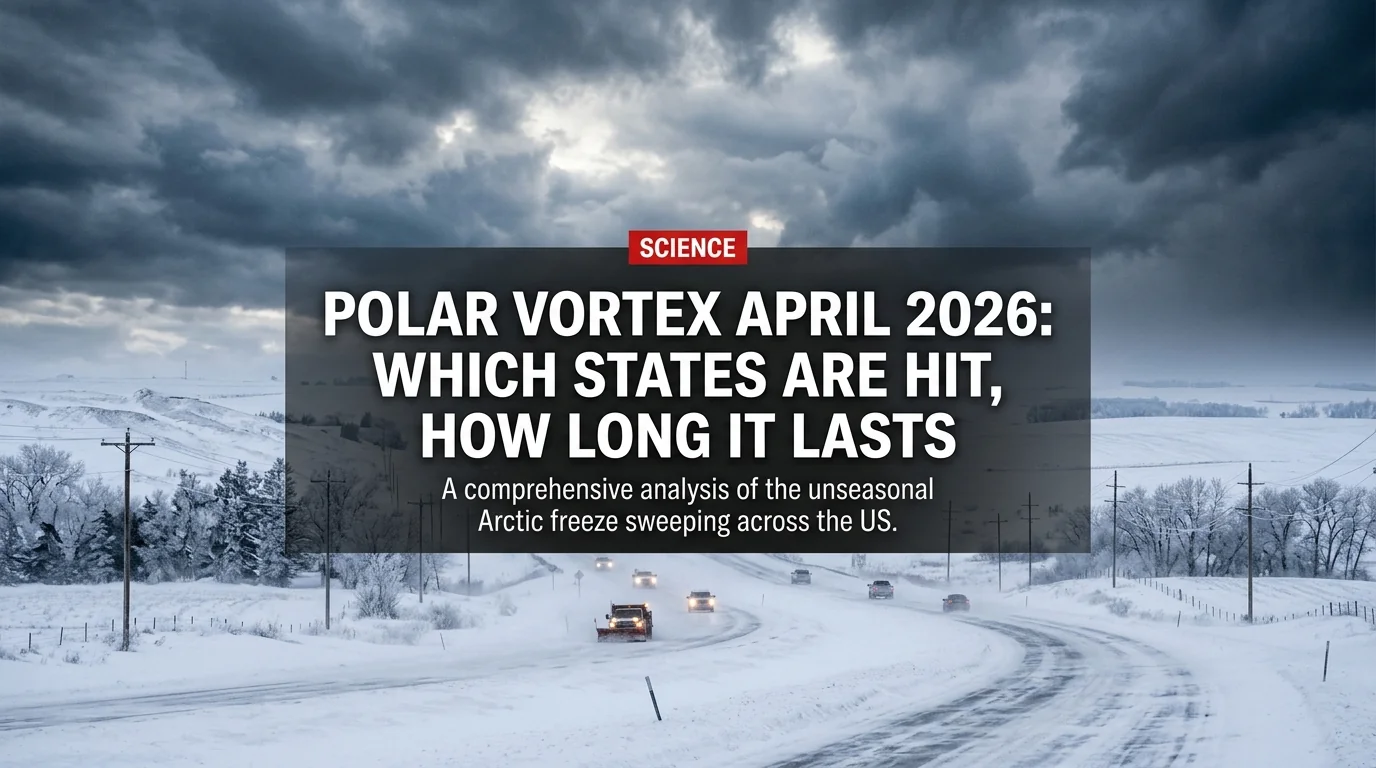
A polar vortex disruption in late March has sent a tongue of Arctic air plunging deep into the United States during the first week of April 2026 — a rare and jarring cold outbreak for a time of year when most Americans expect spring warmth. Temperatures across parts of the Midwest, Great Plains, and Northeast are running 15 to 30 degrees Fahrenheit below seasonal averages, and forecasters warn the anomaly could linger through mid-April.
Here's everything you need to know: what caused it, which states are hardest hit, and when the cold finally breaks.
What Is the Polar Vortex?
The polar vortex sits high in the stratosphere, roughly 10 to 30 miles above Earth's surface, spinning counterclockwise like a massive whirlpool over the Arctic. Under normal conditions, the jet stream acts as a fence, keeping that frigid air locked at high latitudes.
But when the polar vortex weakens — a phenomenon scientists call a Sudden Stratospheric Warming (SSW) event — the jet stream buckles. Cold air pours southward in what meteorologists call a "vortex displacement" or "vortex split." The result is the bone-chilling outbreaks that can catch even seasoned weather-watchers off guard, especially in spring.
The March 2026 SSW event was detected by NOAA instruments on March 18-19, when stratospheric temperatures over the North Pole rose by more than 50°F in just a few days — a textbook sudden warming that precedes surface cold outbreaks by roughly two to four weeks.
Why Is This Happening in April?
- The March 2026 Sudden Stratospheric Warming (SSW) was one of the five strongest on record
- SSW events take 2–4 weeks to translate into surface cold outbreaks
- Spring vortex disruptions are rarer than winter ones but often more extreme in perceived impact
- Climate data shows polar vortex disruptions have increased in frequency since 2010
- The last comparable April polar vortex outbreak occurred in April 2018
Spring polar vortex events are unusual but not unprecedented. The 2018 "Beast from the East" episode and the April 2013 cold snap both followed similar stratospheric disruptions. What makes April 2026 notable is the intensity of the initial SSW — scientists at the European Centre for Medium-Range Weather Forecasts (ECMWF) rated it in the top five percent of all SSW events in the satellite record.
The warming Arctic — sea ice coverage in March 2026 hit its third-lowest recorded extent — may also be playing a role. A warmer Arctic reduces the temperature contrast that normally keeps the jet stream strong and orderly. A weaker jet stream meanders more dramatically, producing the deep southward dips of cold air that define polar vortex outbreaks.
Which States Are Affected?
The hardest-hit regions are the Midwest and Great Plains, where the core of the Arctic air mass settled. Cities like Minneapolis, Chicago, Kansas City, and Omaha are seeing temperatures more typical of January than April. Wind chills in northern Minnesota and the Dakotas have dipped into dangerous territory — the National Weather Service issued wind chill advisories for portions of those states with effective temperatures near -20°F.
The Northeast is feeling the cold too, though less severely. New York City saw its coldest April 4th on record in 2026, with a morning low of 24°F. Boston recorded a hard freeze. Philadelphia's cherry blossoms, just beginning to bloom, suffered frost damage.
The Southeast is not immune. A frost advisory stretches from the Tennessee Valley into the Virginia piedmont and parts of western North Carolina. Farmers with early-season crops — strawberries, peaches, early vegetables — were warned to cover or harvest what they could before overnight lows hit.
The Mountain West is dealing with a different problem: snow. The Denver metro area picked up 14 inches in the storm's opening act, while ski resorts in Colorado, Utah, and Wyoming are reporting late-season powder that will keep lifts spinning well into May.
How Long Will It Last?
Meteorologists tracking the pattern expect the initial cold pulse to moderate by late next week. However, the buckled jet stream may allow one more reinforcing shot of cold air to clip the Northeast and Mid-Atlantic around April 9-11 before a genuine warm-up takes hold around the middle of the month.
By April 15, most forecast models agree that high pressure will build from the southwest, sweeping warmer air northward and effectively ending the vortex episode. Some extended outlooks suggest temperatures may swing well above normal by the third week of April — a classic spring "slingshot" pattern following a deep cold outbreak.
Who's Most At Risk?
The April timing creates specific vulnerabilities that a January cold snap would not:
Agriculture: Early spring crops, fruit tree blossoms, and recently planted seedlings are all in vulnerable stages. Orchard operators in Michigan, Pennsylvania, and New York — states with major apple and cherry industries — were monitoring overnight temperatures closely. A single hard freeze during blossom stage can wipe out an entire season's yield.
Infrastructure: Pipes in homes where owners have already drained and shut off winterization are at risk. In warmer-climate states like Virginia and North Carolina, homes are less insulated for extreme cold, and local utility grids can be strained by unexpected heating demand spikes.
Public health: Homeless populations face compounded risk when cold returns after weeks of milder weather — shelters that reduced capacity for spring may scramble to reopen overflow beds.
Energy: Natural gas spot prices spiked sharply on April 3 as utilities saw a demand surge. Electricity grids in Texas — still operating under scrutiny following past winter failures — activated emergency protocols to ensure reserve margins.
Is Climate Change Making Polar Vortex Events Worse?
The science here is genuinely contested among atmospheric scientists, which makes it worth being precise.
One school of research, associated with scientists like Jennifer Francis and Stephen Vavrus, argues that Arctic amplification — the rapid warming of the Arctic relative to lower latitudes — weakens the jet stream and makes it more prone to the dramatic meanders that produce polar vortex outbreaks. Under this theory, a warming world paradoxically produces more frequent extreme cold events for the mid-latitudes.
A competing school points out that the raw data on polar vortex disruption frequency does not show a clear upward trend once you control for natural variability. These researchers argue that individual SSW events are still primarily driven by internal atmospheric dynamics and wave patterns, not Arctic sea ice loss.
What is less contested: when cold outbreaks do happen in spring, they feel more dramatic — partly because the contrast with a warming climate baseline makes the anomaly more jarring, and partly because society has adapted its expectations and infrastructure toward a warmer norm.
What Should You Do Right Now?
- Late-season snow is excellent for drought-prone western states (water storage)
- Ski resorts get a welcome extension of their season
- Cold may reduce early-season pollen counts (relief for allergy sufferers)
- Energy companies can sell into a late-season demand spike
- Agricultural damage to fruit crops and early vegetables
- Frost risk to landscaping and garden plantings
- Higher-than-expected heating bills in April
- Travel disruptions from late-season snow in mountain passes and northern cities
Practical steps for the next 10 days:
- Check your pipes. If you've already disconnected heat tape or drained exterior lines, consider temporary measures for the overnight lows ahead.
- Cover garden plants. Frost cloth, old bedsheets, or even plastic sheeting can protect newly planted beds when temperatures drop below 32°F overnight.
- Locate your winter gear. Wind chills in the Midwest are dangerous — frostbite can set in within 30 minutes at -10°F wind chill.
- Watch for ice on roads. April ice is often more treacherous than January ice because road crews have shifted to spring staffing levels and fewer people are driving with winter tires.
- Check in on vulnerable neighbors. Elderly residents who live alone may be caught off guard by the cold return.
The Bottom Line
The April 2026 polar vortex outbreak is a reminder that winter does not follow a calendar. A powerful Sudden Stratospheric Warming event in mid-March set the atmospheric stage for this intrusion, and the result is a week-plus stretch of dangerous cold across a wide swath of the country at a time when most Americans have mentally — and physically — moved on from winter.
The good news: this too shall pass. Models broadly agree that a genuine spring warm-up arrives by mid-April, and the pattern after that looks decidedly spring-like. For now, pull the coats back out of storage and keep an eye on those overnight lows.