
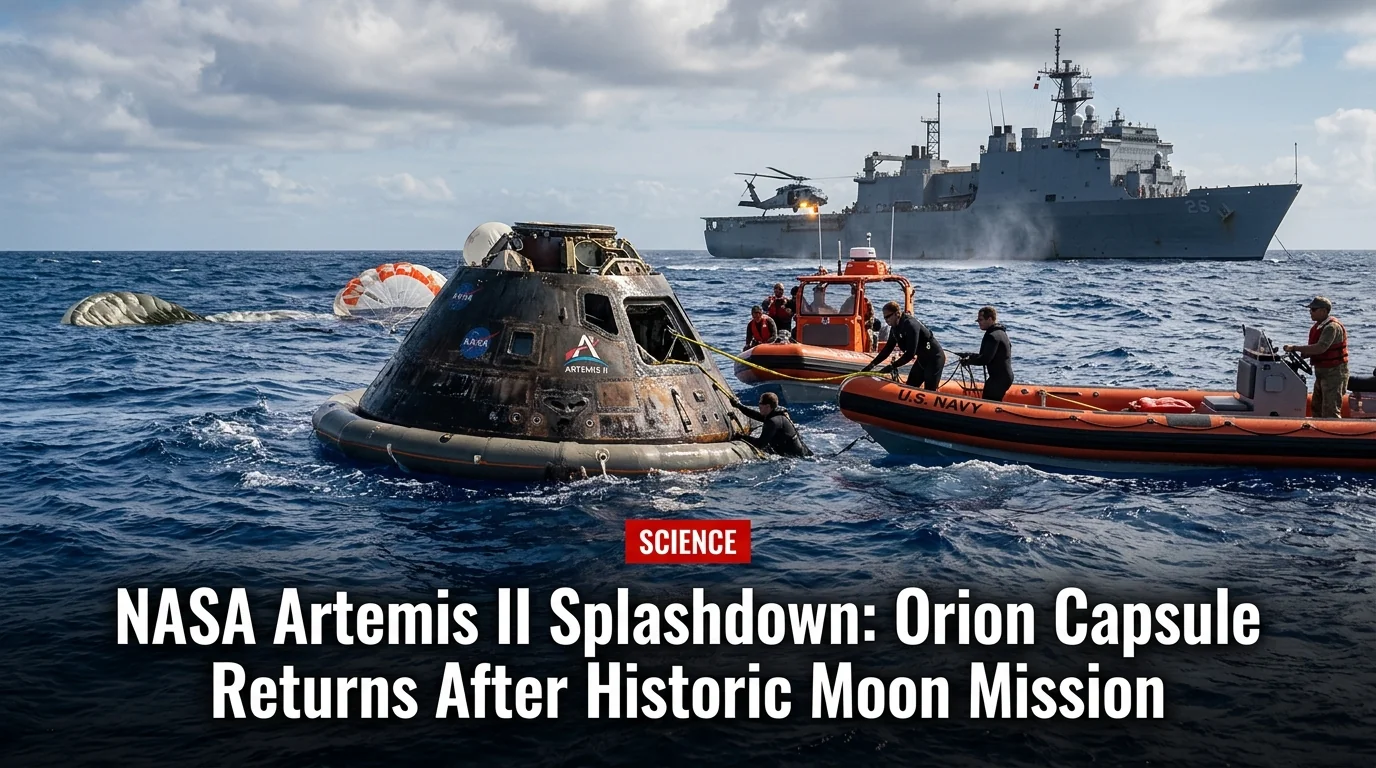
NASA Artemis II Splashdown: Orion Capsule Returns After Historic Moon Mission
NASA's Orion spacecraft Integrity splashed down in the Pacific Ocean at approximately 8:07 p.m. EDT on Friday, April 10, 2026, marking the successful conclusion of the Artemis II mission — the first crewed voyage to the Moon's vicinity in more than 50 years.
The four-member crew traveled 695,081 miles over 10 days, reaching a maximum distance of 252,760 miles from Earth and breaking the record set by Apollo 13.
The Crew
Artemis II carried four astronauts:
- G. Reid Wiseman — Commander (NASA)
- Victor J. Glover — Pilot (NASA)
- Christina Hammock Koch — Mission Specialist (NASA)
- Jeremy Hansen — Mission Specialist (Canadian Space Agency)
Glover became the first Black astronaut to travel beyond low Earth orbit. Hansen is the first non-American to fly on a lunar mission.
Mission Timeline
The crew launched from Kennedy Space Center's Pad 39B on April 1 at 6:35 p.m. EDT aboard NASA's Space Launch System (SLS) rocket. After entering a high Earth orbit to test life support systems, Orion performed a lunar flyby on April 6, passing behind the far side of the Moon at a distance of 4,070 miles.
Christina Koch described the flyby as producing an "overwhelming sense of being moved by looking at the moon," while noting the crew was "bumping into each other 100% of the time" inside the compact capsule.
The return sequence began on April 10:
- 7:33 p.m. EDT — Service module separation
- 7:53 p.m. EDT — Atmospheric entry at approximately 23,864 mph (nearly Mach 32)
- 8:03 p.m. EDT — Drogue parachute deployment at 22,000 feet
- 8:04 p.m. EDT — Three main parachutes deployed at 6,000 feet
- 8:07 p.m. EDT — Splashdown approximately 600 miles off San Diego
The heat shield endured temperatures reaching 5,000°F during reentry. Engineers will spend months analyzing its performance after unexpected charring was observed during the uncrewed Artemis I flight.
Recovery Operations
The USS John P. Murtha (LPD 26) led recovery operations, supported by two MH-60S Seahawk helicopters from Helicopter Sea Combat Squadron 23. A specialized four-person dive medical recovery team, led by Lt. Cmdr. Jesse Wang, was assigned one medic per astronaut.
"Our four Artemis II astronauts took humanity on an incredible journey around the moon and brought back images so exquisite they will inspire generations to come," said Nicky Fox, NASA's Associate Administrator for the Science Mission Directorate.
Cost and Criticism
The Artemis program has cost approximately $93 billion through 2025, with each SLS launch estimated at $4.1 billion. During the mission itself, a White House budget proposal described the SLS rocket as "grossly expensive" and suggested pursuing more cost-effective commercial alternatives for future deep-space missions.
What Comes Next
The crew will undergo post-mission medical evaluations aboard the recovery vessel before returning to Johnson Space Center in Houston.
NASA's next step is Artemis III, expected in late 2027 or 2028. That mission aims to land the first woman and the first person of color on the lunar South Pole using SpaceX's Starship Human Landing System.
Sources: NASA, ESA, U.S. Navy, Space.com