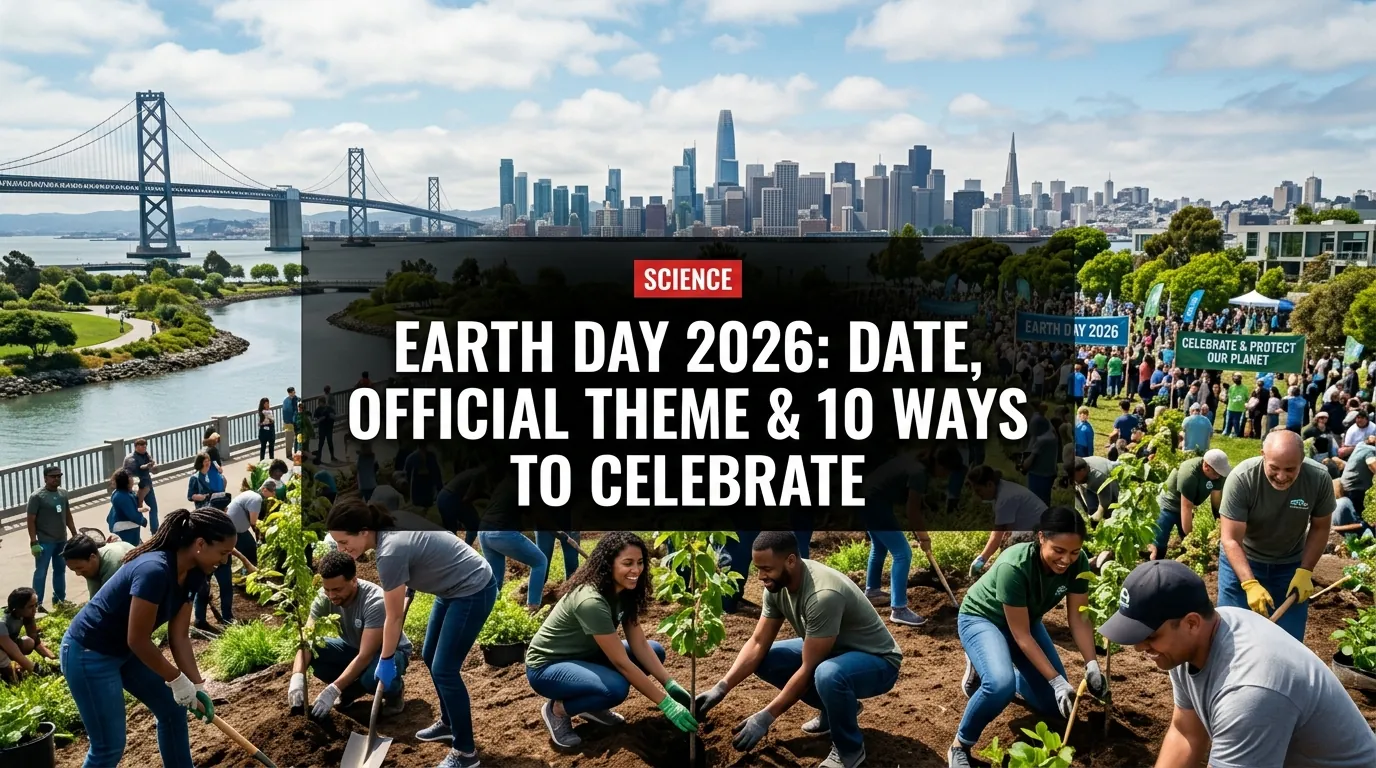
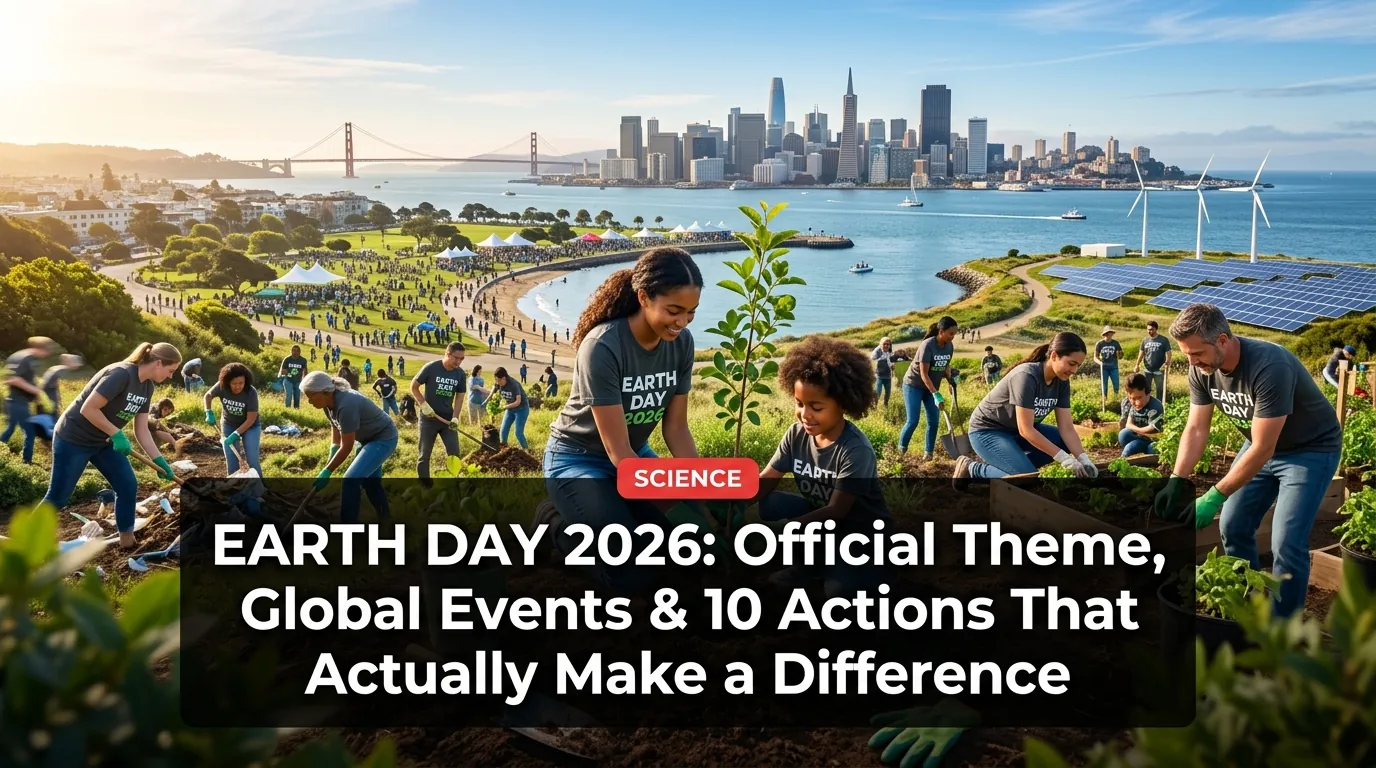
Earth Day lands on Wednesday, April 22, 2026 — and this year marks 56 years since the first Earth Day in 1970 mobilized 20 million Americans and kickstarted modern environmental law. The stakes feel higher than ever: record-breaking heat years, accelerating species loss, and plastic pollution reaching the deepest ocean trenches.
Here's everything you need to know: the official 2026 theme, the biggest events worldwide, and 10 concrete actions ranked by how much they actually matter.
The Official Earth Day 2026 Theme
Earth Day Network has centered the 2026 campaign around "Our Planet, Our Power" — a direct call to accelerate the renewable energy transition and hold governments accountable for climate commitments made at COP30 in Belém, Brazil (November 2025).
The theme has three pillars:
- End fossil fuel subsidies — governments still funnel $7 trillion/year globally to fossil fuels (IMF, 2024)
- Triple renewables by 2030 — the IEA target endorsed by 130+ countries at COP28
- Plastic treaty now — negotiations for a global plastics treaty have stalled; 2026 is the decisive push year
The 2026 campaign marks the first year Earth Day Network is requiring verified climate pledges (not just symbolic sign-ups) through its platform.
Top Earth Day 2026 Events by Region
United States
Washington, D.C. — Earth Day on the Mall (April 22): The flagship event returns to the National Mall with 500+ exhibitors, live music, and a keynote focused on the U.S. renewable energy buildout. Free admission.
New York City — Climate Week Earth Day Kickoff (April 20–22): Central Park hosts a three-day festival with climate science panels, zero-waste food vendors, and a youth climate march on April 22 starting at Columbus Circle.
San Francisco — Golden Gate Park Earth Fair (April 22): One of the longest-running Earth Day festivals in the U.S., with EV showcases, urban farming demos, and marine conservation exhibits from the Monterey Bay Aquarium.
Chicago — Earth Day Chicago at Millennium Park (April 22): Free outdoor concert series plus environmental education booths. The city is also launching its 2026 tree-planting initiative — 10,000 trees by December.
Europe
Paris, France (April 22): A march from Place de la République to the Eiffel Tower, coinciding with France's national climate action week. Organizers are targeting 100,000 participants.
London, UK — Earth Day London (April 20–22): Hyde Park hosts a sustainability expo with 200+ exhibitors. The Mayor of London is expected to announce expanded ULEZ changes.
Berlin, Germany (April 22): Volkspark Friedrichshain hosts a community repair café marathon — bring broken electronics, clothing, or appliances for free fixing.
Asia-Pacific
Tokyo, Japan (April 22): Earth Day Tokyo in Yoyogi Park draws 100,000+ annually. 2026 features a focus on Japan's 2050 carbon neutrality pledge and ocean plastic art installations.
Sydney, Australia (April 22): The Sydney Harbour foreshore becomes a zero-waste festival zone with a Great Barrier Reef fundraiser marathon.
- Over 193 countries hold official Earth Day events
- The UN Environment Programme co-sponsors 40+ major events globally
- earthday.org lists 10,000+ local events searchable by zip or postcode
- Many events livestream on YouTube — search "Earth Day 2026 live" on April 22
10 Actions That Actually Make a Difference — Ranked
Not all environmental actions are equal. Here's what the science says about real-world impact, from smallest to largest:
Low Effort, Real Impact
10. Switch to a renewable energy plan (1–2 hours) Most U.S. states and EU countries offer green energy plans through your existing utility. Switching takes about 20 minutes online and can cut your home's carbon footprint by 1.5–2 tons CO₂/year. Check EnergySage or your utility's green plan portal.
9. Eliminate single-use plastics at home (ongoing) Swapping plastic bags, bottles, and wrap for reusables removes roughly 400 single-use plastic items per person per year. The downstream impact: less microplastic in groundwater and food supply. Start with the three highest-volume items in your household.
8. Shift one meal per day away from beef (ongoing) Beef produces 60× more greenhouse gas than legumes per gram of protein. Cutting beef to two meals per week saves approximately 0.5 tons CO₂/year per person — equivalent to not driving for six weeks.
Medium Effort, High Impact
7. Vote climate in every election (election days) Policy change is the highest-leverage single action any individual can take. One vote for strong climate policy can influence decisions affecting millions of tons of emissions. Local elections — city council, school board — set EV charging infrastructure, building codes, and transit funding.
6. Insulate your home (1 weekend + cost) Poor insulation is one of the biggest residential energy wasters. Adding attic insulation and sealing drafts can cut heating and cooling energy use by 15–25%. The U.S. IRA offers a 30% tax credit for insulation upgrades (up to $1,200/year).
5. Switch to an electric or hybrid vehicle (major purchase) EVs now produce 50–70% less lifecycle CO₂ than gas cars in most U.S. states and EU countries — and the savings grow as the grid gets cleaner. Federal tax credits of up to $7,500 remain available for qualifying vehicles in 2026.
- $7,500 federal tax credit (U.S.) still available
- Grid is now 30%+ renewable in most states — bigger carbon savings than 2020
- Lower fuel and maintenance costs over vehicle lifetime
- More model choices than ever — sedans, trucks, SUVs all covered
- Upfront purchase cost remains higher than comparable gas vehicles
- Charging infrastructure still patchy in rural areas
- Apartment dwellers often can't charge at home
- Battery supply chain still has environmental and human rights concerns
Highest Impact Actions
4. Pressure your employer or institution (ongoing) Corporate and institutional emissions dwarf individual footprints. Pushing your employer to set a Science-Based Target (SBTi), switch to renewable energy, or commit to a 2030 net-zero date has outsized impact. Over 7,000 companies have now set SBTi targets — largely due to employee pressure.
3. Divest from fossil fuel investments (hours) If you have a 401(k), pension, or investment account, it likely holds fossil fuel stocks. Ask your HR department about ESG fund options or switch to fossil-free index funds on platforms like Betterment or Ellevest. Removing financial support from extraction companies matters at scale.
2. Reduce flights — especially long-haul (trip planning) Aviation accounts for about 2.5% of global CO₂ emissions, but when non-CO₂ effects (contrails, water vapor) are included, its total warming impact is 3–4× higher. One transatlantic flight generates approximately 1.5–2 tons CO₂ equivalent per passenger. Replacing one long-haul flight per year with train travel or a videoconference removes more carbon than a year of recycling.
1. Become a climate advocate (ongoing) The single highest-impact action: dedicating time to organized climate advocacy. Volunteering for climate-focused candidates, joining groups like Sunrise Movement or Citizens' Climate Lobby, or running for local office yourself. Research shows social tipping points happen when 3–5% of a population actively advocates — and we're close in many regions.
How to Watch Earth Day 2026 Online
Can't make it to a live event? You won't miss out:
- earthday.org streams the Washington D.C. Mall event live from 10 AM ET on April 22
- YouTube — search "Earth Day Live 2026" for dozens of regional event streams
- Global Climate Hub on Discord runs a 24-hour relay of events across time zones
- BBC, CNN, and DW typically carry live coverage segments throughout April 22
The Bottom Line
Earth Day 2026 arrives at a pivotal moment: the first year governments must start delivering on post-COP30 commitments, and the year a global plastic treaty may finally get signed. The theme — "Our Planet, Our Power" — is a reminder that the energy transition is technically and economically viable. What's needed now is political will and consistent individual pressure.
You don't have to overhaul your life on April 22. Pick one action from this list, do it, and tell someone why. That's what Earth Day was built for.