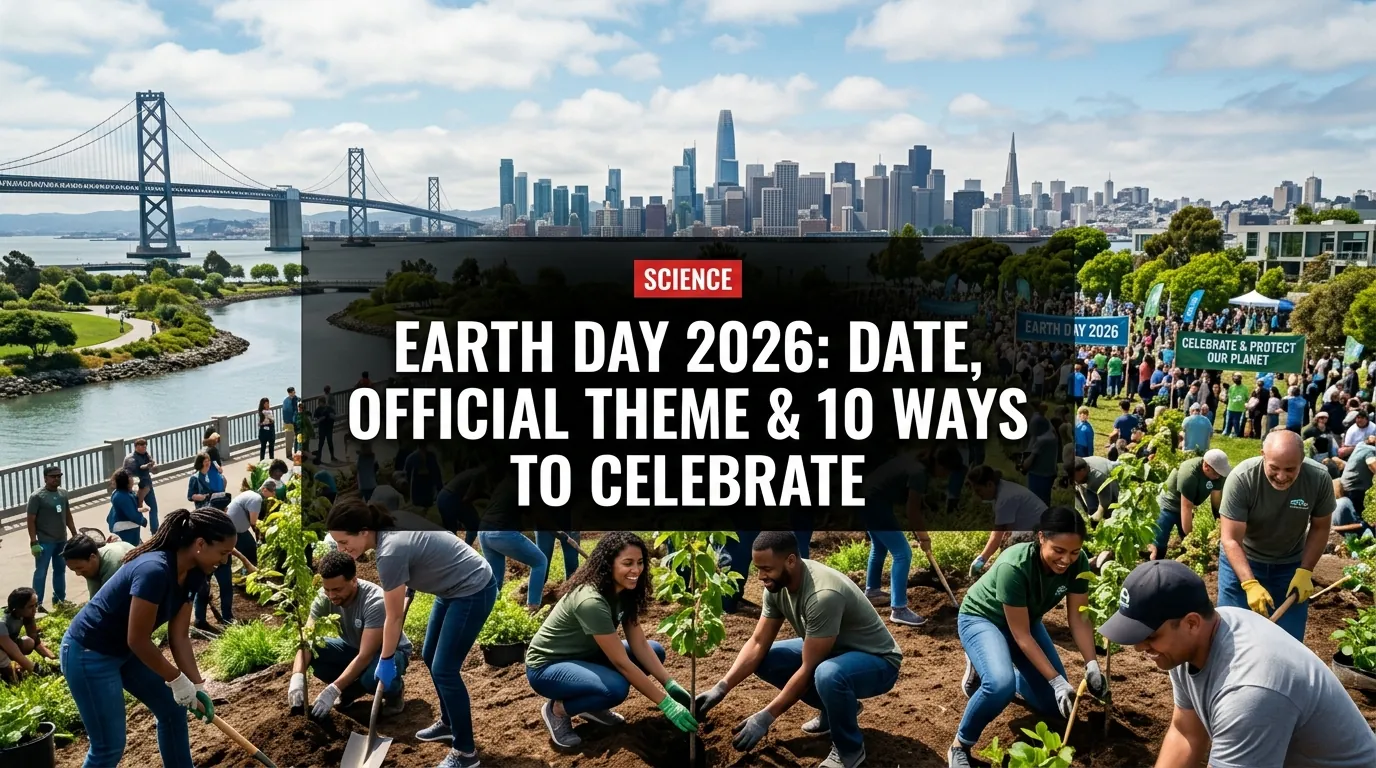
Earth Day is one of the largest civic events on the planet — over a billion people across 190+ countries participate each year. In 2026, the date, the official theme, and the activities have particular weight given ongoing climate milestones and global conservation talks. Here's everything you need to know.
When Is Earth Day 2026?
Earth Day is Wednesday, April 22, 2026.
Earth Day is always on April 22. The date was chosen in 1970 by Senator Gaylord Nelson and activist Denis Hayes to maximize student participation — it falls between spring break and final exams, and well after the ski season but before summer heat.
The first Earth Day in 1970 mobilized 20 million Americans and directly led to the creation of the U.S. Environmental Protection Agency and the passage of the Clean Air Act, Clean Water Act, and Endangered Species Act — all within four years.
- Date: Wednesday, April 22, 2026
- Official theme: "Our Power, Our Planet"
- Organized by: earthday.org (Earth Day Network)
- Participants: 1 billion+ people in 193 countries
- First Earth Day: April 22, 1970
- 2026 marks the 56th annual Earth Day
2026 Official Theme: Our Power, Our Planet
The 2026 Earth Day theme — "Our Power, Our Planet" — centers on renewable energy as the defining climate action of this decade. The Earth Day Network has called for world governments and corporations to commit to tripling global renewable energy capacity by 2030, a target set at COP28 in Dubai and reaffirmed at subsequent climate summits.
The "Our Power" framing has a double meaning: it refers both to electricity (clean power) and to collective human agency — the idea that citizens, communities, and organizations hold real power to drive change through advocacy, investment, and behavior.
Key focus areas for 2026 include:
- Solar energy access — expanding rooftop solar and community solar programs in underserved regions
- Grid modernization — making electrical grids smarter and more resilient to support renewable integration
- Energy poverty — ensuring clean energy reaches the 700 million people globally who still lack reliable electricity
- Corporate accountability — pushing Fortune 500 companies to match 100% of their energy consumption with renewables
Where Earth Day 2026 Is Happening: Global Events
Major Earth Day 2026 events and campaigns span every continent:
Washington D.C. — The March for the Planet The flagship Earth Day rally returns to the National Mall on April 22. Past marches have drawn over 100,000 attendees. The 2026 event includes a major policy forum with legislators, scientists, and clean energy industry leaders.
New York City The Times Square Earth Day concert and cleanup drive returns, with music performances, environmental activations, and a Central Park volunteer tree-planting event.
United Nations, New York The UN typically marks Earth Day with a special session. In 2026, the focus is on the Global Plastics Treaty negotiations and renewable energy commitments under the Paris Agreement framework.
Europe Major events in Paris, Berlin, and London tie Earth Day 2026 to EU Green Deal progress reports and national net-zero transition milestones.
Asia-Pacific In Japan, South Korea, and Australia, corporate sustainability pledges and school-based campaigns dominate. India's events focus on solar adoption in rural communities, where off-grid renewables are transforming daily life.
10 Ways to Celebrate Earth Day 2026
You don't need to attend a march to participate. Here are ten meaningful actions — from small to large.
1. Plant a Tree The Trillion Trees campaign is a core Earth Day initiative. Find a local tree planting event through earthday.org or plant one in your yard or community space. One mature tree absorbs roughly 48 pounds of CO₂ per year.
2. Do a Neighborhood Cleanup Organize or join a litter pickup in your neighborhood, park, beach, or riverbank. Earth Day Network's Great Global Cleanup platform lets you find registered events near you or register your own.
3. Audit Your Energy Use Use Earth Day as a trigger for a home energy audit. Check your utility's website — most offer free audits. Simple switches (LED bulbs, smart thermostats, weather stripping) can cut household energy use by 10-25%.
4. Go Car-Free for the Day Walk, bike, or take transit on April 22. If every American skipped one car trip, it would eliminate roughly 100 million pounds of CO₂ in a single day.
5. Switch to a Clean Energy Plan Many utilities now offer green energy options where your electricity is matched to renewable sources. Some require no equipment, just a plan change. Takes about 10 minutes.
6. Eat Plant-Based for the Day Food production accounts for about 26% of global greenhouse gas emissions, with meat and dairy making up the majority. Choosing plant-based meals on Earth Day is a measurable act with real impact.
7. Learn and Share Watch a documentary ("2040," "Kiss the Ground," "Seaspiracy" are strong choices), read about the clean energy transition, and share what you learn. Awareness that leads to conversations matters.
8. Support an Environmental Organization Earth Day Network, Sierra Club, Rainforest Alliance, Surfrider Foundation, and hundreds of local conservation groups rely on individual donations. Even small contributions fund advocacy and on-the-ground work.
9. Attend a Local Event Schools, libraries, parks, and community centers host Earth Day events throughout April. Many cities have week-long programming. Search "Earth Day events near me" in the days leading up to April 22.
10. Advocate Contact your local representative about clean energy legislation, zoning for community solar, or public transit investment. Elected officials track constituent messages. Five minutes writing an email or making a call is one of the highest-leverage actions available to a private citizen.
- Earth Day creates a focal point for collective action with proven policy outcomes
- Local events are accessible to everyone, from school kids to seniors
- Corporate Earth Day commitments now drive measurable sustainability changes
- The theme drives attention to renewable energy — the most critical climate lever
- Risk of "greenwashing" — companies using Earth Day for PR without real change
- One-day awareness can fade without follow-through
- Events in developing countries often underfunded compared to Western nations
- The urgency of climate timelines (2030, 2050) increasingly outpaces annual awareness cycles
Earth Day 2026 in Schools
For teachers and parents, Earth Day offers ready-made educational content. The Earth Day Network publishes free curriculum for K-12 covering climate science, renewable energy, biodiversity, and environmental justice.
Common school activities for Earth Day 2026 include:
- Science fair projects on solar and wind energy
- Classroom debates on climate policy
- School garden projects or composting programs
- Pledges to reduce single-use plastic use
- Virtual field trips to renewable energy facilities
Many districts designate the week of April 20-24 as "Earth Week" with daily themed activities leading up to the 22nd.
Frequently Asked Questions
Is Earth Day always April 22? Yes. Earth Day is always April 22, every year, regardless of what day of the week it falls on. In 2026, it's a Wednesday.
Who organizes Earth Day? Earth Day is organized globally by the Earth Day Network (earthday.org), a nonprofit based in Washington D.C. that coordinates events in 193 countries.
Is Earth Day a public holiday? No. Earth Day is not a federal holiday in the United States or a public holiday in most countries. Schools, businesses, and offices remain open. Some schools and organizations do hold special programming.
What's the difference between Earth Day and Earth Hour? Earth Hour is organized by WWF and takes place on the last Saturday of March — participants turn off non-essential lights for one hour. Earth Day is April 22 and involves a much wider range of global activities and advocacy.
How can I find Earth Day events near me? Visit earthday.org and use the event finder, or search "Earth Day 2026 events [your city]" in the weeks leading up to April 22.
The Bottom Line
Earth Day 2026 is April 22, and the "Our Power, Our Planet" theme puts renewable energy center stage at a critical moment — with a real 2030 deadline attached. Whether you plant a tree, attend a march, switch your energy plan, or simply have a conversation with someone about climate, April 22 is a meaningful moment to act.
Find events at earthday.org. Mark your calendar.