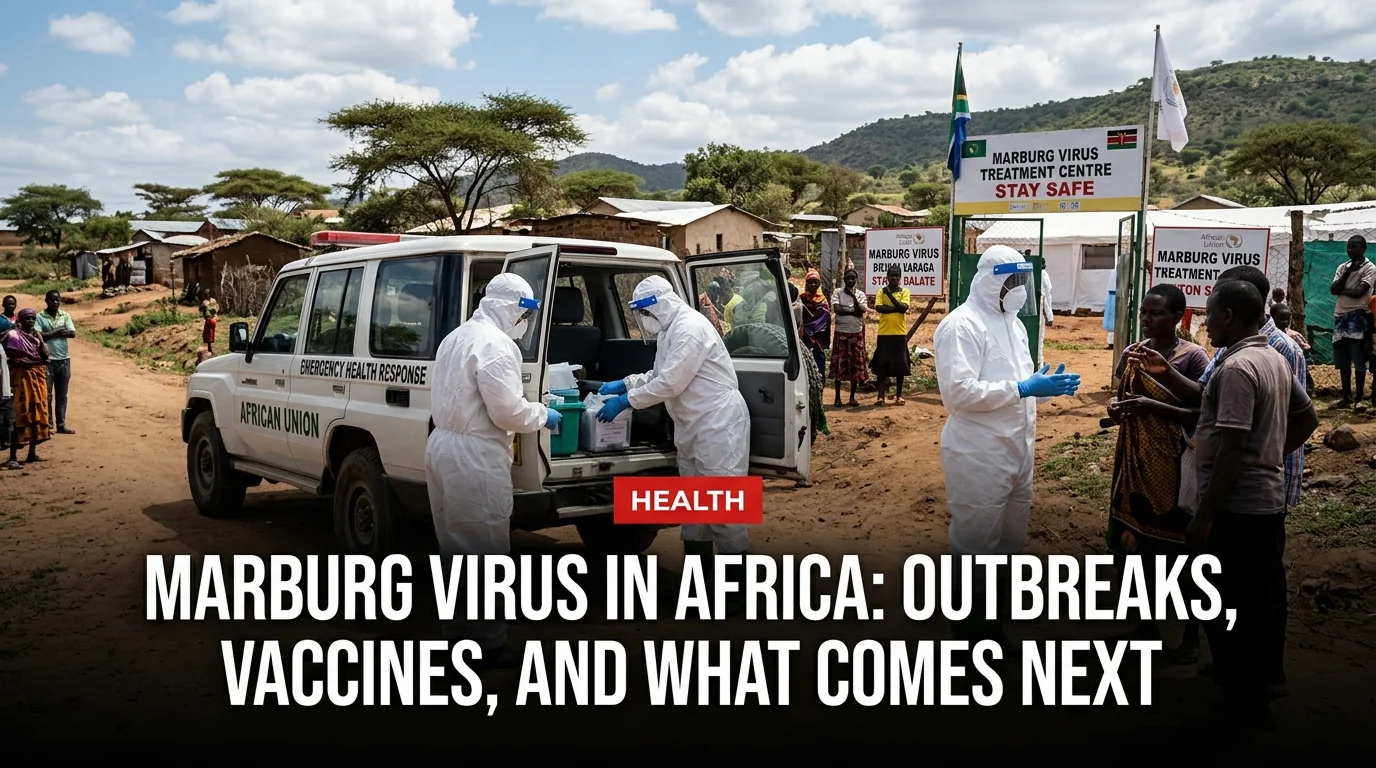
A virus once confined to isolated caves and lab accidents is now a recurring threat across Africa. Marburg virus disease — Ebola's lesser-known but equally lethal cousin — has hit six African countries since 2021, killed dozens, and forced the world's first emergency vaccination campaigns.
Ethiopia declared its outbreak over in January 2026. Rwanda is vaccinating healthcare workers. And scientists are racing to get the first approved Marburg vaccine across the finish line before the next inevitable outbreak.
Here's what you need to know.
What Is Marburg Virus?
Marburg virus disease (MVD) is a severe hemorrhagic fever caused by a filovirus — the same family as Ebola. First identified in 1967 when lab workers in Marburg, Germany fell ill after handling infected African green monkeys, the virus lurks in Egyptian fruit bats (Rousettus aegyptiacus) across sub-Saharan Africa.
- Family: Filoviridae (same as Ebola)
- Reservoir: Egyptian fruit bats
- Transmission: Direct contact with blood, bodily fluids, or contaminated surfaces
- Incubation: 2–21 days
- Approved vaccines: None (as of March 2026)
- Approved treatments: None — supportive care only
Symptoms begin abruptly — high fever, severe headache, muscle pain — and can escalate within days to hemorrhaging, organ failure, and death. The case fatality rate has ranged from 23% to 90% depending on the outbreak and available care.
A Virus on the Move: Africa's Recent Outbreaks
For decades, Marburg outbreaks were rare and geographically contained. That changed in 2021 when the virus appeared in West Africa for the first time. Since then, it has surfaced in six countries across three regions of the continent.
The pattern is clear: Marburg is no longer a once-a-decade event. It's appearing in countries that have never seen it before, spreading faster in urban and healthcare settings, and testing public health systems already stretched by malaria, Lassa fever, and the long tail of COVID-19.
Ethiopia's Outbreak: A Case Study
Ethiopia's first Marburg outbreak lasted roughly ten weeks and provided both warnings and cautious optimism.
The outbreak began on November 14, 2025 in the South Ethiopia Region and spread to the Sidama Region. Three healthcare workers were among the infected — a grim reminder that hospital transmission remains Marburg's most dangerous amplifier.
The outbreak was declared over on January 26, 2026 after 42 consecutive days with no new confirmed cases. Ethiopia is now in a 90-day enhanced surveillance period ending in late April 2026.
The Vaccine Race: Closer Than Ever
There has never been an approved vaccine for Marburg. That may change soon.
The Sabin Vaccine Institute's cAd3-Marburg vaccine is the frontrunner. It's a single-dose, chimpanzee adenovirus-vectored vaccine that has shown promise in early trials and has been deployed under emergency protocols during active outbreaks.
- Single dose — critical for outbreak response
- Already deployed in Rwanda and Ethiopia during active outbreaks
- Phase 2 trials running simultaneously in the US, Uganda, Kenya, and Rwanda
- Initial Phase 2 results expected by April 2026
- No Phase 3 efficacy data yet
- Emergency use only — not available for general prevention
- Cold chain requirements complicate African deployment
- Marburg outbreaks are too short and sporadic to run traditional large-scale trials
Beyond vaccines, Rwanda and WHO partners launched the world's first Marburg treatment trials in October 2024, testing remdesivir and MBP091 (a monoclonal antibody). The Coalition for Epidemic Preparedness Innovations (CEPI) has committed $26.7 million toward multivalent vaccines covering both Ebola and Marburg.
Why Marburg Is Expanding
Three factors explain why a virus that barely troubled humanity for 50 years is now a recurring headline.
1. Habitat disruption. Deforestation, mining, and agricultural expansion are pushing humans deeper into fruit bat territory. The Egyptian fruit bat — Marburg's natural reservoir — roosts in caves and mines across sub-Saharan Africa. More human-bat contact means more spillover events.
2. Urbanization. When Marburg reaches a city or hospital, it spreads fast. Rwanda's 2024 outbreak was amplified by healthcare transmission. Ethiopia's outbreak infected three medical workers. In dense urban environments, a single undiagnosed case can seed a cluster.
3. Surveillance gaps. Early Marburg symptoms — fever, headache, muscle pain — mimic malaria, typhoid, and dozens of other tropical diseases. In countries with limited diagnostic capacity, cases can circulate undetected for weeks before hemorrhagic symptoms trigger alarm.
How Marburg Compares to Ebola
Marburg and Ebola are siblings — same viral family, similar symptoms, comparable lethality. But there are key differences that matter for outbreak response.
| Marburg | Ebola | |
|---|---|---|
| First identified | 1967 (Germany) | 1976 (DRC/Sudan) |
| Case fatality rate | 23–90% | 25–90% |
| Largest outbreak | 252 cases (Angola, 2005) | 28,616 cases (West Africa, 2014) |
| Approved vaccine | None | rVSV-ZEBOV (Ervebo) since 2019 |
| Approved treatment | None | Inmazeb (monoclonal antibodies) |
| Natural reservoir | Egyptian fruit bats | Suspected fruit bats |
| Outbreaks since 2020 | 6 countries | 4 countries |
The critical gap: Ebola has both a licensed vaccine and treatment. Marburg has neither. If the current vaccine trials succeed, that gap could close by 2027.
What Happens Next
Three developments to watch in the coming months:
April 2026: Initial Phase 2 results from the Sabin cAd3-Marburg vaccine trial are expected. Positive data could accelerate emergency use authorization.
Late April 2026: Ethiopia's 90-day enhanced surveillance period ends. If no new cases emerge, it will confirm the outbreak chain is fully broken.
Ongoing: CEPI-funded research into multivalent filovirus vaccines — a single shot protecting against both Ebola and Marburg — could transform outbreak preparedness across Africa.
The window for preventing Marburg from becoming the next Ebola-scale crisis is open but narrowing. The virus is appearing in new countries, reaching urban centers, and killing healthcare workers. The science is finally catching up — vaccines are in trials, treatments are being tested, surveillance networks are expanding.
Whether the world invests enough, fast enough, is the question that will define the next chapter of this story.