Two years ago, dairy workers in the Texas Panhandle started noticing something wrong with their cows — low appetite, thick yellow milk, and a mystery illness that stumped veterinarians. What followed was a paradigm shift in infectious disease: H5N1 avian influenza had jumped into cattle, and from cattle into humans.
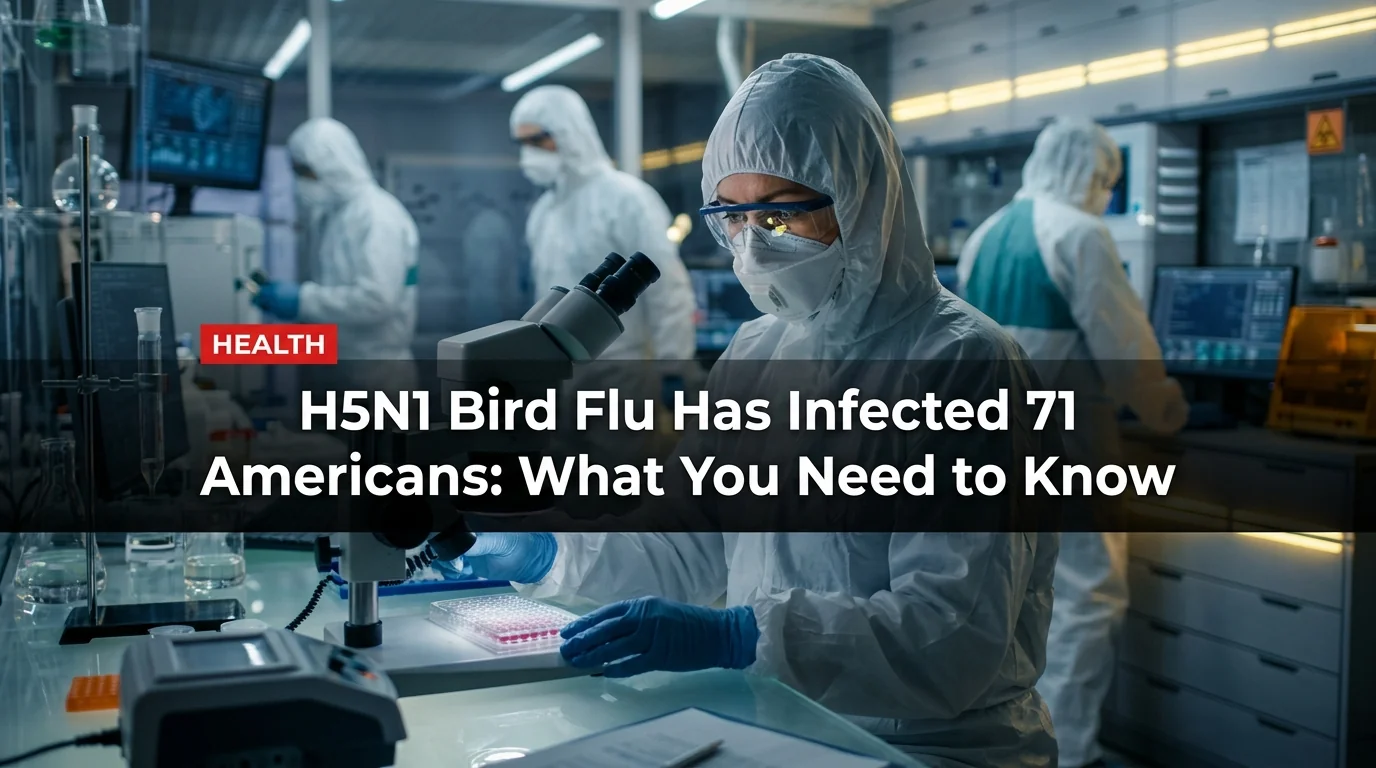
As of March 2026, the United States has confirmed 71 human cases of H5N1 and two deaths, according to the CDC. No human-to-human transmission has been documented — every case traces back to direct animal contact. But the virus's ability to cross species barriers has the global health community on high alert.
The Numbers Right Now
The gap between the US fatality rate and the global historical average is striking. Experts attribute it to the specific strain circulating in American cattle — clade 2.3.4.4b, genotype B3.13 — and the fact that most US cases have involved mild symptoms, primarily conjunctivitis.
How We Got Here: A Two-Year Timeline
Why Cattle Changed Everything
Before 2024, H5N1 was a bird problem. It decimated poultry flocks worldwide and occasionally infected humans who handled sick birds, but it didn't circulate in mammals at scale.
Texas changed that calculus. Cattle live in close, sustained proximity to humans. A dairy worker milking infected cows faces repeated, prolonged exposure — very different from brief contact with a sick chicken. Each time the virus replicates inside a mammal, it gets more chances to mutate toward efficient human transmission.
"The virus is looking for new hosts. This is a worry." — Jeremy Farrar, WHO Chief Scientist
The People Tracking This
The response spans multiple agencies with overlapping jurisdictions:
| Agency | Role |
|---|---|
| CDC | Human health monitoring, genetic sequencing, risk assessment |
| USDA/APHIS | Animal-side outbreak management, dairy and poultry testing |
| Texas DSHS | State-level case investigation and health alerts |
| Texas Animal Health Commission | Livestock health oversight |
| FDA | Commercial milk and beef supply safety |
| WHO | Global coordination and pandemic risk classification |
Key figures leading the response include Dr. Nirav Shah, CDC Principal Deputy Director, and Dr. Luis Z. Ostrosky at UTHealth Houston, who provided early clinical context on the first Texas case.
Is the Milk Safe?
Short answer: yes, if it's pasteurized.
The FDA tested over 460 retail dairy products through late 2024 — all came back negative for live virus. Pasteurization kills H5N1 effectively. The outstanding question is raw dairy: the FDA is conducting a study on whether the virus survives in 60-day aged raw milk cheese, with results expected in late spring 2026.
- Pasteurized milk and commercial dairy confirmed safe by FDA
- Over 460 retail products tested negative for live virus
- No evidence of foodborne transmission to date
- Raw milk safety remains unconfirmed pending FDA study
- Virus detected in unpasteurized milk from infected herds
- Limited testing of artisanal and small-batch dairy products
What Happens Next
Three developments to watch:
1. Enhanced surveillance in Texas. The state has launched targeted flu surveillance programs specifically designed to catch potential human-to-human clusters before they spread. If sustained transmission ever begins, Texas will likely be ground zero.
2. The vaccine question. The US holds 20 million H5N1 vaccine doses in its National Strategic Stockpile — enough for a targeted rollout but far short of population-wide coverage. These would deploy only if person-to-person transmission is confirmed.
3. The raw dairy study. FDA results on aged raw milk cheese, expected late spring 2026, could reshape public health guidance for the growing raw dairy consumer market.
The Bottom Line
H5N1 in its current form is not a pandemic. The risk to the general public remains low, and every US case links back to direct animal exposure. But the virus has done something unprecedented — established itself in American cattle, jumped repeatedly into humans, and acquired mutations associated with mammalian adaptation.
The gap between "not a pandemic" and "pandemic" can close quickly. The 1918 flu, the deadliest in history, likely originated from an avian influenza virus that adapted to mammals. The scientific community isn't watching H5N1 because of what it's doing now. They're watching because of what it could do next.
- H5N1 has infected 71 Americans since 2024, killing 2 — all cases linked to animal contact
- No human-to-human transmission has been confirmed anywhere in the world
- The virus jumped from birds to cattle to humans — an unprecedented pathway
- Pasteurized dairy is safe; raw dairy safety study pending
- 20 million vaccine doses stockpiled for emergency deployment
- CDC rates current public health risk as "low" for general population