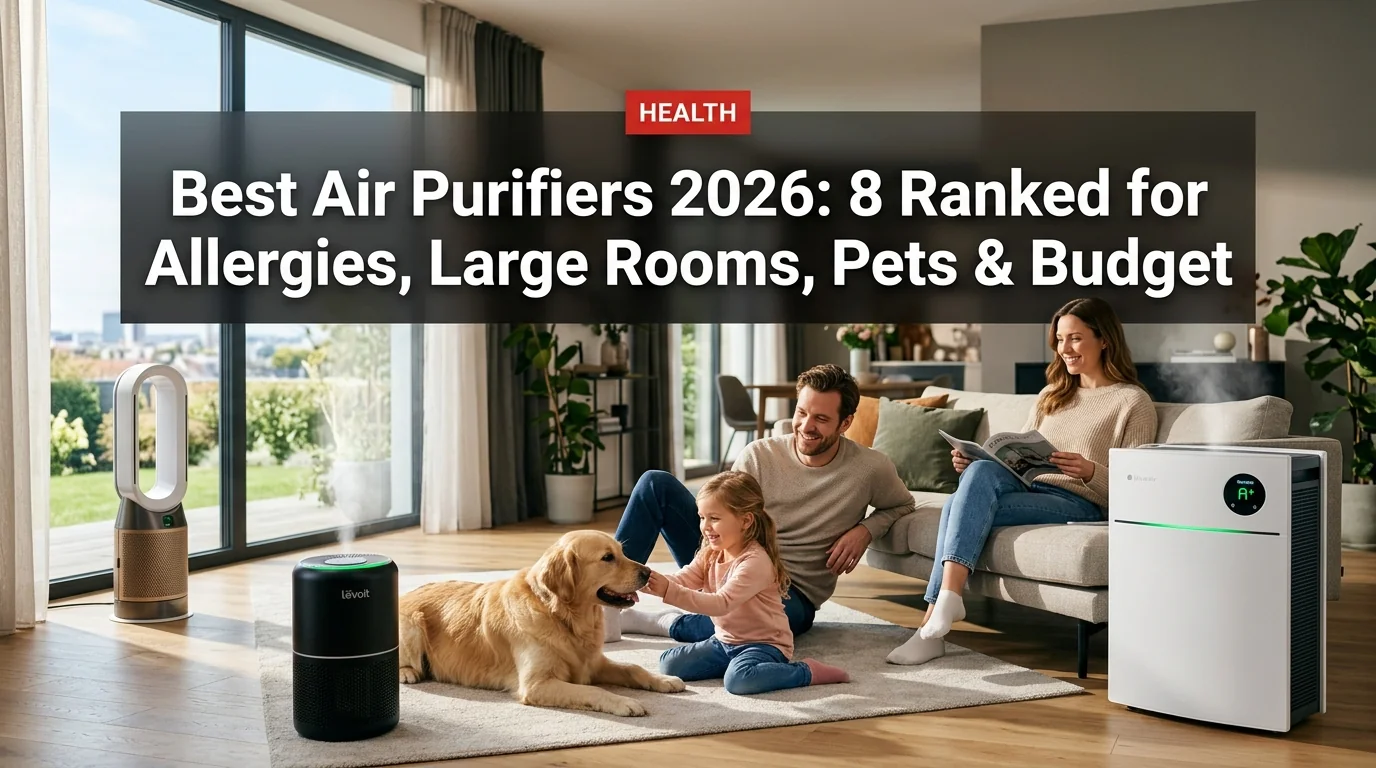
Air quality concerns are at an all-time high in 2026 — wildfire smoke, pollen season arriving earlier, and post-pandemic focus on indoor air have all pushed air purifiers into the mainstream. With hundreds of models flooding the market, the spec sheets blur together fast. We've cut through it: here are the 8 best air purifiers of 2026, ranked by actual performance, filtration quality, noise levels, and value.
What to Look For in 2026
The air purifier market has matured, but marketing has kept pace with improvements. Here's what actually matters:
- True HEPA (H13 or H14): Captures 99.97% of particles 0.3 microns and larger. "HEPA-type" filters capture up to 37% fewer allergens — avoid them.
- CADR score: Measures how quickly the unit cleans a room. Smoke, dust, and pollen CADR are the three ratings. Higher = better.
- Activated carbon filter: Essential for odors, VOCs (paint, cleaning products), and smoke. HEPA alone won't remove gases.
- Coverage area: Manufacturer ratings are often optimistic. For real performance, use 80% of the stated maximum as your guide.
- Noise at low speed: You'll run this thing 24/7. At low speed, under 30 dB is library-quiet. Over 45 dB at low will become annoying fast.
1. Coway Airmega ProX — Best Overall
Best for: Large rooms, all-round performance Coverage: Up to 2,560 sq ft CADR: Smoke 246, Dust 246, Pollen 246
The Coway Airmega ProX is the benchmark for whole-home or large living space purification in 2026. It runs quieter than competitors at equivalent airflow, the dual-fan design covers serious square footage, and its certified HEPA + activated carbon combination handles particles and odors simultaneously. App connectivity and auto mode adjust based on real-time air quality readings. The price is steep (around $700), but filter costs are reasonable and units last years.
2. LEVOIT Vital 200S — Best for Pet Owners
Best for: Pet hair, pet dander, odors Coverage: Up to 1,875 sq ft CADR: Smoke 250, Dust 254, Pollen 289
The Vital 200S has become the go-to recommendation for households with dogs or cats in 2026. Its pre-filter handles pet hair efficiently (extending HEPA life), the activated carbon layer is thicker than most budget-to-mid models, and pet dander CADR scores are among the highest in its class. App control, voice assistant compatibility, and a 10-year brand track record make this the safest mid-range buy for pet households. Priced around $250.
3. IQAir HealthPro Plus — Best for Severe Allergies and Asthma
Best for: Allergy sufferers, asthma, medical-grade filtration Coverage: Up to 1,125 sq ft CADR: Smoke 300 (equivalent)
IQAir remains the gold standard for clinical air quality. The HyperHEPA filtration goes beyond standard HEPA — it captures ultrafine particles down to 0.003 microns, including viruses and nano-particulates that standard True HEPA misses. Consumer Reports testing in 2026 put it at 99.5% removal of airborne allergens in sealed-room conditions. The downsides: it's expensive (~$900), large, and filter replacements are pricier than competitors. If you have severe respiratory conditions, the premium is justified.
4. Blueair Blue Pure 311i Max — Best Quiet Operation
Best for: Bedrooms, light sleepers, medium rooms Coverage: Up to 1,009 sq ft Noise: 20 dB at lowest setting
At 20 dB on low — quieter than a whisper — the Blueair 311i Max is the choice for bedrooms and nurseries in 2026. It doesn't sacrifice performance for quiet: CADR ratings are solid for the coverage area, and the combination fabric pre-filter + HEPA core + carbon layer handles the full range of particles and odors. The washable fabric pre-filter is a nice touch that reduces consumable costs. App-connected with auto mode. Priced around $330.
5. Winix 5500-2 — Best Budget Performer
Best for: Budget buyers who don't want to compromise on filtration Coverage: Up to 360 sq ft Price: ~$160
The Winix 5500-2 has been the consistent value recommendation for years, and 2026 testing still validates it. It cleared 94% of allergens in independent testing — impressive at this price point. True HEPA + activated carbon + PlasmaWave technology (optional, can be switched off). Smart sensors and auto mode are included at a price that competes with air purifiers that use HEPA-type filters. The 360 sq ft coverage is limited, making this best for bedrooms or home offices rather than open living areas.
- Measurably reduces allergens, pollen, pet dander, and dust mites
- HEPA + carbon combos remove smoke and VOCs (essential in wildfire regions)
- Can reduce allergy and asthma symptoms in clinical and home settings
- Energy efficient: most run on 20–60W at normal settings
- Don't remove gases unless they include a carbon filter
- Ongoing filter replacement costs ($25–$80/year)
- Coverage limitations: one unit rarely cleans an entire home effectively
- Humidity doesn't affect performance, but don't use in rooms above 85% humidity
6. Dyson Purifier Hot+Cool Formaldehyde — Best Multitasker
Best for: Year-round use, heating/cooling + purification Coverage: Up to 800 sq ft Price: ~$650
The Dyson Purifier Hot+Cool Formaldehyde earns its place for one specific use case: households that want a heater, fan, and air purifier in a single unit with no floor space compromise. The formaldehyde-destroying catalytic filter is a genuine differentiator — formaldehyde is emitted by furniture, flooring, and cleaning products in most homes and is not addressed by standard HEPA. Real-time air quality display, voice control, and the signature Dyson build quality round out a compelling (if pricey) package.
7. Levoit Core 600S — Best Smart Features Under $300
Best for: Smart home integration, app control, large single rooms Coverage: Up to 635 sq ft Price: ~$270
The Core 600S is Levoit's flagship smart model for 2026. Alexa and Google Home integration, a detailed companion app with air quality history, auto mode with fine-particle detection, and a quiet sleep mode (24 dB) make it the best-connected mid-range purifier on the market. Coverage is solid for a living room or large bedroom. Filter life indicator is accurate, and replacement filters are among the most affordable in the category.
8. RabbitAir MinusA3 — Best for Odors and Custom Filtration
Best for: Odors, VOCs, customizable filtration needs Coverage: Up to 1,070 sq ft Price: ~$580
The RabbitAir MinusA3 lets you configure your filtration stack based on your specific need: standard HEPA, germ defense (adds antimicrobial layer), pet allergy, toxin absorber (extra carbon), or odor remover. For households with serious odor challenges — smokers, cooking smells, chemical sensitivity — this customization matters. Ultra-quiet (25 dB on medium), wall-mountable, and with a six-stage filtration system, it's the most thoughtful design on this list. Priced at a premium but genuinely differentiated.
How to Choose the Right Air Purifier
For allergies and asthma: Prioritize True HEPA certification (H13 minimum), high CADR for your room size, and a unit with an air quality sensor. IQAir or Coway Airmega ProX for serious cases; LEVOIT Core 600S or Winix 5500-2 for moderate needs.
For large rooms: Coverage area is the critical spec. Coway Airmega ProX and LEVOIT Vital 200S lead here. Avoid under-sizing — a unit running at max capacity all day wears faster and is noisier.
For pets: Need strong pre-filtration (stops hair from clogging the HEPA), high pollen/dust CADR for dander, and solid activated carbon for odors. The LEVOIT Vital 200S is the top pick.
For bedrooms: Noise is the decisive factor. Under 30 dB at low speed. Blueair 311i Max (20 dB) is the benchmark; Levoit Core 600S at 24 dB is a close second.
For budget buyers: Winix 5500-2 at ~$160 remains the best proof that you don't need to spend $400+ for real HEPA performance.
Frequently Asked Questions
Do air purifiers actually work? Yes — for particles. True HEPA units demonstrably reduce airborne allergens, dust, and particulates. The science is solid. They don't work on gases or odors without a carbon filter, and they don't affect humidity or temperature.
How often do I need to replace filters? Most HEPA filters last 12–18 months with regular use. Pre-filters are often washable and last the life of the unit. Carbon filters typically need replacement every 6–12 months. Check manufacturer recommendations and use the filter life indicator if your unit has one.
Should I run it 24/7? Yes, on low speed. Air purifiers are most effective when running continuously. Modern units on low consume as little as 5–20W — less than an LED bulb — and the filtration benefits are cumulative.
Can an air purifier remove COVID or viruses? True HEPA filters capture particles as small as 0.1–0.3 microns, which includes virus-carrying aerosol droplets. They don't neutralize viruses — just trap them in the filter. HEPA purifiers do reduce airborne transmission risk in enclosed spaces, but aren't a substitute for ventilation.
The Bottom Line
The Coway Airmega ProX is the best overall air purifier of 2026 for serious coverage. For pets, the LEVOIT Vital 200S. For bedrooms, the Blueair 311i Max. For tight budgets, the Winix 5500-2 overdelivers at its price point. Whatever you choose — True HEPA, not HEPA-type, and size up for your room. The right unit running daily will make a measurable difference in air quality within days.