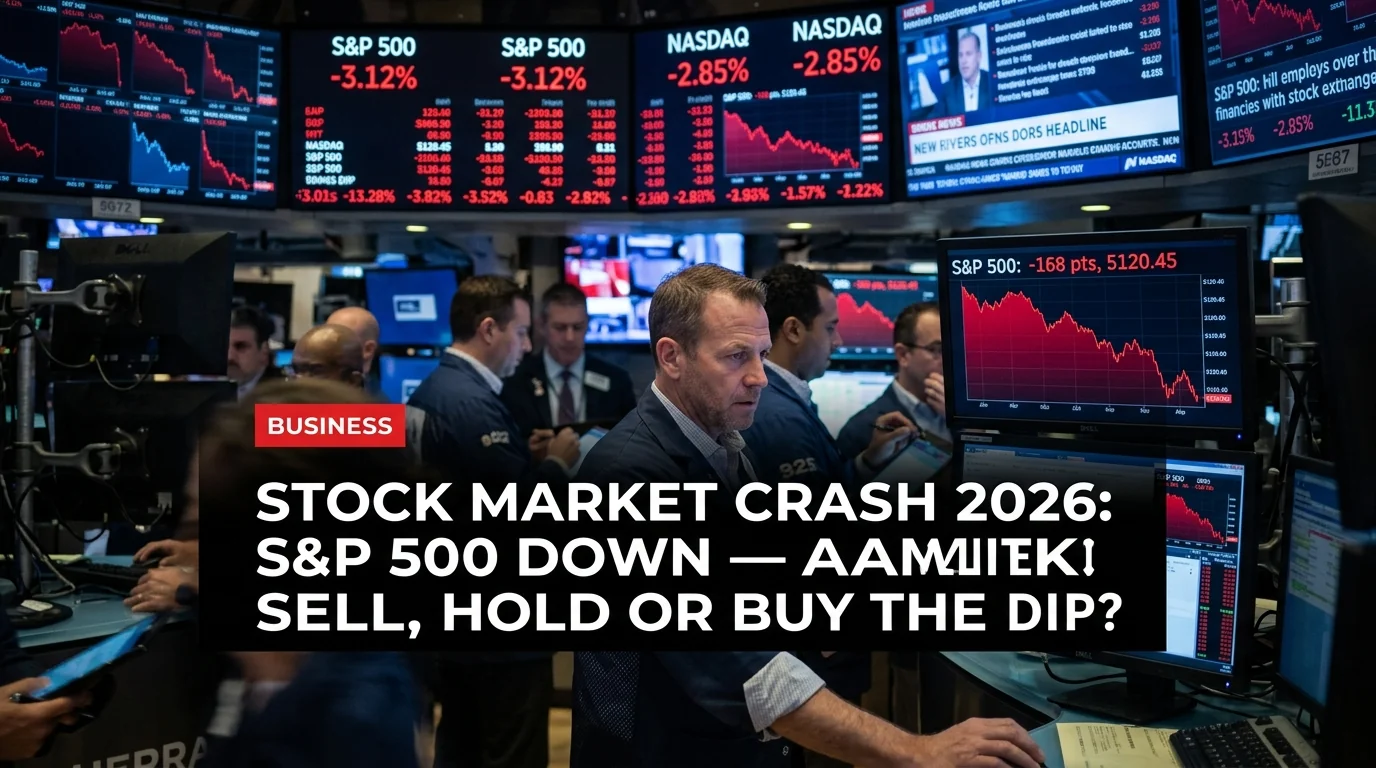
The US stock market is having one of its worst stretches in years. A sweeping tariff regime, an escalating trade war with China, and rising fears of a recession have sent the S&P 500, Dow Jones, and Nasdaq sharply lower in early April 2026. If you're watching your portfolio shrink and don't know whether to sell, hold, or buy more — you're not alone.
Here's a clear-eyed breakdown of what's happening, what history says, and what you should actually do.
What's Causing the 2026 Stock Market Drop?
The selloff has multiple overlapping causes, but tariffs are the primary trigger:
- US reciprocal tariffs — The Trump administration's sweeping tariff package slapped a 10% baseline duty on all imported goods, with much higher rates on China, the EU, and dozens of other trading partners.
- China's retaliation — Beijing responded with its own tariffs on American exports, hitting agriculture, semiconductors, and aerospace hard.
- Recession fears — Economists have raised recession probability estimates as consumer prices rise and corporate margins compress.
- Iran conflict — The ongoing US military engagement in Iran has added geopolitical risk premium to energy prices, pushing oil higher and squeezing transport costs.
How Bad Is It? By the Numbers
The sectors getting hit hardest include technology (tariff supply chain exposure), retail (import cost spikes), and consumer discretionary (spending slowdown). Meanwhile, energy and defense stocks have held up better given the geopolitical backdrop.
What History Tells Us About Market Crashes
Panicking during a crash is the single most reliably wealth-destroying move investors make. Here's why:
2020 COVID Crash: The S&P 500 fell 34% in 33 days. Investors who sold in March locked in massive losses. Those who held — or bought — saw the market recover to new all-time highs within six months.
2022 Bear Market: Rising Fed rates pushed the S&P 500 down 25%. It took about 18 months to fully recover, but again, those who stayed invested came out ahead.
2008 Financial Crisis: The most severe modern crash — down 57% peak to trough. Even here, patient investors who held through the bottom and into the recovery (2012-2013) made back all losses and more.
Tariff-driven crashes, specifically, tend to be policy-driven rather than structural. That means they can reverse quickly if trade deals are struck or tariffs are walked back — as happened multiple times during the 2018-2019 US-China trade war.
Should You Sell, Hold, or Buy the Dip?
- Stops further short-term losses
- Frees up cash to buy lower (if you can time it)
- Reduces emotional stress
- Locks in permanent losses
- You must also time the re-entry correctly — almost impossible
- Missing just the 10 best days in a decade cuts returns by 50%+
The case for holding
For most investors — especially those with a time horizon of 5+ years — the data overwhelmingly supports staying invested. Trying to time the market requires being right twice: when to get out, and when to get back in. Almost no one does this successfully.
If your portfolio allocation still matches your risk tolerance, holding is the statistically strongest move.
The case for buying the dip
If you have cash on the sidelines or are making regular contributions (like 401k contributions), a down market is actually a buying opportunity. You're purchasing the same assets at a discount.
This is called dollar-cost averaging — investing fixed amounts at regular intervals regardless of price. It's not exciting, but it works.
When selling makes sense
- You need the money within 1-2 years for a major expense
- Your portfolio is so overweighted in stocks that the losses are causing real financial stress
- You're rebalancing to hit a target allocation (sell some stocks, buy bonds)
Selling because you're scared is almost never the right answer.
Where Is the Money Going? Safe Havens in 2026
- Gold hit $2,900+ per ounce — a record high — as investors seek safety
- US Treasury bonds (especially short-term T-bills) are seeing strong inflows
- The US Dollar has weakened against the Japanese Yen and Swiss Franc
- High-yield savings accounts are offering 4-5% APY with zero volatility risk
- Dividend stocks in utilities and consumer staples are outperforming
If you want to reduce risk without selling equities entirely, shifting some allocation to short-term bonds or high-yield savings can provide stability without permanently exiting the market.
Sectors to Watch: Losers and Survivors
Hit hardest by tariffs:
- Technology (Apple, NVIDIA — supply chains in China and Taiwan)
- Retail (Walmart, Target — heavy reliance on imported goods)
- Automotive (Ford, GM — tariffs on imported parts)
Holding up better:
- Energy (US producers benefit from higher oil prices)
- Defense (military spending continues regardless of trade wars)
- Financials (banks benefit from higher interest rates if they persist)
- Domestic industrials (companies that source and sell within the US)
What the Fed Is Likely to Do
The Federal Reserve faces a difficult balancing act. Inflation from tariffs argues for keeping rates high. But recession risk argues for cutting. Markets are currently pricing in 2-3 rate cuts in the second half of 2026.
If the Fed does cut rates, that's historically bullish for stocks — particularly growth and tech names. It could be a catalyst for recovery.
The Bottom Line
Market crashes are terrifying in the moment and obvious in hindsight. The investors who come out ahead are almost always the ones who did nothing dramatic — or who used the drop as a chance to invest more.
If your financial situation is stable, your time horizon is long, and your allocation still fits your goals: hold. If you have extra cash and a long runway: consider buying more. If you genuinely need the money soon: yes, de-risk — but do it as a plan, not a panic.
The tariff situation is real, the uncertainty is real, and the short-term pain is real. But so is the historical record: every crash has eventually become a buying opportunity in retrospect.