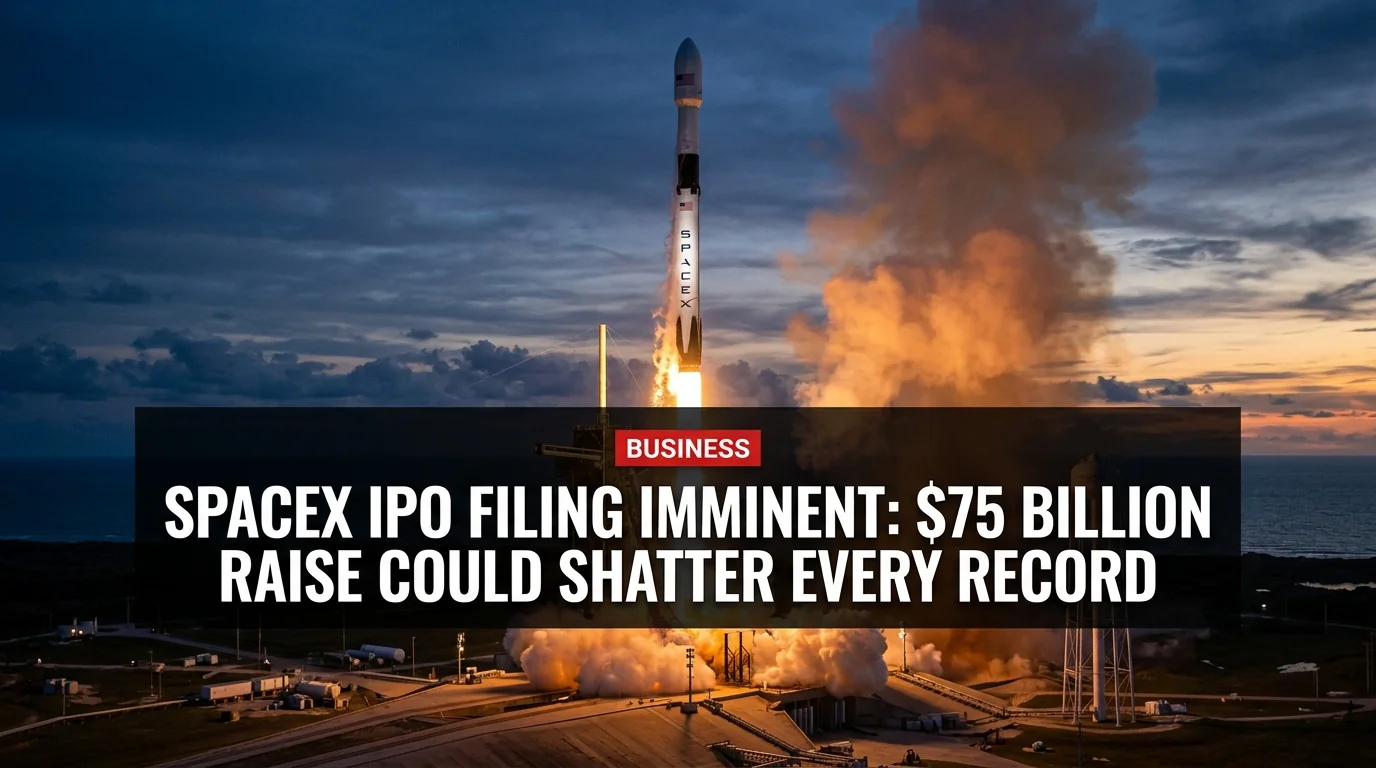
SpaceX is on the verge of filing the largest initial public offering in history, with reports confirming a confidential S-1 prospectus headed to the SEC as early as this week. The offering would value Elon Musk's aerospace empire at up to $1.75 trillion and raise over $75 billion in fresh capital — obliterating Saudi Aramco's 2019 record of $29.4 billion.
The filing caps a frantic two months that saw SpaceX absorb Musk's AI company xAI in a $250 billion all-stock merger, pushing the combined entity past the trillion-dollar mark in private valuation. A public listing on the Nasdaq is now targeted for June 2026.
Why SpaceX Is Going Public Now
For years, Musk resisted taking SpaceX public, arguing that quarterly earnings pressure would conflict with the multi-decade mission to colonize Mars. What changed? Starlink's economics.
::stats stat: $18.7B | label: Projected Starlink Revenue 2026 stat: 9.2M | label: Active Starlink Subscribers stat: 9,500+ | label: Satellites Currently in Orbit stat: 122 | label: Successful Launches in 2025 ::/stats
Starlink now accounts for 79% of SpaceX's projected $23.8 billion in 2026 revenue. The satellite internet division has crossed the threshold Musk set years ago — predictable, growing cash flow that can survive public market scrutiny. But the real catalyst was the xAI merger. Building orbital AI data centers requires capital that even SpaceX's private fundraising rounds can't sustain. xAI alone burns through an estimated $1 billion per month on computing infrastructure.
The Trillion-Dollar Timeline
::timeline event: 2019 | Starlink v0.9 launches; Musk first hints at eventual IPO once cash flow stabilizes event: Dec 2025 | Starlink hits 8 million subscribers; traffic doubles year-over-year event: Feb 2, 2026 | SpaceX acquires xAI in $250B all-stock deal, creating a $1.25T private entity event: Mar 24-26, 2026 | Reports confirm SpaceX finalizing confidential S-1 with the SEC event: Apr-May 2026 | Global roadshow pitching 'Orbital Data Center' concept to sovereign wealth funds event: Jun 2026 | Expected Nasdaq listing under ticker 'SPACE' or 'STRLK' ::/timeline
The Underwriting Army
SpaceX has assembled a who's-who of Wall Street to manage the offering. Morgan Stanley and Goldman Sachs are leading institutional allocation, while Bank of America has been handpicked by Musk to spearhead the domestic retail push.
Citibank is coordinating international distribution. Barclays covers the UK, Deutsche Bank handles Germany, Mizuho takes Japan, Royal Bank of Canada leads its home market, and UBS manages international wealth clients.
The syndicate's size reflects both the deal's scale and Musk's unusual demand: he wants up to 30% of shares allocated to retail investors.
30% Retail Allocation: Musk Rewrites the IPO Playbook
Typical IPOs reserve 5% to 10% of shares for individual investors. Musk wants triple that. The strategy leverages his massive fan base to create a loyal shareholder base that's less likely to dump stock on day one — the same playbook he's used with Tesla.
::keyfacts fact: SpaceX plans to allocate 20-30% of IPO shares to retail investors — 3x the industry standard fact: Bank of America will handle high-net-worth individuals and family offices domestically fact: Morgan Stanley's E*Trade platform will give smaller retail investors direct access fact: The $75B raise would shatter Saudi Aramco's $29.4B record from 2019 fact: SpaceX holds 8,285 BTC (~$580M) that will be disclosed in the public S-1 ::/keyfacts
The move has already generated enormous interest. Pre-IPO secondary market trades are pricing SpaceX shares at valuations consistent with the $1.75 trillion target.
How the Valuation Breaks Down
::chart bar title: SpaceX Revenue by Segment (2026 Projected) Starlink Internet: 18.7 Launch Services: 3.2 Government Contracts: 1.2 xAI Integration: 0.7 ::/chart
Starlink is the engine. With 9.2 million subscribers paying an average of $120 per month, the division generates recurring revenue that Wall Street loves. The subscriber base is projected to hit 14 million by year's end.
Launch services remain steady, with 150+ missions planned for 2026. But the xAI integration is the wild card. Musk's vision of orbital AI data centers — computing infrastructure deployed in space — is either a $500 billion opportunity or a money pit, depending on who you ask.
Bulls vs. Bears
::proscons pro: Starlink is a de facto global utility with 9.2M subscribers and 60% YoY revenue growth pro: 150+ planned launches in 2026 demonstrate unmatched operational scale pro: xAI merger creates first vertically integrated space-AI company pro: Retail allocation strategy could build loyal, stable shareholder base con: xAI burns $1B/month — SpaceX cash flow may subsidize unprofitable AI division con: $1.75T valuation implies near-perfect execution on every business line con: Orbital data centers remain theoretical — no proven commercial model yet con: Regulatory risk from both SEC scrutiny and international spectrum disputes ::/proscons
Morgan Stanley analysts argue the valuation is justified by SpaceX's "multi-planetary and AI-integrated" business model. Critics counter that Musk is using Starlink's healthy cash flow to subsidize xAI's enormous compute buildout — a concern that will face intense scrutiny once the S-1 financials go public.
The Ripple Effect on Space Stocks
The IPO announcement has already lifted the entire sector. Rocket Lab (RKLB) surged 16% on the news, while AST SpaceMobile (ASTS) climbed 10%. The logic: a SpaceX public listing legitimizes commercial space as an investable sector and draws institutional capital that benefits competitors too.
::alert info For investors: SpaceX has not yet publicly filed its S-1, and no shares are available for purchase. Be cautious of pre-IPO platforms offering secondary market access — these carry significant liquidity and pricing risks. The official listing is expected in June 2026. ::/alert
What Happens Next
The confidential S-1 filing kicks off a regulatory review process that typically takes 4 to 8 weeks. If the timeline holds, SpaceX executives will hit the global roadshow circuit in April and May, pitching sovereign wealth funds and asset managers on the orbital data center thesis.
The formal Nasdaq listing would follow in June. At that point, SpaceX would become the most valuable company to go public in history — and every investor on the planet will have an opinion on whether it's worth $1.75 trillion.
For Musk, the IPO represents something he avoided for two decades: subjecting his Mars mission to quarterly earnings calls. But with xAI's appetite for capital and Starlink's proven economics, the math finally made the decision for him.
Key People Driving the IPO
| Role | Name | Position |
|---|---|---|
| CEO & CTO | Elon Musk | Founder, SpaceX; Owner, xAI and X platform |
| COO | Gwynne Shotwell | President, SpaceX; architect of $1.25T private valuation |
| CFO | Bret Johnsen | Leading S-1 preparation and SEC engagement |
| Lead Underwriter | Morgan Stanley | Institutional share allocation |
| Retail Lead | Bank of America | Domestic retail and family office distribution |