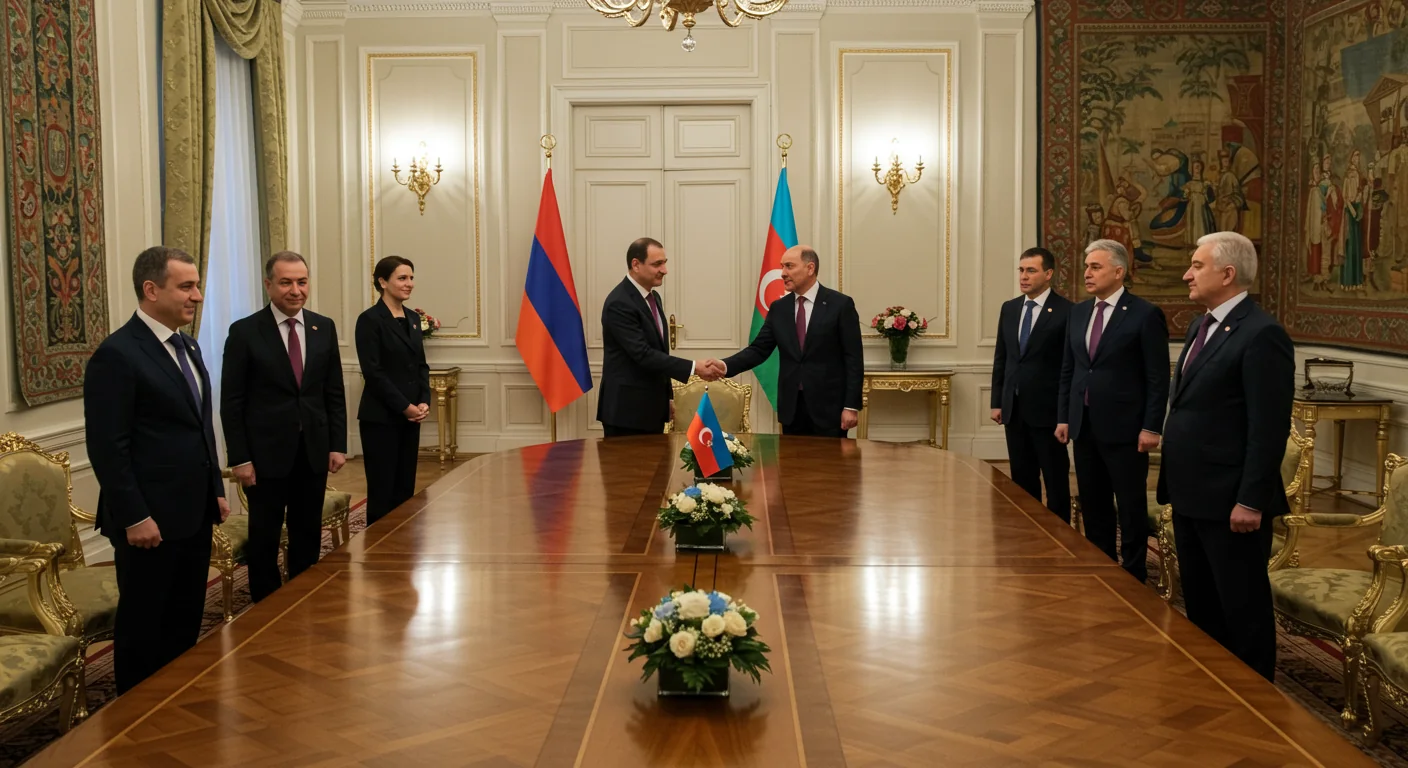
Armenia and Azerbaijan stand closer to a formal peace treaty than at any point in their three-decade conflict — yet a single constitutional clause threatens to stall the entire process.
Foreign Minister Ararat Mirzoyan confirmed in a parliamentary hearing on March 23 that while the 17-article Agreement on the Establishment of Peace and Interstate Relations is substantively complete, Azerbaijan continues to demand Armenia amend its constitution before signing. President Ilham Aliyev has stated the treaty could be signed "the very next day" if Yerevan complies.
What Is the Tbilisi Protocol?
The Tbilisi Protocol refers to the final phase of peace negotiations between Armenia and Azerbaijan, hosted in Georgia's capital. It builds on the landmark agreement initialed at the White House on August 8, 2025, under U.S. mediation.
The deal would formally end hostilities over the former Nagorno-Karabakh region — a conflict that has killed over 30,000 people since 1988 and displaced hundreds of thousands more.
- 17-article treaty initialed in Washington on August 8, 2025
- 30+ years of conflict over Nagorno-Karabakh formally ended
- Constitutional referendum in Armenia expected 2027 — the final hurdle
- TRIPP corridor through Syunik province to begin construction late 2026
- Parliamentary elections in Armenia set for June 7, 2026
The Constitutional Stalemate
The core dispute is deceptively simple. Armenia's constitution includes a preamble referencing the 1990 Declaration of Independence, which itself cites a 1989 act of unification with Nagorno-Karabakh. Azerbaijan views this as an implicit territorial claim and refuses to sign until it is removed.
Prime Minister Nikol Pashinyan has agreed in principle to a new constitution but insists the referendum cannot happen until after Armenia's June 2026 parliamentary elections — placing a realistic timeline no earlier than 2027.
- Treaty is substantively agreed and ready for signature
- Constitutional change requires a national referendum — cannot be rushed
- The TRIPP corridor preserves full Armenian sovereignty over Syunik
- Western alignment replaces Russian security dependence
- No signature until Armenia removes Karabakh references from constitution
- Peace is "de facto" established; legal formality awaits Yerevan's action
- Demands go beyond the treaty text to Armenia's founding documents
- Views delay as strategic hedging by Pashinyan
U.S. intelligence assessments have noted that the referendum outcome is "not guaranteed," given domestic opposition from Armenian nationalists who view constitutional changes as a capitulation.
The TRIPP Corridor: America's 99-Year Bet on the Caucasus
The most consequential element of the peace framework isn't the treaty itself — it's the infrastructure deal attached to it.
The Trump Route for International Peace and Prosperity (TRIPP) is a 43-kilometer multimodal transit corridor through Armenia's Syunik province, connecting Azerbaijan to its Nakhchivan exclave and onward to Turkey. Previously known as the "Zangezur Corridor," it was rebranded after U.S. mediation secured the deal.
The corridor will include railways, roads, gas pipelines, power lines, and digital infrastructure. Crucially, Armenia retains full sovereignty — legislative, judicial, security, customs, and tax authority — over the route. This resolved the most explosive pre-negotiation demand: Azerbaijan's earlier insistence on extraterritorial control.
Secretary of State Marco Rubio, who co-authored the TRIPP Implementation Framework in January 2026, described it as "a vital link in the Trans-Caspian Trade Route" bypassing both Russia and Iran.
Timeline: From War to Protocol
The Geopolitical Chessboard
The Tbilisi Protocol reshapes far more than Armenian-Azerbaijani relations. It marks the most significant reduction of Russian influence in the South Caucasus since the Soviet collapse.
Armenia has agreed to the withdrawal of Russian defensive forces from its borders, replacing Moscow's security umbrella with U.S.-backed economic and strategic partnerships. For Washington, the TRIPP corridor represents a physical foothold in a region where Russia and Iran have historically dominated.
"This is not just a peace deal — it's the end of Russia's security monopoly in the South Caucasus." — Atlantic Council analysis, February 2026
Iran has condemned the U.S. role, with officials describing the TRIPP as an "encroachment" on regional stability. Tehran's concern is strategic: a U.S.-controlled corridor on Iran's northern border, combined with the ongoing military campaign in the Persian Gulf, tightens the pressure on Iran from multiple directions.
Georgia, the host of current negotiations, faces its own anxiety. The TRIPP corridor could divert transit trade currently flowing through Georgian territory, potentially impacting Tbilisi's role as a regional logistics hub.
Why It Matters
The Armenia-Azerbaijan conflict has been one of the world's longest-running frozen wars. If the Tbilisi Protocol succeeds, it will:
- End 30+ years of hostilities between two nations that share a 1,007-km border
- Open the Middle Corridor trade route connecting Central Asia to Europe, bypassing Russia
- Establish a U.S. strategic presence in a region dominated by Russia and Iran for centuries
- Test constitutional diplomacy — whether external peace demands can drive internal legal reform
The deal is closer than ever. Whether it crosses the finish line depends on Armenian voters, Azerbaijani patience, and whether Washington can keep both sides at the table long enough to make history permanent.