
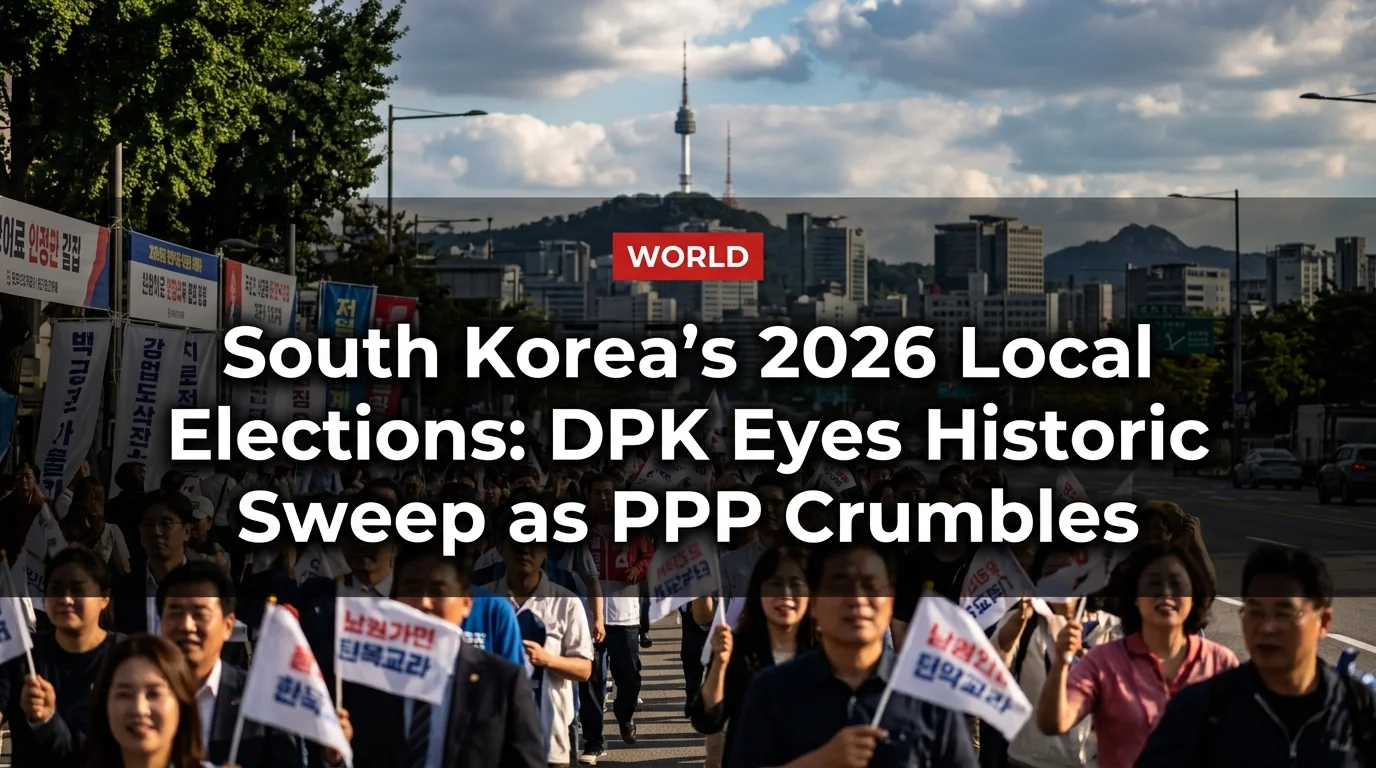
South Korea is heading toward what could be the most lopsided local elections in its democratic history. With the June 3 vote just ten weeks away, the Democratic Party of Korea (DPK) commands a 27-point lead over the People Power Party (PPP), whose approval has cratered to levels unseen since the martial law crisis that toppled former President Yoon Suk-yeol.
The question is no longer whether the DPK will win — but whether the PPP can survive as a viable opposition.
What's at Stake
Voters will fill over 4,000 positions across every level of local government on June 3, a designated public holiday.
Several National Assembly by-elections will run concurrently, adding a parliamentary dimension to what is already the first nationwide referendum on President Lee Jae-myung's administration.
The Polls Tell a Brutal Story
Every major survey paints the same picture: a ruling party surging and an opposition in freefall.
President Lee's approval rating hit an all-time high of 67% on March 20, according to Gallup Korea. Meanwhile, the PPP recorded just 17% support in a February 27 Korea Times poll — its lowest since August 2025.
KEY STAT: Polymarket gives the DPK a 92.7% implied probability of winning the most local government seats. The PPP sits at 5.7%.
The Martial Law Shadow
The PPP's collapse traces directly to December 3, 2024, when President Yoon Suk-yeol declared martial law in a bid to dissolve the National Assembly. The move lasted hours but shattered public trust.
The PPP's March resolution — unanimously apologizing for the martial law declaration and opposing any call for Yoon's political return — came 15 months too late for most voters. Political analysts say the party's failure to cleanly break from Yoon immediately after the crisis created a credibility wound that hasn't healed.
Five Battlegrounds to Watch
While the DPK leads nationally, several key races could define the political map for years.
Seoul: The Prize Everyone Wants
Incumbent Mayor Oh Se-hoon (PPP) faces the tightest race in the country. A January poll showed him within the margin of error against DPK challenger Jung Won-oh, the Seongdong District head. But citywide PPP support has since fallen to 19%, making Oh's personal popularity his only lifeline.
Busan: Conservative Fortress Under Siege
A March KNN survey showed DPK lawmaker Jeon Jae-soo leading incumbent Mayor Park Heong-joon (PPP) by 40.2% to 26.7% in a head-to-head matchup. If Busan flips, it would be a seismic shift — the port city has been a conservative stronghold for decades.
- Oh Se-hoon (PPP) — Incumbent, strong personal brand
- PPP citywide support: 19%
- Strategy: Run on competence, distance from party
- Jeon Jae-soo (DPK) leads Park Heong-joon (PPP)
- DPK: 31.8% vs PPP: 25.4%
- 35% of voters still uncommitted
Gyeonggi Province
DPK candidate Kim Dong-yeon leads all PPP contenders beyond the margin of error. As South Korea's most populous province surrounding Seoul, a DPK win here would cement the party's grip on the capital region.
Daegu–North Gyeongsang: The Last Conservative Bastion?
In what would have been unthinkable two years ago, the DPK is now tied with the PPP in Daegu and North Gyeongsang Province — the historical heartland of Korean conservatism. If these regions flip, the PPP effectively has no geographic base left.
Incheon: The Merger Test
The Incheon Yeonsu-gu Gap by-election, triggered by Rep. Park Chan-dae's resignation to run for mayor, will test whether the DPK-Rebuilding Korea Party alliance can hold despite their failed merger talks.
The Demographic Shift Nobody's Talking About
For the first time in South Korean electoral history, voters aged 60 and older (31.4%) outnumber those in their 20s and 30s (31.1%). This crossover has profound implications.
- Older voters tend toward higher turnout, boosting overall participation
- Senior-focused policies (pensions, healthcare) will get more attention
- Greater electoral stability — older voters shift preferences more slowly
- Youth policy priorities (housing, jobs) may lose political urgency
- Generational resentment could deepen if young voters feel sidelined
- Progressive parties may need to recalibrate messaging for an older electorate
The DPK has historically performed well across age groups since the martial law crisis, but this demographic tilt could particularly challenge the party's progressive flank.
The DPK's Consolidation Problem
Despite its commanding position, the DPK faces internal friction. Party leader Jung Chung-rae's January proposal to merge with Cho Kuk's Rebuilding Korea Party collapsed in February amid factional backlash. Critics within the DPK called the merger attempt a power play for the 2027 party leadership race rather than a strategic necessity.
The two parties remain allies in practice, but the failed merger has created awkward dynamics in districts where both field candidates.
What Happens Next
- **May 14–15:** Official candidate registration
- **May 21:** Campaign period begins (13 days)
- **May 29–30:** Early voting
- **June 3:** Election day (public holiday)
- **Election crime tip reward:** Up to 500 million won ($375,000)
Both parties are pivoting to economic messaging for the campaign's final stretch. Fuel price caps and measures to stabilize the weakening won against Middle East uncertainty are emerging as the bread-and-butter issues that could sway undecided voters — particularly the 35% of Busan residents who told pollsters they haven't made up their minds.
For the PPP, the next ten weeks are existential. Seoul Mayor Oh Se-hoon put it bluntly: the party is "standing at the edge of a cliff." Whether it falls or finds a foothold may determine the shape of South Korean democracy for a generation.
Sources: Gallup Korea (March 20, 2026), Korea Times, Korea JoongAng Daily, KNN Busan, Polymarket, National Election Commission