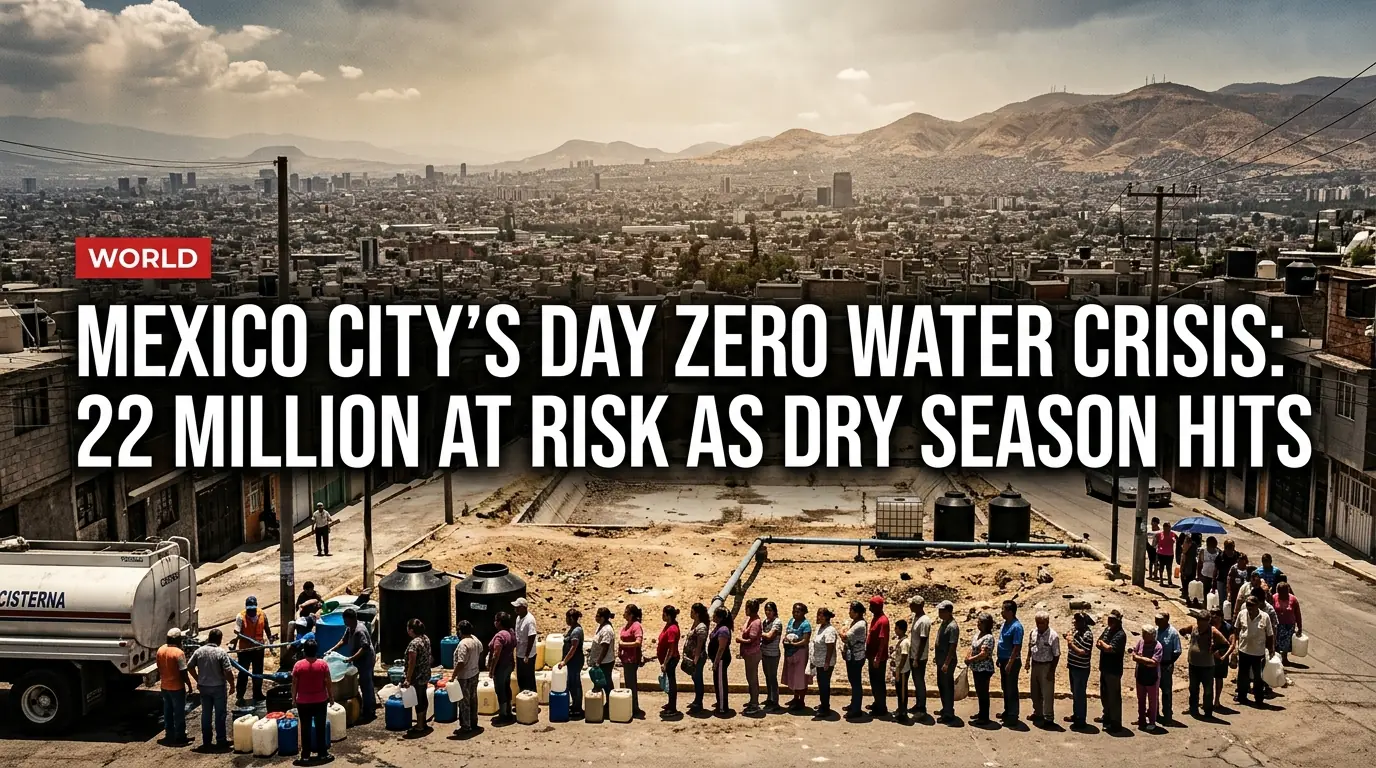
Mexico City is entering its most dangerous months. The Cutzamala System — the engineering lifeline that pumps water over mountains to feed 22 million people — sits at roughly 56% capacity as the 2026 dry season accelerates. Two years after the city narrowly dodged its first "Day Zero," the structural crisis that nearly shut off the taps hasn't gone away. It's just waiting for a bad rain year.
What Day Zero Actually Means
Day Zero is the point when Cutzamala reservoir levels drop below 155 million cubic meters — approximately 20% capacity. Below that threshold, the system physically cannot pump water over the mountains into the Valley of Mexico. Taps stop. Hospitals ration. Firefighters run dry.
The term entered Mexico City's vocabulary in late 2023, when CONAGUA — the national water commission — projected that reservoirs would hit dead storage by June 26, 2024. That date passed without a total collapse, but only because emergency rationing and an unusually strong rainy season intervened at the last moment.
Where Things Stand in March 2026
Reservoirs recovered significantly during the 2025 rainy season, when over 220 million cubic meters of rainfall poured into the basin in June alone. But "recovered" is relative. Current levels remain below historical averages, and the city is now entering the driest stretch of the year — March through May — when demand peaks and supply drops.
The structural math is brutal: Mexico City extracts groundwater 2.15 times faster than aquifers recharge. Every year the deficit grows. Every year the city sinks further into the ancient lakebed it was built on.
A Crisis Five Centuries in the Making
Mexico City's water paradox is almost poetic in its cruelty. The city floods catastrophically because it was built on a drained lake with no natural drainage. Yet it runs out of drinking water because asphalt and concrete prevent rain from reaching the aquifers below. The ground collapses because over-pumping creates voids in the clay. The Angel of Independence monument has had dozens of stairs added to its base over the decades — the surrounding ground keeps dropping away from it.
The Inequality Map
The crisis doesn't hit everyone equally. In wealthy Polanco, residents pay for private water tankers — called pipas — to fill rooftop cisterns. Service rarely stops. In Iztapalapa, the sprawling southeastern borough that is home to nearly two million people and is sinking the fastest, residents sometimes go weeks without running water. When it does arrive, some report it smells of sewage or fuel.
- Private tanker deliveries on demand
- Rooftop cisterns standard in buildings
- Consistent pressure, minimal rationing
- Residents spend $50–$200/month on supplemental water
- Dependent on government *pipa* trucks
- Weeks-long outages common
- Water quality complaints (odor, contamination)
- Sinking up to 40 cm/year — pipes crack faster than they're repaired
This divide is why hydrologists like UNAM's Manuel Perló argue that Day Zero isn't a future event — it's already a daily reality for millions of residents in the city's southern and eastern boroughs.
Sheinbaum's Water Gamble
President Claudia Sheinbaum — a climate scientist who previously served as Mexico City's mayor — has staked significant political capital on the National Water Plan 2024–2030 and the landmark General Water Law passed in December 2025.
The legislation represents the most aggressive water reform in Mexican history:
- **De-privatization:** Water concessions can no longer be traded between private parties. CONAGUA must approve all reassignments.
- **Mandatory rainwater harvesting:** New building codes require collection systems. Federal target: 20% of city water sourced from rainfall.
- **Water crimes:** Illegal connections and industrial dumping now carry fines up to MXP $10.8 million (~$600,000 USD).
- **Infrastructure overhaul:** 110 km Macrocircuito Aqueduct repair, 87 wells rehabilitated, new purification plants.
The investment is massive but arguably still insufficient:
KEY STAT: Total committed spending across public and private sectors approaches $8.6 billion USD — but experts estimate the city needs $15–20 billion to truly modernize its water infrastructure.
The most innovative piece may be the Cosecha de Lluvia (Rain Harvest) program, which has installed nearly 60,000 domestic rainwater collection systems since 2019. The non-profit Isla Urbana is working with the government to reach 100,000 installations, targeting the hardest-hit boroughs first.
What Happens If the Rains Don't Come
The 2026 rainy season — which typically begins in late May — will determine whether Mexico City enters another emergency. Climate models show increasing variability: wetter wet years, drier dry years, and less predictability overall.
- Reservoir levels entering 2026 significantly better than 2024
- New water law provides stronger enforcement tools
- Rainwater harvesting scaling rapidly
- Federal investment at historic highs
- 40% pipe leakage unchanged — repairs are years behind schedule
- Aquifer extraction still outpaces recharge by 2:1
- City sinking accelerates infrastructure decay
- Population continues to grow despite water constraints
- Climate change making rainfall patterns less predictable
The honest assessment: Mexico City has bought itself time, not a solution. The 2025 rains were a gift. The 2026 rains are a question mark. And the fundamental equation — too many people, too little recharge, too much leakage — hasn't changed.
Day Zero isn't a date on a calendar. It's a condition that already exists in Iztapalapa and Milpa Alta, and it's slowly expanding outward. The question isn't whether it will arrive for the rest of the city. It's whether $8.6 billion and a new water law can move fast enough to stop it.
This article draws on data from CONAGUA technical reports, UNAM geosciences research, the Mexico City Official Gazette, and World Bank water availability assessments.