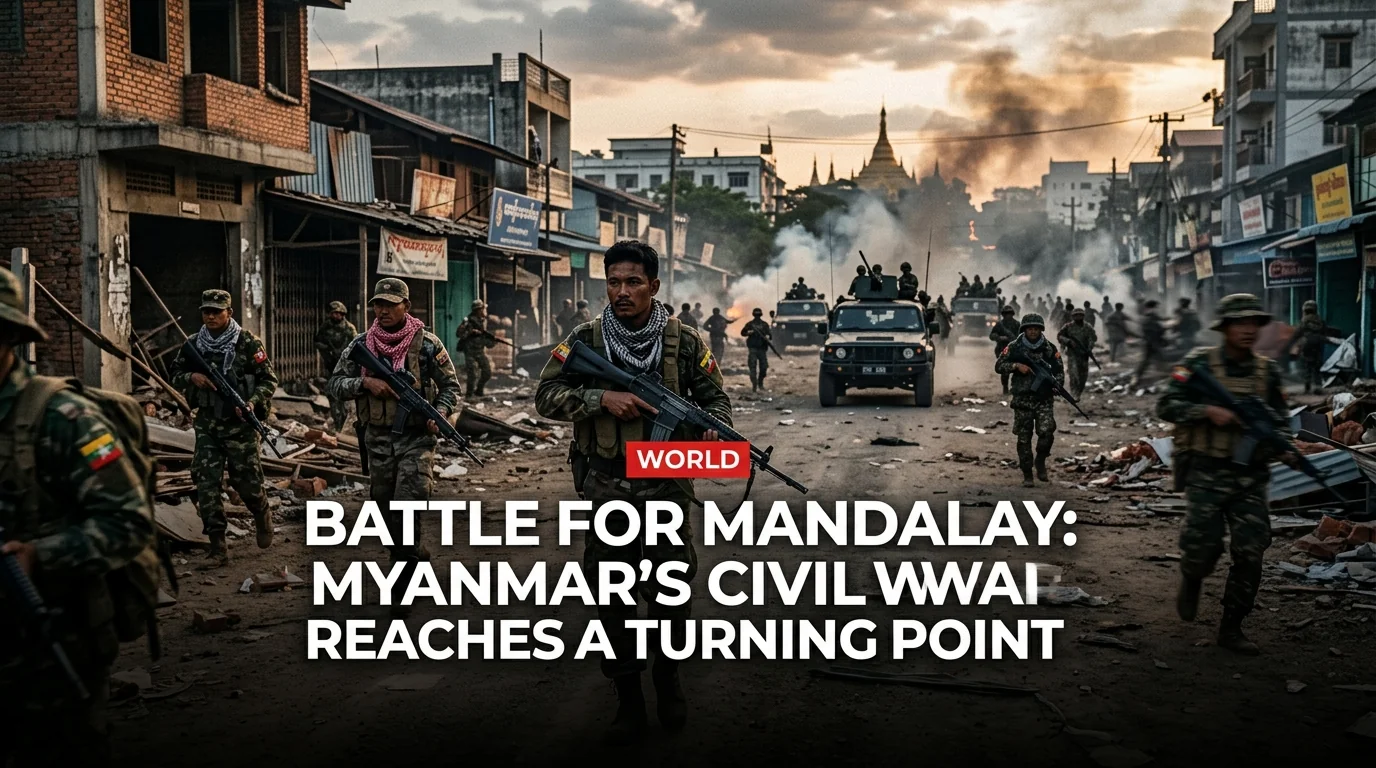
Myanmar's five-year civil war has reached a critical inflection point. In March 2026, the military junta recaptured the last resistance-held town in the Mandalay Region, marking its most significant territorial gain since the 2021 coup — and potentially reshaping the trajectory of a conflict that has displaced millions.
But the battle for Mandalay is far from over. Resistance forces are regrouping, China is pulling strings from the sidelines, and a city of 1.6 million people is caught in the crossfire.
Why Mandalay Matters
Mandalay is not just Myanmar's second-largest city. It is the cultural and spiritual capital of the Bamar majority — the seat of the last Burmese monarchy, a symbol of national identity that has been fought over for nearly 150 years.
For the junta, losing Mandalay would have been an existential blow — a signal to the world and to Myanmar's own military rank-and-file that the generals can no longer defend the heartland. For the resistance, holding territory around the city was proof that the revolution was winning.
The Junta's Counter-Offensive
The turning point came gradually. After resistance forces surged to within striking distance of Mandalay city in mid-2024, a combination of factors reversed their momentum.
- **Tagaung fell on March 11, 2026** — the last resistance-held town in Mandalay Region
- **500 fighters allegedly surrendered** at Mandalay Palace on March 19 — resistance calls it propaganda
- **China brokered ceasefires** with key ethnic armies, isolating the Mandalay PDF
- **Junta air superiority** proved decisive against lightly armed resistance units in open terrain
The sequence was methodical. First, Beijing pressured the Ta'ang National Liberation Army (TNLA) — one of the most capable ethnic armed organizations — into a ceasefire in mid-2025. This removed a critical ally from the Mandalay front. Then the junta concentrated its air power, deploying drones and artillery against resistance positions in Madaya, Singu, Thabeikkyin, and Patheingyi townships.
By early 2026, the Mandalay People's Defense Force (MDY-PDF) was fighting alone on the plains — terrain that favors conventional military forces with air support.
The Human Cost
The numbers tell a story that neither side's propaganda captures. Mandalay has become a city under siege from within — flooded with internally displaced people fleeing fighting in the surrounding townships, its infrastructure shattered by a catastrophic earthquake in March 2025 that killed over 3,400 and caused an estimated $11 billion in damage.
Civilian neighborhoods in Madaya Township were destroyed by junta drone and artillery strikes as recently as this month. The military's strategy of collective punishment — targeting communities suspected of harboring resistance fighters — has turned entire townships into ghost towns.
Two Narratives, One War
The junta and the resistance tell starkly different stories about what is happening in Mandalay.
- Tagaung recapture proves the military is winning
- 500+ fighters surrendered voluntarily at Mandalay Palace
- "Living in the jungle is nothing like the movies... a person in the light can live in freedom" — Brig. Gen. Aung Htay
- Elections in March 2026 show governance is returning to normal
- Territorial losses are tactical retreats, not defeats
- Alleged surrenders are fabricated or coerced from civilians
- Shifting to urban guerrilla warfare — a deliberate strategic pivot
- December 2025 rocket attack on Central Military Command showed Mandalay is not secure
The truth likely sits between these accounts. The junta has undeniably reclaimed territory around Mandalay, but it controls only an estimated 21% of Myanmar's total landmass. Resistance forces and ethnic armies hold roughly 42% of the country. The junta's gains in Mandalay came at the cost of losing ground elsewhere.
China's Shadow Over the Battlefield
Perhaps the most consequential player in the battle for Mandalay is not in Myanmar at all. China's role has been decisive — and deeply controversial.
China's motivations are pragmatic. Major Chinese-backed enterprises — including Wanbao Mining and Alpha Cement — operate in the Mandalay Region. Beijing wants stability to protect its investments and secure the strategically vital Muse-Mandalay trade highway, a key corridor in the Belt and Road Initiative.
By pressuring the TNLA into a ceasefire while leaving the Bamar-led PDF to face the junta alone, China effectively picked a side — not out of ideology, but out of economic self-interest.
What Comes Next
The junta will attempt to parlay its Mandalay gains into legitimacy. A new parliament formed from the widely criticized March 2026 elections is being presented as evidence of restored civilian governance. The newly elected Speaker of the Upper House, U Aung Lin Dwe, represents the Mandalay Region — a symbolic choice designed to project stability.
But the resistance is not finished. The MDY-PDF has announced the formation of a new brigade in neighboring Sagaing Region, signaling a shift from conventional territorial defense to long-term attrition warfare. The December 2025 rocket attack on the Central Military Command headquarters inside Mandalay Palace demonstrated that even the junta's most fortified positions are not safe.
Myanmar's civil war is entering a new phase. The battle for Mandalay's hinterland may be over, but the war for Myanmar's future is not. History shows that in this country, the fall of Mandalay is never the end of the story — it is usually just the beginning of a longer, harder fight.