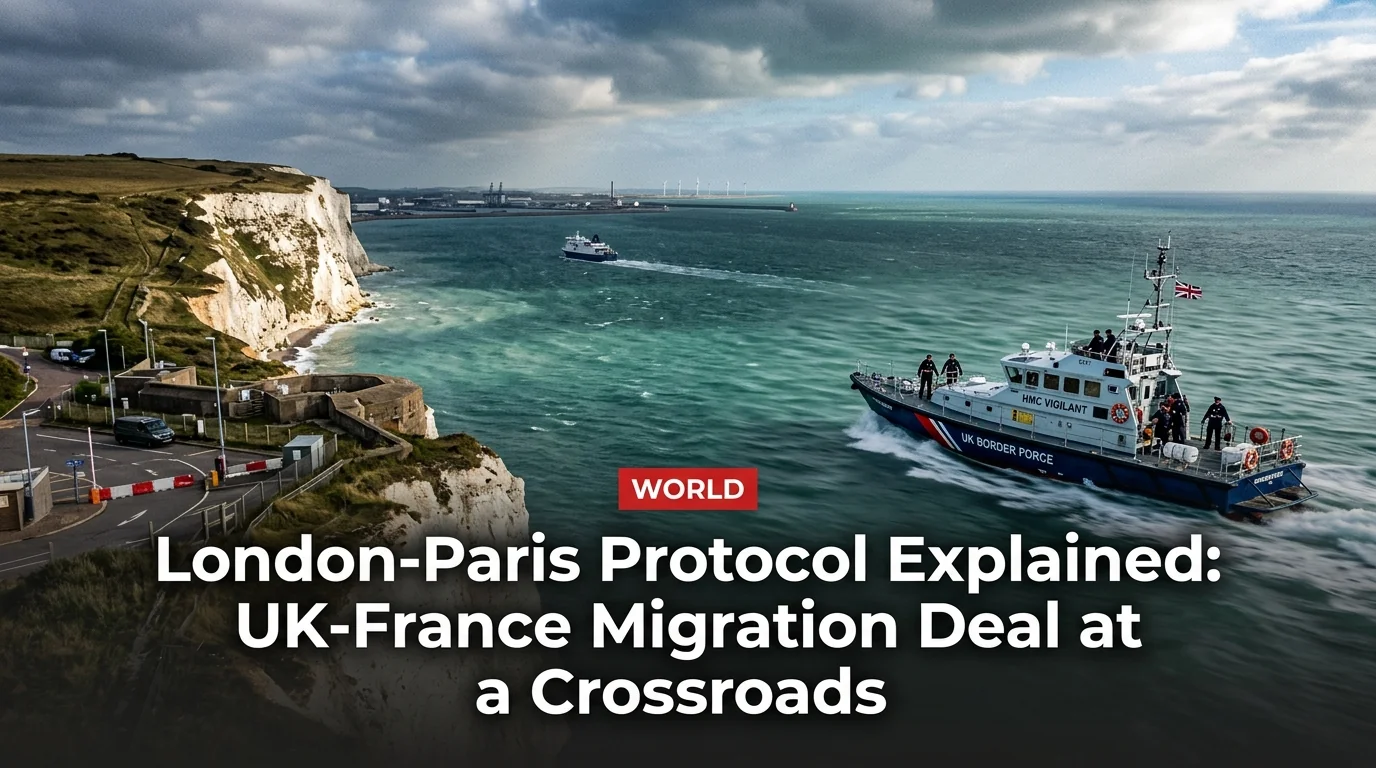
The UK-France Returns Agreement — known internally as Operation Hillmore and publicly as the London-Paris Protocol — is entering its most critical phase. With the pilot scheme set to expire on June 11, 2026, and legal challenges stacking up in both London and Paris, the landmark "one-in, one-out" migration deal faces an uncertain future.
Here's what you need to know about where the treaty stands today, what the numbers actually show, and why the next 80 days will determine the future of English Channel migration policy.
How the Deal Works
The mechanism is deceptively simple: for every migrant the UK returns to France after an illegal small-boat crossing, the UK accepts one eligible asylum seeker from France through a legal resettlement route.
- **Signed:** July 29–30, 2025, by PM Keir Starmer and President Emmanuel Macron
- **Ratified:** August 4, 2025
- **Expiry:** June 11, 2026 (pilot period)
- **Scope:** Adult migrants only — unaccompanied minors are strictly excluded
- **Returns window:** UK must submit a readmission request within 14 days of arrival
- **Weekly cap:** Approximately 50 returns and 50 admissions per week
The deal replaced the controversial Rwanda deportation plan, which was scrapped after the 2024 election. It marks the first formal returns mechanism between the UK and France since the Dublin III Regulation ceased to apply post-Brexit.
The Numbers Tell a Complicated Story
Seven months into the pilot, the data reveals a scheme that is functioning — but barely making a dent in the overall crisis.
The ratio tells the real story. The scheme was designed as a deterrent, but with only 2% of arrivals actually returned, the deterrent effect is questionable at best.
To put that in perspective: for every person returned under the protocol, roughly 49 others crossed successfully and remained in the UK system.
The Money Behind the Border
The UK's financial commitment to French border operations is substantial and growing.
Negotiations for a new three-year funding cycle covering 2026–2029 are currently underway. The UK is expected to push for expanded enforcement powers, while France wants increased financial support for processing centers in Calais and Dunkirk.
Who's Involved — and Who's Fighting It
The treaty has created strange political bedfellows and fractured traditional alliances.
- PM Starmer: "If you come here illegally on a small boat, you will face being sent back to France"
- French Interior Minister Retailleau: Focused on "stopping the flow" and breaking smuggler networks
- Home Secretary Shabana Mahmood: Defending the scheme against internal Labour rebellion
- 100+ Labour MPs signed a letter protesting "dehumanizing" reforms linked to the strategy
- Tony Vaughan MP (Folkestone): "You don't win back public confidence by threatening to forcibly remove refugees who have lived here lawfully for 15 or 20 years"
- Amnesty International: Called the deal "performative cruelty"
- French NGO Utopia 56: Filed constitutional challenge with the Council of State
Timeline: How We Got Here
The Loophole Problem
This loophole exposes a fundamental flaw in the protocol's design. The deal addresses boat crossings but does nothing about other entry methods. Smuggling networks have reportedly adapted, offering "lorry packages" to migrants who have already been returned — at a higher price than the original boat crossing.
What Happens Next
Three critical deadlines are converging:
- May 2026 — The UK and France must decide whether to formalize the pilot into a permanent treaty or let it lapse
- June 11, 2026 — The pilot scheme officially expires
- Late 2026 — The French Council of State is expected to rule on the constitutionality of the "one-in, one-out" mechanism
- First functioning returns mechanism since Brexit
- Creates a legal route that didn't exist before
- French authorities stopped 22,500 crossing attempts in 2025
- Diplomatic relationship between London and Paris is stronger than under previous governments
- Only 2% of Channel crossers are actually affected
- Returned migrants are re-entering via alternative routes
- Legal challenges are disrupting scheduled deportation flights
- £476M funding has not significantly reduced overall crossing numbers
- 80,000+ asylum backlog continues to grow
The Bigger Picture
The London-Paris Protocol represents a philosophical shift in how the UK approaches irregular migration — from the punitive offshore processing model of the Rwanda Plan to a reciprocal, diplomatic framework. Whether that shift produces results depends entirely on what happens in the next 80 days.
If the pilot is made permanent, expect expanded weekly return quotas, new funding commitments, and likely further legal battles. If it lapses, the UK will be back to square one — no returns mechanism, no deterrent, and a Channel crossing crisis that shows no signs of slowing.
KEY STAT: At the current return rate of ~50 per week, it would take over 7 years to process just the migrants who crossed during the pilot's first 7 months.
The math doesn't lie. The question facing Starmer and Macron isn't whether the protocol works in principle — it's whether it can ever work at scale.