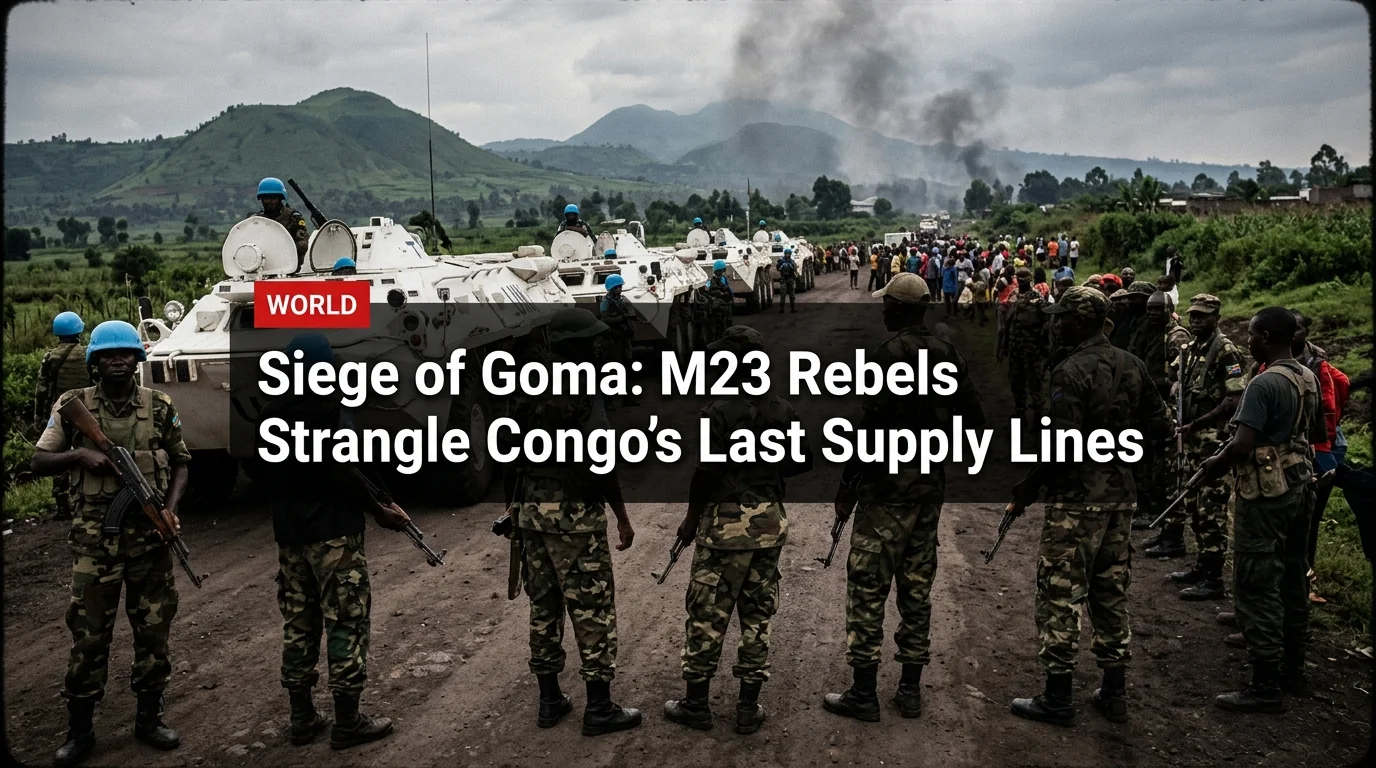
The last road into Goma is dead. M23 rebels now control every land route into the provincial capital of North Kivu, turning a city of two million into a sealed pressure cooker of hunger, disease, and desperation. Fourteen months after seizing the city, the rebels are tightening their grip — and the international community is running out of options.
- **7.3 million** people displaced across eastern DRC — the world's largest internal displacement crisis
- **26.6 million** Congolese face crisis-level food insecurity through June 2026
- **$1.4 billion** humanitarian appeal for 2026 remains critically underfunded
- **900+ civilians** killed during the January 2025 offensive alone
- **150 tons** of coltan smuggled monthly from DRC to Rwanda under rebel control
How Goma Fell
The siege didn't happen overnight. It was a methodical strangulation.
M23 spent late 2024 positioning forces across North Kivu's highlands, capturing territory the Congolese army (FARDC) couldn't defend. By January 2025, the noose was ready.
The fall of Sake was the decisive moment. That single road — the N2 highway connecting Goma to the rest of Congo — was the city's lifeline. When it fell, Goma became an island.
The Money Behind the War
This conflict isn't just about territory or ethnic grievances rooted in the 1994 Rwandan genocide. It's a resource war worth billions.
Eastern Congo sits atop some of the world's richest deposits of coltan, cobalt, and gold — minerals essential to every smartphone, electric vehicle, and data center on earth. M23's control of these mines has turned the rebel group into a resource extraction empire.
Two Wars, Two Narratives
The conflict generates radically different stories depending on who's talking.
- Rwanda provides "command and control" for M23 operations
- M23 is a proxy invasion force, not a liberation movement
- The conflict is driven by economic plunder of Congolese resources
- Foreign Minister Wagner told the UN: "Rwanda is preparing to orchestrate a carnage in broad daylight"
- M23 protects the Tutsi minority from genocidal Hutu militias (FDLR)
- The Kinshasa government is corrupt and unable to govern eastern provinces
- Spokesperson Kanyuka: "M23 is on its way to liberate the people of Goma"
- Establishing schools and civil administration proves long-term governance intent
The international community largely sides with Kinshasa's narrative. Both the UN and the United States have documented Rwandan military involvement, with reports identifying Rwandan troops operating alongside M23 under direct Kigali command.
But condemnation hasn't translated into consequences. Rwanda's President Paul Kagame, a longtime Western ally in the region, has faced remarkably little diplomatic pressure despite overwhelming evidence.
The Human Cost Inside Goma
For Goma's residents, the political chess game is irrelevant. What matters is survival.
Daily earnings for market sellers have collapsed from 100,000 Congolese francs ($36) to less than 30,000 CDF ($11). The local currency has devalued sharply under rebel administration. Cholera and mpox outbreaks are ravaging overcrowded displacement camps ringing the city.
KEY STAT: Humanitarian organizations need $1.4 billion for DRC in 2026, but insufficient funding is forcing them to prioritize assistance for only a fraction of those who need it.
MSF and the WHO have warned of a "looming health catastrophe" as medical infrastructure collapses under the weight of displacement. Hospitals in Goma are overloaded, and aid convoys that once entered via the N2 highway now require rebel permission — permission that is rarely granted.
The Peace Process Nobody Believes In
Peace talks haven't stopped. They've just become performative.
The Washington Accords of mid-2025 produced ceasefires that were violated within days. An AU-backed ceasefire announced in February 2026 was "largely ignored on the ground," according to the International Crisis Group, which noted a "growing disconnect between diplomatic processes in Washington and Doha and the reality on the ground."
Most recently, Congo and Rwanda agreed on steps to de-escalate in mid-March 2026. But M23 continues consolidating its parallel state — setting up schools, tax collection systems, and administrative structures that suggest they intend to stay permanently.
What Happens Next
Three scenarios are emerging:
Frozen conflict. M23 maintains control of North and South Kivu indefinitely, operating a de facto state within Congo's borders — similar to Transnistria in Moldova or Somaliland. The international community condemns but ultimately accepts the status quo.
Internal fracture. Reports from February 2026 suggest AFC leader Corneille Nangaa and other senior officials may be seeking exile in Uganda or Namibia due to internal paranoia and increased drone surveillance. If M23's political leadership collapses, military commanders could fragment into competing factions — potentially more dangerous than a unified rebel movement.
Regional escalation. A US-DRC "minerals-for-security" deal signed in December 2025 faces a fundamental problem: M23 controls the actual mining sites. If Washington decides those minerals are strategically important enough to secure by force, the conflict could draw in external military intervention.
None of these outcomes is good. The best-case scenario — a negotiated withdrawal with security guarantees for Tutsi communities — requires Rwanda to abandon a proxy war that generates hundreds of millions in mineral revenue annually. That hasn't happened in 30 years of conflict. There's no reason to believe it will happen now.
The siege of Goma continues. The world watches. And 7.3 million displaced Congolese wait for help that may never arrive.