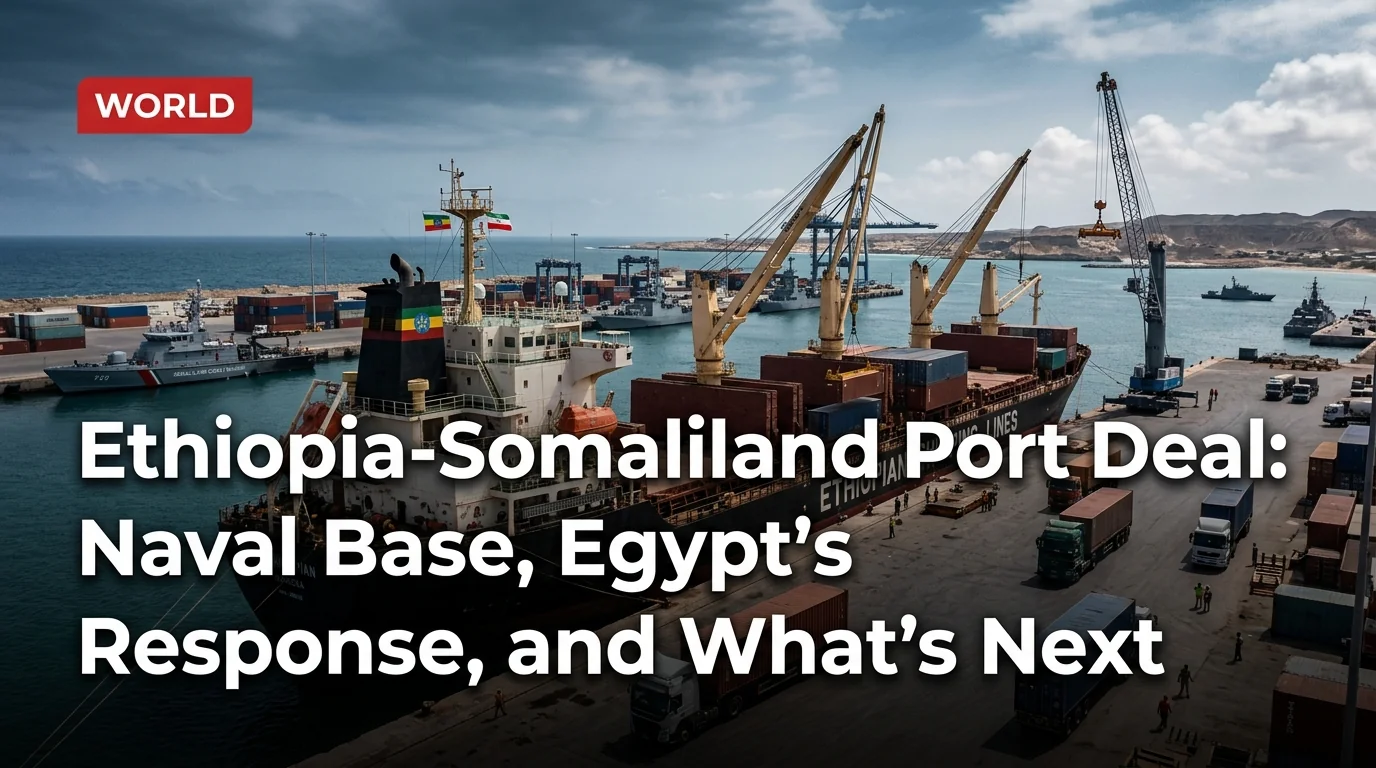
Ethiopia's controversial port deal with Somaliland — signed in January 2024 — was supposed to end the country's decades-long struggle as the world's most populous landlocked nation. Two years later, the Memorandum of Understanding has instead triggered a full-blown regional crisis involving Egyptian troops, Israeli recognition, and a diplomatic standoff that shows no sign of cooling.
Here's where things stand as of March 2026.
The Deal That Started It All
On January 1, 2024, Ethiopian Prime Minister Abiy Ahmed and then-Somaliland President Muse Bihi Abdi signed an MoU granting Ethiopia a 50-year lease on 20 kilometers of Somaliland's coastline. The plan: build a naval base and commercial port facilities near Lughaya and Seylac in Somaliland's Awdal province, close to the Djibouti border.
In return, Somaliland would receive an equity stake in Ethiopian Airlines and — the real prize — formal diplomatic recognition from Addis Ababa.
Why Ethiopia Wants This So Badly
Ethiopia lost its coastline in 1993 when Eritrea gained independence. Since then, the country has been entirely dependent on Djibouti's ports — a vulnerability that costs roughly 10% of its national budget in annual port fees.
Prime Minister Abiy has called sea access an "existential issue" for Ethiopia's 120 million people. The Somaliland deal would let Ethiopia shift up to 30% of its imports away from Djibouti, breaking a monopoly that has constrained its economic growth for three decades.
The Domino Effect: How One Deal Reshaped the Horn
What began as a bilateral agreement rapidly drew in regional and global powers. The timeline tells the story of an escalation that no one anticipated.
The Players: Who Wants What
This crisis has drawn in an unusual coalition of interests. Understanding each player's motivation explains why resolution remains elusive.
- Needs sea access for 120M people
- Wants to break Djibouti port monopoly
- Plans naval presence in Gulf of Aden
- Signed MoU, considers it legally binding
- Claims Somaliland as sovereign territory
- Labels deal a "land grab" and aggression
- Recruited Egyptian military support
- Demands Ethiopian troop withdrawal by late 2026
The Regional Power Brokers
Egypt has emerged as Somalia's most powerful backer, deploying a 10,000-strong military force under the AU's AUSSOM mission. But Cairo's motives extend well beyond African solidarity — the Ethiopia-Egypt rivalry over the Grand Ethiopian Renaissance Dam (GERD) on the Nile makes any Ethiopian strategic gain a threat to Egyptian interests.
Israel's recognition of Somaliland in December 2025 added a completely new dimension. For Somaliland, it was a diplomatic breakthrough. For Egypt and Somalia, it represented an alarming expansion of Israeli influence near the Bab el-Mandeb Strait, one of the world's most critical maritime chokepoints.
Turkey has tried to play mediator through the "Ankara process," but talks collapsed in February 2025 when Ethiopia rejected Somalia's offer to co-manage commercial ports in Mogadishu and Hobyo. Ethiopia insists on a dedicated naval facility — something Somalia will never grant.
The DP World Factor
Often overlooked in the geopolitical drama is the commercial reality on the ground. DP World, the UAE-based port operator, has already invested $442 million in Somaliland's Port of Berbera and plans a total of $1 billion over the next decade through its "Berbera Corridor" project.
- DP World tripled Berbera Port capacity to **500,000 TEUs per year**
- Ethiopia previously held a **19% stake** in Berbera Port (2018) but lost it in 2022
- Somaliland officials project an **80% traffic increase** if the Ethiopia deal goes through
- A separate "Trade and Transit Agreement" is being negotiated alongside the stalled MoU
The commercial angle may ultimately matter more than the military one. Somaliland's new President Abdirahman Irro appears to be prioritizing the trade agreement over the controversial naval base component — a shift that could de-escalate tensions with Egypt while still delivering economic benefits.
What's at Stake: The Numbers
*Figures in millions USD*The financial stakes are enormous. Ethiopia spends $1.5 billion annually on Djibouti port access alone. If even a fraction of that trade shifts to Berbera, it would transform Somaliland's economy while saving Ethiopia hundreds of millions per year.
What Happens Next
Three scenarios are emerging:
1. The Commercial Compromise. The naval base component gets quietly shelved. Ethiopia and Somaliland sign a trade-and-transit agreement through DP World's Berbera Corridor. Egypt stands down. This is the most likely outcome — President Irro's recent diplomatic moves suggest this is the direction Hargeisa is heading.
2. The Election Wildcard. Ethiopia's national elections in June 2026 make the port deal a major campaign issue. If Abiy Ahmed faces political pressure to deliver on his "sea access" promise, he may push harder on the military component — reigniting tensions.
3. The Frozen Conflict. The MoU stays "legally valid" but permanently unimplemented. Egyptian troops remain in Somalia. The status quo hardens into a new normal — costly for everyone, resolved for no one.
The Bigger Picture
The Ethiopia-Somaliland crisis is really three conflicts layered on top of each other: Ethiopia's fight for sea access, Egypt's proxy war against Ethiopian influence, and Somaliland's quest for international recognition. Israel's entry has added a fourth — great-power competition for Red Sea influence.
Analysts at the International Institute for Strategic Studies warn that the crisis has triggered a "re-militarization" of the Horn of Africa, drawing in Middle Eastern proxy rivalries that could destabilize the region for years.
For 120 million Ethiopians, the stakes couldn't be higher. For Somaliland's 4 million people, the deal represents their best chance at global recognition. And for the rest of the world, the outcome will determine who controls access to one of the planet's most important shipping lanes.