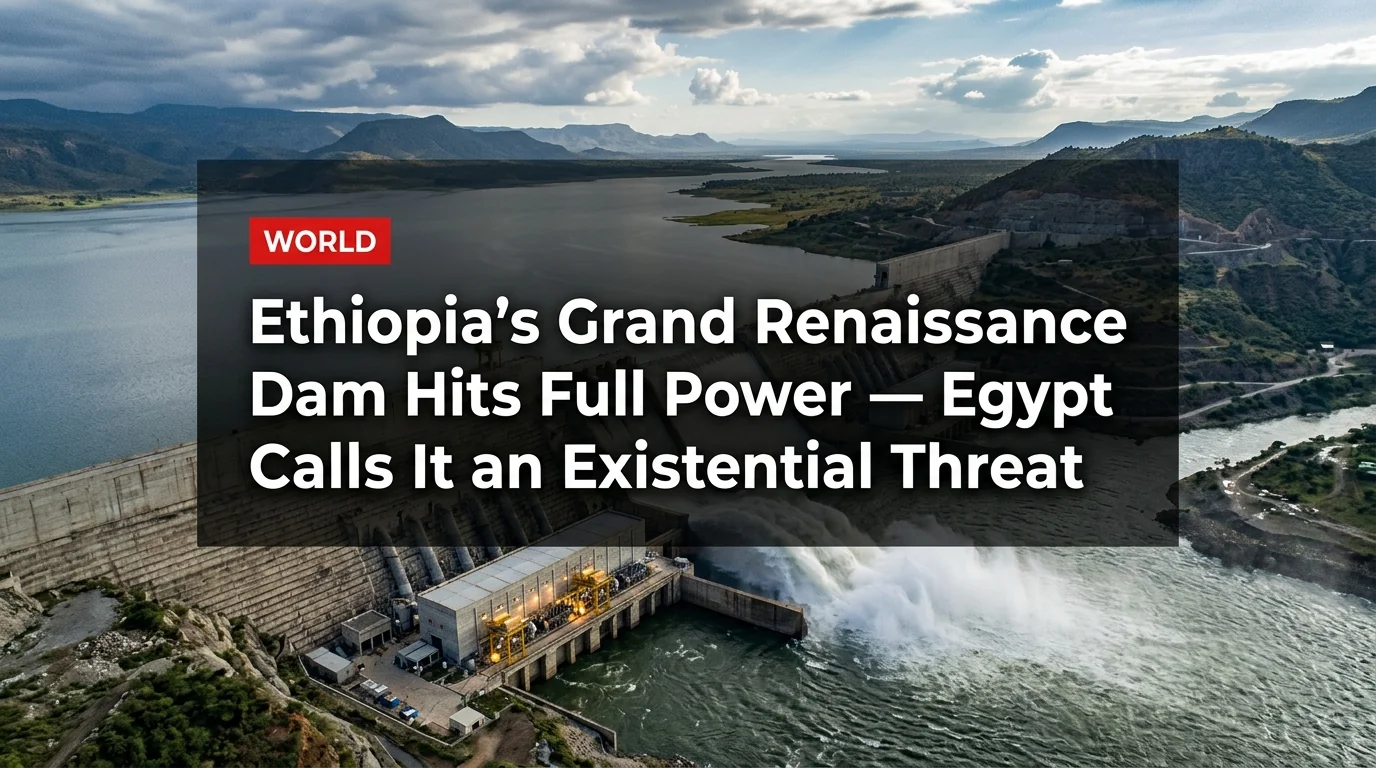
Ethiopia's Grand Ethiopian Renaissance Dam (GERD) has reached full operational capacity in early 2026, generating 5,150 megawatts of electricity and holding 74 billion cubic meters of water behind its walls. The milestone makes it Africa's largest hydroelectric power plant — and the most controversial infrastructure project on the continent.
Egypt and Sudan are not celebrating. Cairo has called emergency security meetings, filed protests at the UN Security Council, and President Abdel Fattah el-Sisi has publicly described the dam as an "existential threat" to Egypt's water security. With no legally binding agreement in place, the Nile crisis is entering its most dangerous phase yet.
The Numbers Behind the Dam
The dam sits near Guba in Ethiopia's Benishangul-Gumuz region, just 15 kilometers from the Sudanese border. Italian firm Webuild led the construction, while GE Alstom installed the turbines. The project was funded almost entirely through domestic bonds and public contributions — a point of intense national pride.
In March 2026, Ethiopian Electric Power (EEP) reported its first-ever profit of 7.1 billion Birr (roughly $56–125 million), driven directly by GERD's output. Ethiopia's national installed capacity now exceeds 10 GW, positioning the country as East Africa's emerging energy superpower.
15 Years in the Making
Why Egypt Says This Is Life or Death
Egypt depends on the Nile for 97% of its freshwater. The country's annual allocation under colonial-era treaties (1929 and 1959) stands at 55.5 billion cubic meters — treaties that Ethiopia was never party to and now openly rejects.
Egypt's fear is straightforward: during multi-year droughts, Ethiopia could reduce downstream flow to dangerous levels while prioritizing its own reservoir. Without a binding drought-management protocol, Cairo has no legal mechanism to compel water releases.
Three Countries, Three Positions
- Dam is "non-consumptive" — water passes through turbines and continues downstream
- Colonial-era treaties are illegitimate; Ethiopia provides 85% of Nile water but got 0% allocation
- Energy exports will benefit the entire region, including Sudan
- PM Abiy Ahmed: "A great achievement not only for Ethiopia, but for all black people"
- Unilateral operation violates international water law
- 55.5 BCM annual allocation supports 100 million people
- No drought protocol means Egypt has zero guarantees during dry years
- Military strategists actively planning for worst-case water scenarios
The Colonial Treaties Egypt Clings To
The root of this crisis predates the dam by a century. The 1929 Anglo-Egyptian Treaty and 1959 Nile Waters Agreement divided the river's flow between Egypt (55.5 BCM) and Sudan (18.5 BCM). Together, they claimed nearly 90% of the Nile's total discharge — and gave Egypt veto power over any upstream construction.
Ethiopia, which contributes over 85% of the Nile's water through the Blue Nile, was excluded entirely. The GERD is Ethiopia's physical rejection of that framework, built in favor of the Cooperative Framework Agreement (CFA), which advocates for "equitable and reasonable" use among all 11 Nile Basin nations.
Percentage figures: Ethiopia contributes ~85% of Nile water but received 0% under colonial treaties. Egypt and Sudan claimed ~100% of allocations.
Energy Exports: Ethiopia's New Revenue Engine
The dam isn't just about domestic power. Ethiopia is rapidly building cross-border transmission lines to monetize its surplus:
| Export Route | Status | Projected Annual Revenue |
|---|---|---|
| Ethiopia → Kenya | Active, scaling up | $100M+ |
| Ethiopia → Djibouti | Transmission line operational | $30M+ |
| Ethiopia → Tanzania | Feasibility stage | TBD |
| Ethiopia → Sudan | Active (when grid stable) | $40M+ |
The Eastern Africa Power Pool (EAPP) is facilitating these deals, and Ethiopia's 2024/25 energy export revenue already hit $118.1 million — a figure expected to triple as GERD runs at full capacity year-round.
What Comes Next — And Why It's Alarming
Ethiopia isn't stopping at one mega-dam. Feasibility studies are underway for three additional projects on the Blue Nile: Mandaya, Karadobi, and Mabil. Combined with the GERD, these could triple the region's hydroelectric output.
Egypt is expected to escalate its "diplomatic offensive" at both the UN and African Union, pushing for a binding water-sharing treaty before those new dams advance. Meanwhile, Egyptian military planners are reportedly modeling scenarios for prolonged upstream water retention.
The Nile has sustained civilizations for 5,000 years without a war over its waters. Whether that record holds may depend on what happens in the next drought cycle — and whether three governments can agree on how to share a river that all of them consider non-negotiable.