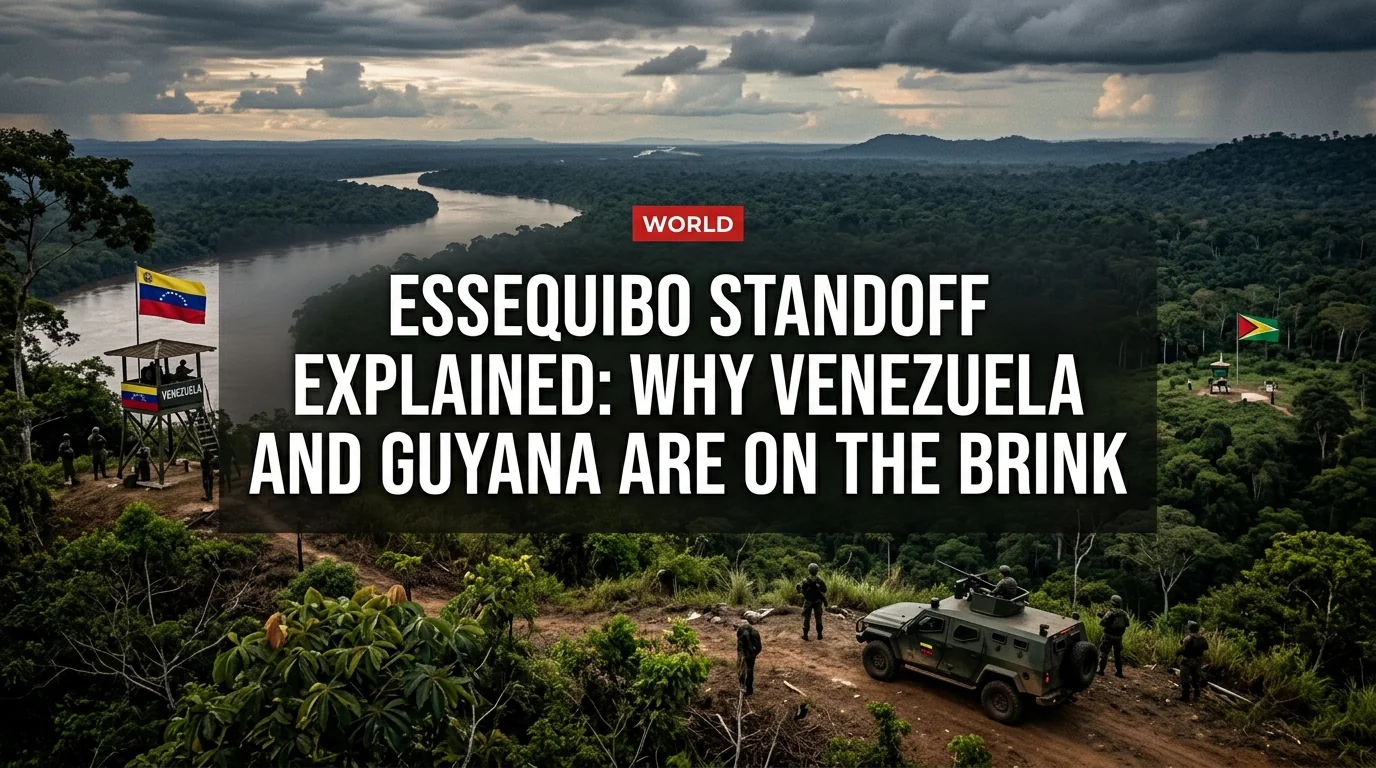
Satellite imagery confirmed this week that Venezuelan military units have repositioned near the Essequibo border — a 159,500 km² region that holds an estimated 11 billion barrels of oil and could determine the future of two nations. Guyana has responded by urging the International Court of Justice to accelerate its ruling, expected later this year.
This is not a new dispute. But the combination of massive oil wealth, a leadership change in Caracas, and growing US military involvement has pushed the Essequibo standoff closer to a tipping point than at any moment since Venezuela's 2023 annexation referendum.
What Is the Essequibo Dispute?
The Essequibo region makes up roughly two-thirds of Guyana's landmass. Venezuela has claimed it since 1962, arguing that an 1899 colonial-era boundary award was fraudulent. Guyana insists the border is settled law.
For decades, the dispute simmered quietly. Then ExxonMobil struck oil.
- **Disputed area:** 159,500 km² — larger than Greece
- **Population:** ~125,000 residents (Guyanese nationals)
- **Oil reserves:** 11 billion barrels recoverable in the Stabroek Block
- **Current production:** ~900,000–1.15 million barrels per day
- **Guyana's defense budget increase:** 800% over five years
The Oil That Changed Everything
When ExxonMobil discovered the Liza-1 field in 2015, it turned a forgotten border argument into a high-stakes geopolitical crisis. The Stabroek Block — operated by an ExxonMobil-Hess-CNOOC consortium — has attracted over $60 billion in investment and transformed Guyana into one of the world's fastest-growing economies.
Guyana's oil revenue hit $2.1 billion in profit oil plus $330.7 million in royalties in 2025. Its Natural Resource Fund now holds $3.25 billion. The 2026 national budget of $7.47 billion is 32% funded by petroleum.
Venezuela sees this wealth being extracted from territory it considers stolen. In early 2026, Guyana granted ExxonMobil a production license for its seventh major development — a move Caracas called "illegitimate."
Military Balance: David vs. Goliath
The force asymmetry is stark. Venezuela fields roughly 115,000 active military personnel. Guyana has approximately 5,000. But the equation is more complex than raw numbers suggest.
- 115,000 active troops
- Naval vessels patrolling disputed waters
- Troops deployed on Anacoco Island since 1966
- Border infrastructure expansion ongoing
- ~5,000 active troops
- Defense budget: $250M (up 800% in 5 years)
- US military support and joint exercises
- UK defense partnership signed 2025
The US factor is decisive. Washington has deployed additional forces to the Guyana-Venezuela border and signed agreements to strengthen joint military operations. Secretary of State Marco Rubio warned in March 2025 that "any attack on Guyana or US-based oil company ExxonMobil would result in serious consequences."
Guyana's Chief of Defense Staff, Brigadier Omar Khan, is leading an aggressive modernization program. But Georgetown's real defense strategy is legal and diplomatic, not military.
Timeline: How We Got Here
The ICJ Question
Guyana's legal strategy centers on the International Court of Justice, where oral hearings are anticipated in the first half of 2026 with a final ruling possible by late 2026 or early 2027.
The legal question is narrow: is the 1899 Arbitral Award valid and binding? Guyana says yes — the border has been respected for over a century. Venezuela argues the award was the product of political pressure and backroom deals, and insists the 1966 Geneva Agreement supersedes it.
President Irfaan Ali has been unequivocal: "While we are a peaceful state, no one should underestimate our resolve. We will not bend to threats nor cower in the face of intimidation."
The Caracas Wildcard
The January 2026 leadership change in Venezuela adds a layer of uncertainty. With Nicolás Maduro reported detained and former Vice President Delcy Rodríguez assuming power, some analysts initially hoped for de-escalation.
That has not materialized. Rodríguez has signaled a willingness for "good faith negotiations" but maintains that the 1966 Geneva Agreement — not the ICJ — is the only legitimate framework. Military deployments have continued. The Essequibo claim remains a pillar of Venezuelan national identity, taught in schools and embedded in the constitution.
What Happens Next
Three developments will shape the standoff in the coming months:
1. The ICJ ruling. A decision affirming the 1899 border would give Guyana powerful legal standing — but enforcement depends on the UN Security Council, where geopolitical interests complicate action.
2. Oil economics. ExxonMobil projects that Guyana may repay all historical development costs for its first seven projects by the end of 2026. That would increase Guyana's profit share from 14.5% to 50% — a financial transformation that makes the status quo increasingly valuable to Georgetown.
3. US posture. Washington's military commitment to Guyana is currently the strongest deterrent against Venezuelan aggression. Any shift in US priorities — toward the Pacific, the Middle East, or domestic politics — could change the calculus.
The Essequibo standoff is ultimately a story about what happens when 19th-century colonial borders collide with 21st-century energy wealth. For Guyana, a nation of 800,000 people sitting on one of the world's largest oil discoveries, the stakes are existential. For Venezuela, abandoning the Essequibo claim would mean rewriting the national narrative.
The ICJ may deliver a ruling. Whether it delivers peace is another question entirely.