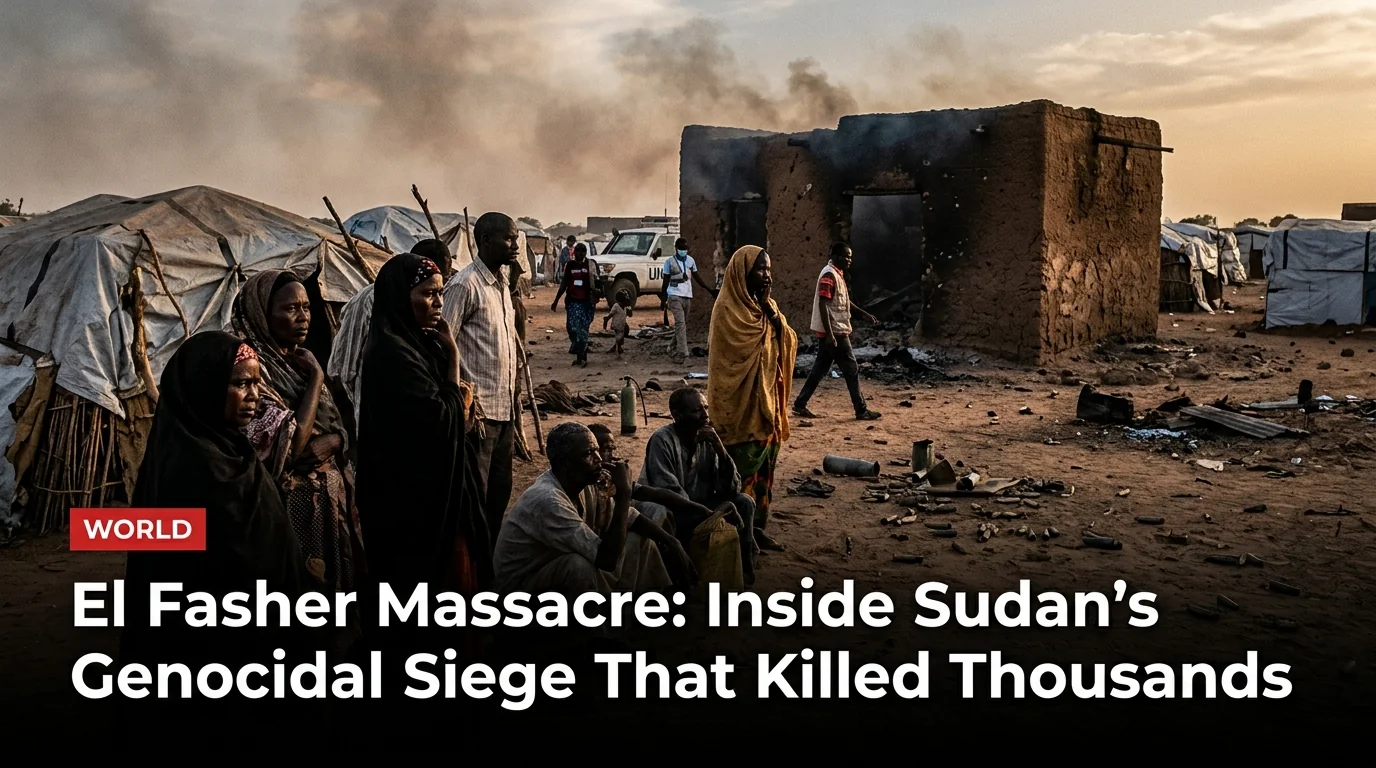
The city of El Fasher — once home to 1.5 million people and the last government stronghold in Darfur — fell to the Rapid Support Forces in October 2025 after an 18-month siege. What followed was one of the worst massacres of the 21st century. A February 2026 UN report concluded the atrocities bear the "hallmarks of genocide."
Five months later, the world is still catching up to the scale of what happened.
- **6,000+ killed** in the first three days of the RSF offensive
- **60,000 estimated dead** in the three weeks after El Fasher fell
- **652,000 people** displaced from the city and surrounding areas
- **150,000 residents** remain unaccounted for
- **18-month siege** cut off all food, water, and medical supplies
- **UN verdict:** "Hallmarks of genocide" targeting Zaghawa and Fur communities
How El Fasher Became Ground Zero
Sudan's civil war erupted on April 15, 2023, when the Sudanese Armed Forces (SAF), led by General Abdel Fattah al-Burhan, clashed with the Rapid Support Forces under Mohamed Hamdan "Hemedti" Dagalo. Fighting that began in Khartoum spread rapidly to Darfur.
By November 2023, the RSF had captured every other major city in Darfur — Nyala, Zalingei, El Geneina. El Fasher was the last one standing. The city swelled to 1.5 million as 800,000 internally displaced people sought refuge behind SAF lines.
Then the RSF tightened the noose.
Three Days of Slaughter
When the SAF withdrew on October 25, an estimated 260,000 people remained trapped in El Fasher. The RSF entered the next morning.
Survivors described fighters going house to house. Bodies filled the streets. At El Fasher University's Al-Rashid dormitory, approximately 500 people sheltering inside were killed by heavy weapons fire. The Saudi Maternity Hospital was turned into a mass killing site.
The violence was not random. The UN Fact-Finding Mission concluded the RSF specifically targeted the Zaghawa and Fur ethnic communities — non-Arab populations with deep roots in Darfur. Women and girls from these communities faced systematic sexual violence, including mass rape and gang rape.
Brigadier General Al-Fateh Abdullah Idris, nicknamed "The Butcher of El Fasher," was documented filming himself executing civilians. His deputy commander, Abdelrahim Hamdan Daglo — Hemedti's own brother — was sanctioned by the United States for ordering "kill everyone" tactics.
The Starvation Weapon
The killing didn't start in October. For 18 months, the RSF weaponized hunger.
Famine was declared at Zamzam IDP camp in August 2024, but conditions across the city were catastrophic. Water systems were destroyed. Health facilities were bombed or rendered dysfunctional. The RSF demanded ransoms of up to $150,000 for kidnapped medical workers.
By February 2026, famine conditions had spread across what remained of El Fasher.
Who Armed the RSF?
The siege raises uncomfortable questions about international complicity.
The contradiction is stark: the UAE pledged half a billion dollars in aid to a crisis it is widely accused of fueling. Egypt, which positioned itself as a mediator for months, shifted to covert military action only after the damage was done.
The Displacement Crisis
More than 652,000 people fled El Fasher after its fall, with the town of Tawila absorbing the largest wave. Another 150,000 residents remain unaccounted for — whether dead, in hiding, or lost in the chaos is unknown.
Acute malnutrition rates have reached catastrophic levels, far exceeding emergency thresholds. Cholera and measles outbreaks are spreading through displacement camps with limited health services.
What Happens Now
The fall of El Fasher has reshaped Sudan's war. Three developments define what comes next.
1. The war moves east. RSF forces are pushing toward North and South Kordofan, targeting strategic towns like Bara and Kadugli. The conflict is no longer contained to Darfur.
2. Sudan is splitting in two. The International Crisis Group warns that El Fasher's fall cements a "durable partition" — a SAF-controlled east centered on Port Sudan and an RSF-controlled west spanning Darfur and Kordofan. No peace process is on the horizon.
3. The genocide question demands an answer. The ICC has the evidence. The UN Fact-Finding Mission has used the word. The question is whether the international community will act — or whether El Fasher joins the list of atrocities acknowledged too late and punished never.
Sudan's war has now lasted nearly two years, displaced over 10 million people, and produced what the UN calls genocide. El Fasher is not the end of the story. It may be the moment the world can no longer pretend it isn't watching.
Sources: UN Human Rights Office (OHCHR), UN Fact-Finding Mission for Sudan, International Crisis Group, Yale Humanitarian Research Lab, Human Rights Watch, Amnesty International, ReliefWeb, UNICEF.