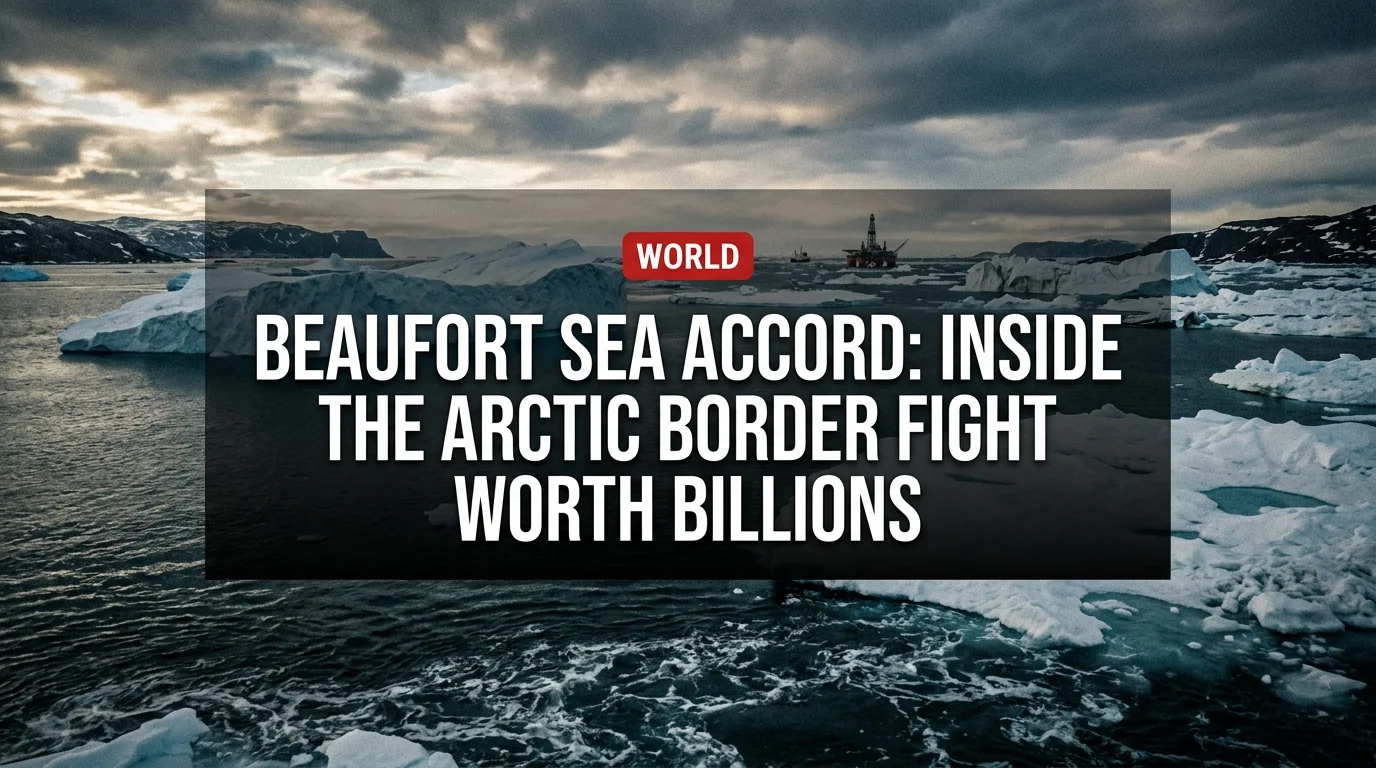
Canada and the United States are locked in negotiations over one of the last unresolved border disputes between the two allies — a wedge-shaped stretch of Arctic ocean the size of New Jersey, sitting on top of billions of barrels of oil.
The Beaufort Sea boundary dispute has simmered for nearly 50 years. But melting ice, Russian military expansion, and a scramble for Arctic resources have turned a frozen footnote into a geopolitical flashpoint. A joint task force created in September 2024 is now working toward what could become the most significant North American territorial agreement in decades.
The Dispute in 90 Seconds
The argument comes down to a single question: where does the ocean border go?
- Border follows the **141st meridian** straight north
- Based on 1825 Treaty of Saint Petersburg
- Consistent with the Alaska-Yukon land border
- Supported by historical precedent
- Border follows an **equidistance line** from the coastline
- Based on modern international maritime law
- Would shift the boundary east, into Canadian-claimed waters
- Supported by UN Convention on the Law of the Sea principles
The result is a triangular "wedge" of disputed ocean — 21,197 km² of seabed that both nations claim as their own.
What's Under the Ice
This isn't just about lines on a map. The Beaufort Sea floor holds enormous resource wealth that's becoming increasingly accessible as Arctic ice retreats.
For context, 2.9 billion barrels of oil at current prices represents roughly $200 billion in potential extraction value. And that's before accounting for the natural gas.
Why Now? Three Converging Forces
The dispute existed for decades as a diplomatic curiosity. Three developments have made resolution urgent.
1. The Ice Is Disappearing
Arctic sea ice has declined by roughly 13% per decade since satellite monitoring began in 1979. Routes that were permanently frozen are now navigable for months each year. The Northwest Passage — which cuts through Canadian Arctic waters — is becoming a viable commercial shipping lane, and the Beaufort Sea sits at its western gateway.
2. Russia and China Are Moving In
Russia has rebuilt Soviet-era Arctic military bases and deployed new submarine patrols along the Northern Sea Route. China, despite having no Arctic coastline, declared itself a "near-Arctic state" and has invested billions in Arctic infrastructure. Both nations are testing the limits of existing territorial claims.
3. The Continental Shelf Race
In December 2023, the United States officially filed its Extended Continental Shelf claim — a massive assertion of sovereign rights over underwater territory that overlaps directly with Canada's own Arctic claim. Both countries now need to sort out where one nation's seabed ends and the other's begins.
The Negotiation Timeline
The Indigenous Factor
What makes these negotiations different from typical border disputes is the central role of Indigenous peoples. The Inuvialuit of Canada and the Inupiat of Alaska have lived in and around the Beaufort Sea for thousands of years. Both communities are demanding — and receiving — seats at the negotiating table.
The 1984 Inuvialuit Final Agreement guarantees certain rights within the Inuvialuit Settlement Region, and any boundary resolution must respect those commitments. Negotiators are developing an unprecedented "Inuit-to-Inuit" co-management framework that would give Indigenous communities shared oversight of subsistence whaling, fishing, and environmental protection regardless of where the final border falls.
The Key Players
| Role | Person | Representing |
|---|---|---|
| Canadian Foreign Minister | Mélanie Joly | Global Affairs Canada |
| U.S. Secretary of State | Antony J. Blinken | U.S. State Department |
| Inuvialuit Chair | Duane Ningaqsiq Smith | Inuvialuit Regional Corporation |
| Canadian Defence Minister | Bill Blair | Arctic security framework |
| Lead Academic Advisors | P.W. Lackenbauer & S. Lalonde | NAADSN |
The Legal Paradox
Here's the wrinkle that concerns international law experts: the United States has never ratified the UN Convention on the Law of the Sea (UNCLOS), yet it's negotiating based on UNCLOS principles — specifically the equidistance method that favors its position.
- Resolves a 50-year diplomatic irritant between close allies
- Creates a united front against Russian and Chinese Arctic ambitions
- Establishes precedent for Indigenous co-management in territorial disputes
- Unlocks resource management clarity for both nations
- U.S. benefits from UNCLOS without ratifying it — "obligations-free" advantage
- Resource extraction could accelerate environmental damage in fragile Arctic
- Final boundary could displace traditional Indigenous hunting and fishing patterns
- Sets a precedent that may embolden other disputed claims globally
What a Deal Looks Like
Experts expect the final agreement — likely in late 2026 or 2027 — to include several components:
A compromise boundary that splits the difference between the meridian and equidistance lines, with a joint management zone in the most sensitive areas.
An environmental overlay modeled on the Beaufort Region Strategic Environmental Assessment, which would restrict extraction in ecologically critical zones regardless of sovereignty.
An Indigenous governance framework that transcends the national border, allowing Inuvialuit and Inupiat communities to co-manage marine resources across the boundary.
- The dispute covers an area roughly the size of New Jersey
- Resolution would be the first new Canada-U.S. border agreement since 1984
- A 16-year international ban on Central Arctic commercial fishing began in 2021
- The Hans Island resolution in 2022 between Canada and Denmark serves as the diplomatic model
- A final treaty is expected by late 2026 or 2027
The Bigger Picture
The Beaufort Sea negotiations aren't happening in isolation. They're part of a broader Arctic recalibration as climate change redraws the map of the far north. Canada under Prime Minister Carney has signaled aggressive Arctic development plans. The U.S. is rebuilding its icebreaker fleet. And both nations recognize that an unresolved border dispute between allies is a gift to adversaries looking for cracks in Western solidarity.
The frozen conflict is finally thawing — and the outcome will shape Arctic geopolitics for the rest of the century.