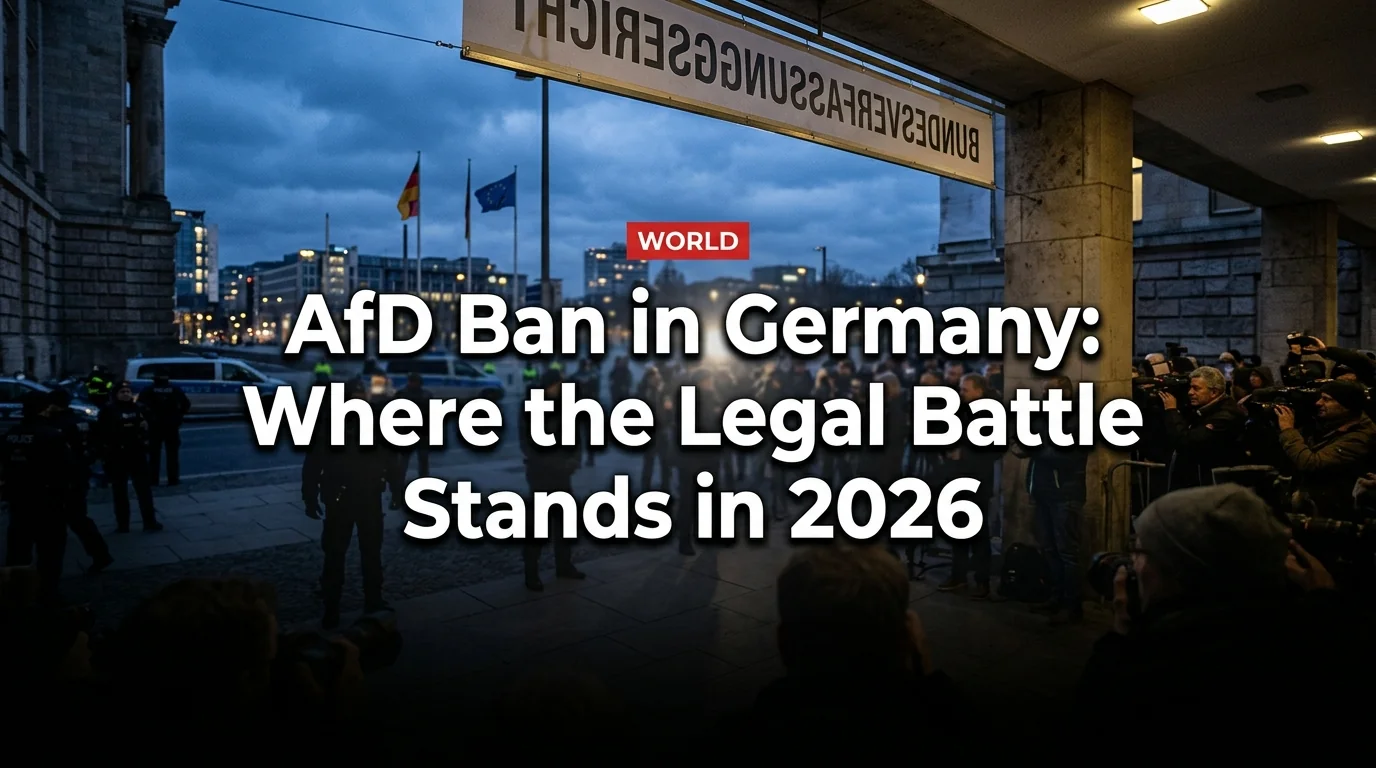
Germany is wrestling with one of the most consequential political questions in its postwar history: can — and should — Europe's largest democracy ban its second-most popular party?
The Alternative for Germany (AfD), now polling at 26–27% nationally, faces a legal gauntlet that could end either in dissolution or in a political windfall that supercharges its support. A Cologne court ruling in February 2026 has thrown the process into uncertainty, and the stakes for Germany — and for Europe — could not be higher.
The February Ruling That Changed Everything
On February 26, 2026, the Cologne Administrative Court issued a bombshell injunction: the Federal Office for the Protection of the Constitution (BfV) can no longer label the AfD a "confirmed right-wing extremist" organization.
The court acknowledged "indications" of anti-constitutional efforts within the party — including demands to ban Muslim minarets, public calls to prayer, and headscarves in public institutions. But it concluded these tendencies do not yet "shape the party as a whole."
Key Players in the Legal Battle
| Person | Role | Position on AfD Ban |
|---|---|---|
| Alice Weidel | AfD Co-Leader | Called ruling a "victory for democracy" and a "slap in the face for ban fanatics" |
| Friedrich Merz | Chancellor (CDU) | Skeptical of ban — prefers to "govern the AfD away" at the ballot box |
| Alexander Dobrindt | Interior Minister (CSU) | Warns of "high legal hurdles" — favors continued monitoring over ban |
| Marco Wanderwitz | CDU MP, Ban Proponent | Led 113+ lawmakers in submitting formal ban motion to the Bundestag |
| Sinan Selen | BfV Director | First agency head with migration background; overseeing ongoing AfD surveillance |
The AfD by the Numbers
How Germany Got Here: A Timeline
Why Banning a Party Is So Hard in Germany
Germany's postwar constitution created a concept called "militant democracy" (wehrhafte Demokratie) — the democratic order can defend itself by banning parties that seek to destroy it. Article 21 of the Basic Law grants this power exclusively to the Federal Constitutional Court.
But the bar is deliberately sky-high. In its entire history, Germany has banned exactly two parties:
The 2017 NPD case is the most instructive precedent. The court ruled the neo-Nazi party was indeed unconstitutional — but too insignificant to actually threaten democracy. The AfD presents the opposite paradox: it is clearly significant enough to threaten democratic norms, but its sheer size (27% support, 70,000 members) makes banning it politically explosive.
The Political Divide
What Happens Next
Three parallel tracks are now in motion:
Track 1: The Cologne Main Case. The administrative court will now hear the substance of whether the BfV's extremist classification was legally justified. Timeline: several months to one year.
Track 2: The Bundestag Vote. The motion from 113+ lawmakers to formally request ban proceedings at the Federal Constitutional Court has not yet been voted on. If passed, the constitutional court would begin its own multi-year investigation.
Track 3: State Elections. Five regional elections are scheduled for 2026, including Baden-Württemberg and Rhineland-Palatinate. The AfD is already framing the Cologne ruling as vindication, campaigning against what it calls "state overreach."
The European Dimension
Germany is not alone in this struggle. Across Europe, established democracies are grappling with how to handle populist parties that use democratic systems to undermine democratic norms. France's Rassemblement National, Italy's Fratelli d'Italia, and Austria's FPÖ all present variations of the same challenge.
But Germany's case is unique because of its history. The country that gave the world the most catastrophic example of democracy's collapse now faces the question its founders designed the constitution to answer: at what point does tolerance of the intolerant become self-destructive?
The Cologne ruling has delayed the answer. It has not eliminated the question.
This is a developing story. We will update as proceedings advance.