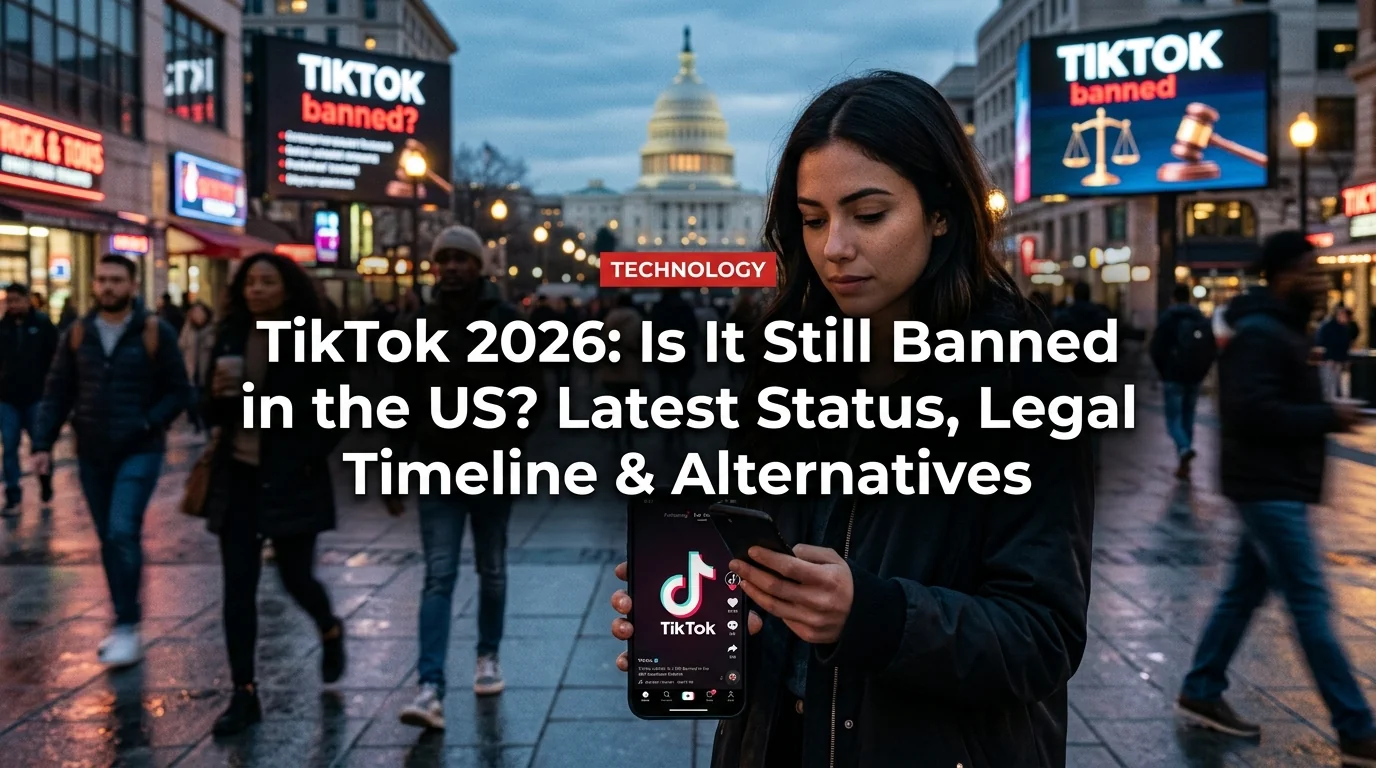
TikTok's fate in the United States has been one of the most-followed tech stories of the past two years — and in April 2026, the situation is still far from fully resolved. Here's everything you need to know about where TikTok stands right now, what the law actually says, and what Americans can do if the app disappears for good.
What the Law Actually Says
In April 2024, President Biden signed the Protecting Americans from Foreign Adversary Controlled Applications Act — a law that gave ByteDance, TikTok's Chinese parent company, 270 days to sell TikTok's US operations or face a ban. That deadline landed on January 19, 2025, one day before the presidential inauguration.
The US Supreme Court unanimously upheld the law in January 2025, ruling that the national security rationale was constitutionally sound and that the First Amendment challenge failed. For roughly 12 hours, TikTok went dark for US users.
Then Donald Trump took office.
Trump's Executive Orders: The Delays
Before taking the oath of office, Trump had publicly stated he wanted to "save TikTok." On his first day back in office, he signed an executive order delaying enforcement by 75 days, citing ongoing negotiations for a deal. Since then, the administration has issued further administrative extensions, effectively keeping TikTok live in the US while deal talks dragged on.
The Oracle Deal: Where Things Stand
The most credible path to TikTok's survival in the US has been a deal in which Oracle Corporation would take control of TikTok's US operations and data infrastructure. Under the proposed framework:
- Oracle would hold a majority stake in a new US-entity called TikTok US
- All US user data would be stored and managed on Oracle Cloud servers
- ByteDance would retain a minority stake with no board control
- The algorithm would be licensed, not transferred — a sticking point that has slowed negotiations
As of April 2026, that deal has not been formally closed. ByteDance has reportedly resisted a full algorithmic separation, and Chinese regulators must also approve any divestiture under China's export control rules — adding a geopolitical wrinkle that has stalled talks repeatedly.
Can You Still Use TikTok in the US Right Now?
Yes — as of April 2026, TikTok is fully functional in the United States. You can:
- Download it from the App Store and Google Play
- Create, post, and engage with content normally
- Use TikTok Shop and live streaming features
- Access the For You Page with full algorithm functionality
The app was never actually deleted from devices, and the brief January 2025 outage was reversed within hours. The current non-enforcement posture from the Justice Department means there is no active legal pressure forcing Apple or Google to remove it from their stores.
However, the underlying law is still on the books. If a deal collapses, a future administration changes course, or a court orders enforcement, the situation could change quickly.
National Security: Why This Keeps Coming Up
The concern at the center of the law is that ByteDance, under Chinese law, could be compelled to hand over data on American users or manipulate content to serve Chinese government interests. Critics of TikTok point to:
- China's National Intelligence Law (2017), which requires Chinese companies to cooperate with state intelligence activities
- Reports of ByteDance employees in China accessing US user data (confirmed in 2022)
- Concerns about content suppression — whether TikTok's algorithm downranks content unfavorable to China
TikTok has consistently denied any data sharing with Beijing and says its algorithm operates independently. But lawmakers on both sides of the aisle have remained skeptical — the 2024 law passed the Senate 79-18.
- TikTok remains accessible and fully functional in April 2026
- Executive extensions have prevented disruption to creators and businesses
- Oracle deal framework provides a potential path to permanent resolution
- 170M US users represent massive political pressure against a real ban
- Legal uncertainty hasn't gone away — the ban law is still enforceable
- ByteDance has not agreed to full algorithmic separation, the key sticking point
- Chinese government approval adds geopolitical complexity outside US control
- Creator businesses built on TikTok remain at risk with no guaranteed resolution
Best TikTok Alternatives (If It Does Go Dark)
Whether the ban eventually materializes or you just want a backup plan, here are the strongest alternatives ranked by active US user base and content quality:
1. Instagram Reels — Built into an app 140M+ Americans already use. The algorithm has improved significantly and creator monetization is now on par with TikTok's. Best for: creators with existing Instagram followings.
2. YouTube Shorts — Google's short-form answer has surpassed 70 billion daily views globally. Monetization through YouTube's Partner Program is the most mature in the space. Best for: creators who want long-term revenue.
3. Snapchat Spotlight — Snap's algorithmically driven feed is less competitive than Reels or Shorts for discovery, but the 25-and-under demographic is strongly concentrated here. Best for: Gen Z audiences.
4. Clapper — A US-based, chronological feed app specifically marketed as a TikTok alternative. Smaller audience but growing. Best for: users wary of algorithmic manipulation.
5. RedNote (小红书 / Xiaohongshu) — During TikTok's January 2025 blackout, millions of Americans migrated to this Chinese app in a moment of irony that became a news story of its own. Usage has faded somewhat but a niche US community remains.
What Happens Next
The most likely scenarios in 2026:
- Deal closes: Oracle and ByteDance finalize terms, Chinese regulators approve, and TikTok US becomes a semi-independent American entity. Probability: moderate, still possible in 2026 if negotiations accelerate.
- More extensions: The current non-enforcement pattern continues through the end of 2026, kicking the resolution into 2027. Probability: high, given the political difficulty of enforcing a ban.
- Deal collapses, enforcement resumes: Negotiations break down, a new administration or DOJ posture changes, and app stores are forced to remove TikTok. Probability: lower near-term, but real if geopolitical tensions escalate.
For now, TikTok users can keep scrolling — but building a presence on at least one alternative platform remains smart contingency planning.