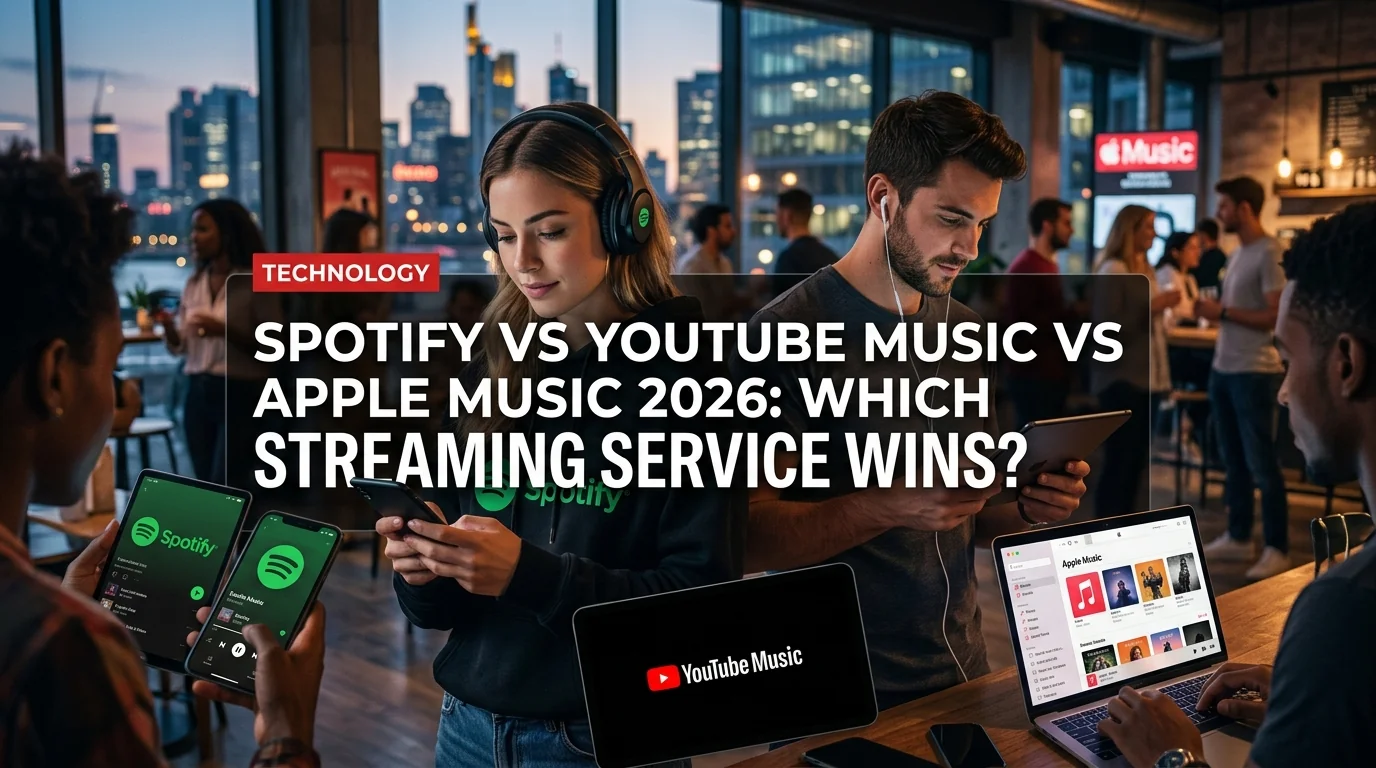
Music streaming has never been more competitive — and the three giants fighting for your ears in 2026 are better than ever. Spotify just rolled out its AI DJ 2.0 and audiobook integration, YouTube Music now offers seamless video-to-audio switching for 100 million tracks, and Apple Music continues to lead on spatial audio and lossless quality. But which one actually deserves your subscription money?
We've tested all three head-to-head across the categories that matter: price, catalog size, audio quality, discovery, and platform integration.
Pricing: They're All $10.99 Now
For years, Spotify undercut Apple Music and YouTube Music. That era is over. All three services now charge $10.99/month for individual plans and $16.99/month for family plans (up to 6 members). Student discounts bring it to $5.99/month across the board.
The key pricing differentiator in 2026: what you get free.
- Spotify Free: Ad-supported, shuffle-only on mobile, skip limits. Still the most generous free tier.
- YouTube Music Free: Ad-supported, background play blocked on mobile, but you can still search and play on demand (unlike Spotify Free).
- Apple Music Free: No free tier. 3-month trial only, then it's pay or leave.
If you're not ready to pay, YouTube Music wins — you get on-demand streaming free (with ads), which Spotify won't let you do.
Catalog: 100 Million Songs — But It's Not Equal
All three claim roughly 100 million songs. In practice, the differences are real:
Spotify has the deepest podcast catalog (5+ million shows) and now includes audiobooks with Premium. Its music library has a few notable gaps — Taylor Swift was famously absent for years, and regional/independent labels sometimes lag months behind.
YouTube Music has a unique advantage: user-uploaded content. Concert recordings, B-sides, unofficial remixes, and live performances that aren't on Spotify or Apple Music are often on YouTube Music because they were uploaded to YouTube. If you're a fan of niche artists or live recordings, this is significant.
Apple Music has exclusive content deals — first-listen albums, Beats 1 radio archives, and Apple Original artist documentaries. It also has the deepest integration with iTunes purchases, so if you've bought music over the years, it all appears in your library alongside streaming.
- YouTube Music uniquely includes user-uploaded concert recordings and live sessions
- Apple Music has the most exclusive first-listen album deals
- Spotify owns the podcast market with 5M+ shows
- All three now support offline downloads for paid subscribers
Audio Quality: Apple Music Wins by a Country Mile
This is where the gap is most dramatic.
Apple Music offers Lossless Audio (ALAC) at up to 24-bit/192kHz at no extra charge. It also has Dolby Atmos Spatial Audio on thousands of albums, which creates a genuine 3D listening experience on compatible hardware. If you have AirPods Pro or a good pair of headphones, the difference is audible.
YouTube Music streams at up to 256kbps AAC on Premium — decent, but nowhere near lossless. There's no spatial audio tier.
Spotify still caps at 320kbps Ogg Vorbis. Spotify HiFi (the long-promised lossless tier) has been teased since 2021 and still hasn't launched in most markets as of 2026. Audiophiles have been waiting five years.
If audio quality matters to you — and it should if you use good headphones — Apple Music is the clear winner.
Discovery & Recommendations: Spotify Still Leads
This is Spotify's crown jewel. After 15+ years of data on half a billion users, its recommendation engine is unmatched.
Discover Weekly drops every Monday with 30 songs calibrated to your taste — still the gold standard after nearly a decade. AI DJ (now version 2.0) narrates transitions between songs and genres like a personalized radio host. Daily Mixes, Release Radar, and genre-specific playlists are all excellent.
Apple Music has improved significantly with Personalized Stations and Music Sense features, but its algorithm still feels more curated-by-humans and less data-driven than Spotify. The result is sometimes better curation, sometimes a miss.
YouTube Music leans on Google's AI and your YouTube viewing history. This is powerful if you watch a lot of music content on YouTube — it cross-references what you've watched, liked, and searched. But if your YouTube habits are varied (gaming, news, tutorials), recommendations can get muddied.
Platform Integration: Depends Entirely on Your Ecosystem
This is the most important factor most people don't think about upfront.
Apple Music is the only choice that integrates natively with Siri, HomePod, Apple Watch, CarPlay, and AirPods — all without friction. If you're deep in Apple's ecosystem, every device just works together. Apple Music also syncs your purchased iTunes library automatically.
Spotify works everywhere. Android, iOS, Windows, Mac, Linux, smart TVs, game consoles, Sonos, Alexa — if a device plays music, Spotify is probably on it. It also has the best third-party app ecosystem (Spotify Connect is genuinely excellent for multi-room audio).
YouTube Music integrates with Google Assistant, Android Auto, Nest speakers, and Chromecast. Android users on Google hardware (Pixel phones, Nest Hub) get the smoothest experience. It also syncs with YouTube Premium — if you pay for YouTube Premium, YouTube Music is included at no extra cost.
Which One Should You Pick?
Pick Spotify if:
- You want the best discovery and playlist features
- You listen to podcasts and audiobooks alongside music
- You use multiple devices across different ecosystems
- You want a generous free tier before committing
Pick Apple Music if:
- You own Apple devices (iPhone, AirPods, HomePod, Mac)
- Audio quality matters — lossless and Spatial Audio are genuinely better
- You have years of iTunes purchases you want integrated
- You want exclusive first-listen album access
Pick YouTube Music if:
- You already pay for YouTube Premium (it's included)
- You need niche live recordings and user-uploaded content
- You're an Android/Google ecosystem user
- You want the most flexible free tier
- Best discovery algorithm in the industry
- 5M+ podcasts included
- Works on every device imaginable
- Best free tier for music
- Lossless + Spatial Audio at no extra cost
- Perfect Apple ecosystem integration
- First-listen exclusives
- iTunes library sync
The Verdict
In 2026, there's no wrong answer — but there is a right answer for you.
Spotify remains the best all-around pick for most people, especially those who value discovery, cross-platform compatibility, and the podcast/audiobook bundle. Its recommendation algorithm is years ahead of the competition.
Apple Music is the audiophile's choice and the obvious pick if you're in the Apple ecosystem. The Lossless + Spatial Audio combination at $10.99/month is genuinely remarkable value for sound quality.
YouTube Music wins on value for YouTube Premium subscribers and niche content depth. For everyone else, it's a solid third.
If you're switching from one to another: all three offer free trials, and Spotify lets you stay on a free tier indefinitely to test before you pay. Start there.