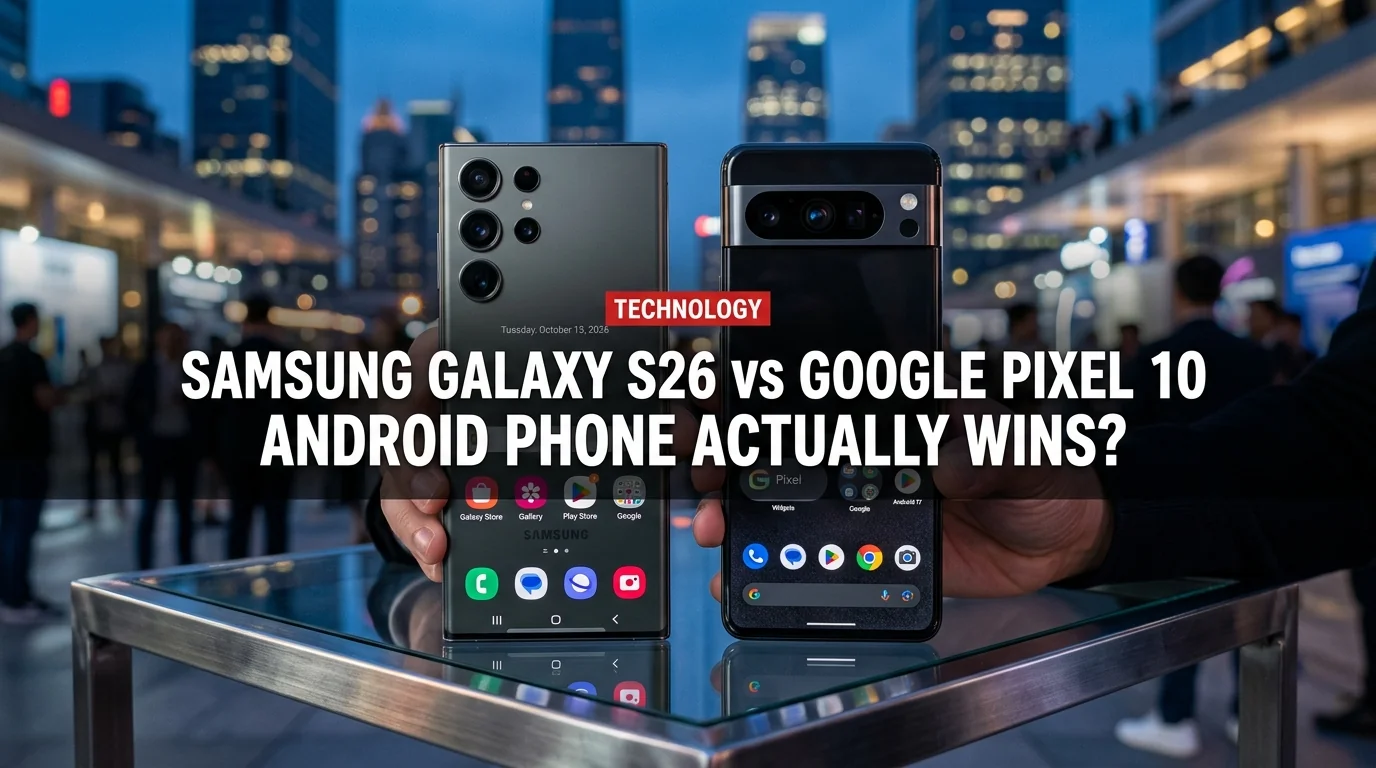
Two Android flagships. One choice. The Samsung Galaxy S26 launched March 11, 2026 at $899, packed with Snapdragon 8 Elite Gen 5 muscle and Galaxy AI upgrades. The Google Pixel 10 arrived with the all-new Tensor G5 — Google's first fully in-house chip, built on TSMC's 3nm process — promising a 60% faster AI engine and the purest Android experience on the market.
If you're buying a flagship Android phone in 2026, these are your two best options under $1,000. Here's how they actually compare.
- Snapdragon 8 Elite Gen 5 (3nm)
- 50MP main + 12MP ultrawide + 10MP 3x telephoto
- 6.3-inch Dynamic LTPO AMOLED 2X, 120Hz
- 12GB RAM / 256GB storage — $899
- One UI 7 with Galaxy AI
- Tensor G5 (3nm, TSMC-made)
- 48MP main + 13MP ultrawide + 10.8MP 5x telephoto
- 6.3-inch Actua FHD+ OLED, 120Hz
- 12GB RAM / 128GB storage — $799
- Android 16 with Gemini AI
Design & Display
Both phones land at exactly 6.3 inches — a clean coincidence that makes side-by-side comparisons genuinely meaningful. The Galaxy S26 brings its signature Dynamic LTPO AMOLED 2X panel with a QHD+ equivalent sharpness and a blinding 2,600 nits peak brightness, protected by Corning Gorilla Glass Victus 3. Samsung's display is broadly considered the best in class on any Android — rich, contrasty, and stunning in direct sunlight.
The Pixel 10's Actua FHD+ display is no slouch — 2,000 nits peak brightness, adaptive 60–120Hz, and Gorilla Glass Victus 2 — but it runs at a lower FHD+ resolution rather than QHD+. For most people scrolling social feeds or watching Netflix, the difference is invisible. For detail-obsessed users or those using their phone as a photo gallery, the Galaxy S26's panel wins.
Both are IP68 rated. Both have in-display ultrasonic fingerprint scanners. In terms of build, the S26 feels more premium in the hand, while the Pixel 10 has a cleaner, less angular design that some users strongly prefer.
Edge: Samsung Galaxy S26 (display resolution and brightness)
Performance: Snapdragon vs Tensor G5
This is where the two phones take fundamentally different paths.
The Snapdragon 8 Elite Gen 5 in the Galaxy S26 is a co-developed Qualcomm chip optimized for Samsung's One UI 7. It delivers raw benchmark dominance — approximately 19% faster CPU, 24% faster GPU, and 39% faster NPU than last year's chip. For gaming, video editing, and multitasking, the Galaxy S26 is a powerhouse. It runs hot under sustained load (a known Snapdragon 8 trait), but real-world throttling is minimal.
The Tensor G5 in the Pixel 10 tells a different story. Google's first fully self-designed chip, manufactured by TSMC instead of Samsung, promises a 60% improvement in TPU (AI processing) performance and a 34% faster CPU versus Tensor G4. Crucially, TSMC's 3nm process runs cooler and more efficiently than Samsung's equivalent — a major change for Pixel users who previously criticized Tensor chips for thermal throttling.
The Tensor G5 is not trying to win synthetic benchmarks. It's built to make on-device AI feel instant: real-time transcription, photo editing with Magic Eraser, live translation, Call Screen, and Gemini Live responses. For these tasks, Tensor G5 is purpose-built and genuinely excellent.
In day-to-day use, both phones are fast enough that most people won't notice the difference. But the Galaxy S26 wins on raw horsepower, while the Pixel 10 wins on AI-accelerated tasks.
Edge: Samsung Galaxy S26 (raw performance) / Pixel 10 (AI processing)
Camera: The Real Battleground
Cameras are the primary reason most people choose between these two phones — and both have strong but different philosophies.
The Samsung Galaxy S26 camera is technically excellent. The 50MP main sensor with its wide dynamic range, 12MP ultrawide, and 3x telephoto covers most situations beautifully. Samsung's Processing produces vivid, punchy photos that look great on social media. Low-light performance using Nightography is strong. The 8K video recording at 30fps leads the industry.
The Google Pixel 10 camera is the computational photography champion. Google's computational magic — Real Tone accuracy, Best Take, Magic Eraser, Photo Unblur, and now Camera Coach (AI tips in real-time while you shoot) — consistently produces photos that look natural and true-to-life rather than processed. The 5x optical telephoto on the standard Pixel 10 is a genuine advantage over the S26's 3x lens, especially for portraits and distant subjects.
Camera reviews consistently put Pixel cameras at or near the top for natural photo reproduction. Samsung cameras produce more "social-ready" images with higher contrast and saturation. Your preference depends on what you value: Samsung's bold look or Pixel's true-to-life accuracy.
Edge: Google Pixel 10 (5x zoom, computational photography)
AI Features: Galaxy AI vs Gemini
- Galaxy AI: Circle to Search, Live Translate, AI Note Assist, Chat Assist, Generative Edit, Sketch to Image
- Gemini AI: Gemini Live, on-device processing, real-time translation, Call Screen, Recorder transcription
- Both: on-device processing for core tasks, cloud for complex requests
- Pixel 10: Gemini is deeply embedded, functions without internet for most tasks
- Galaxy S26: Galaxy AI requires Samsung account and occasional cloud connectivity
Both phones pack in serious AI. Samsung's Galaxy AI suite is deep — Circle to Search (tap anything on screen to search Google), AI-powered note summarization, real-time chat translation, Generative Edit for photos, and the new AI Live Translate for calls. It's broad and covers nearly every use case.
Google's Gemini AI on the Pixel 10 is more focused but more deeply integrated. Because the Tensor G5's TPU was designed specifically for on-device AI, tasks like transcription, translation, and photo editing run locally — faster, more private, and offline-capable. Gemini Live lets you have extended voice conversations with your AI assistant in ways that feel natural rather than transactional.
For business users who need translation, note-taking, and productivity: the Galaxy S26's Galaxy AI suite is hard to beat. For users who want deeply personalized, privacy-first AI that learns from your usage: the Pixel 10 with Gemini is the pick.
Edge: Tie (different strengths, no clear winner)
Battery Life
The Pixel 10 carries a 4,970 mAh battery — among the largest in a compact flagship — paired with TSMC's efficient 3nm process. Real-world users are reporting excellent all-day battery life with the Tensor G5 running cooler and more efficiently than previous Tensor chips. Charging tops out at 30W wired and 15W Qi2 wireless.
The Galaxy S26 battery capacity hasn't been publicly confirmed at the same granularity, but the LTPO display (which drops to low refresh rates when idle) contributes to competitive battery life. Samsung supports 25W wired charging and 15W wireless on the standard S26.
For pure battery longevity: the Pixel 10's larger cell and more efficient chip give it the theoretical edge. Samsung's LTPO display efficiency partially compensates.
Edge: Google Pixel 10 (larger battery, more efficient chip)
Software & Updates
This is Pixel's strongest competitive advantage.
The Google Pixel 10 ships with Android 16 and receives 7 years of guaranteed OS, security, and Pixel Drop updates — taking it to 2032. No Android phone matches this update longevity. For buyers who keep their phones 3–5 years, this is a compelling reason to choose Pixel.
The Galaxy S26 also offers 7 years of OS updates — Samsung matched Google's commitment in 2024 and has maintained it. One UI 7 is mature, feature-rich, and improved significantly over One UI 6. However, Samsung's update timeline lags Google's by weeks or months; Pixel devices receive new Android features on day one.
Edge: Google Pixel 10 (faster updates, pure Android experience)
Price
The Google Pixel 10 starts at $799 for 12GB RAM and 128GB storage — $100 cheaper than the Galaxy S26's $899 entry price (which gets you 256GB storage, it should be noted — Samsung includes more base storage).
For equivalent storage configurations, the gap is modest. But Pixel's lower entry price and longer, faster software support deliver outstanding long-term value per dollar.
- Best-in-class display with 2,600 nits peak brightness
- Snapdragon 8 Elite Gen 5 raw performance lead
- Comprehensive Galaxy AI feature suite
- More base storage (256GB) at entry price
- Excellent 8K video capabilities
- $100 more expensive than Pixel 10
- Only 3x optical zoom on standard model
- Updates arrive later than stock Android
- One UI adds complexity some users don't want
- $799 starting price — better value
- 5x optical telephoto on the standard model
- Best computational photography on Android
- Tensor G5 runs cooler, more efficient
- 7-year updates with day-one Android releases
- Deeper Gemini AI on-device integration
- FHD+ display (lower resolution than S26)
- Base storage is only 128GB
- Tensor G5 trails Snapdragon in raw benchmarks
- Camera Coach is novel but unproven long-term
Verdict: Which Should You Buy?
Buy the Samsung Galaxy S26 if: You want the brightest, sharpest display in class; you care about raw gaming and app performance; you're already in the Samsung ecosystem with a Galaxy Watch or Galaxy Tab; or you prefer Samsung's bold, vivid camera output and the comprehensive Galaxy AI suite.
Buy the Google Pixel 10 if: Camera quality and 5x zoom matter more than raw speed; you want the cleanest, fastest Android 16 experience; you care about on-device AI privacy; the $100 savings matters; or you plan to keep your phone for 4–5 years and want day-one Android updates throughout.
Both phones are excellent. Neither is a wrong choice. But in 2026, the Pixel 10's combination of value, camera versatility, and update longevity edges it ahead for the majority of Android buyers.