
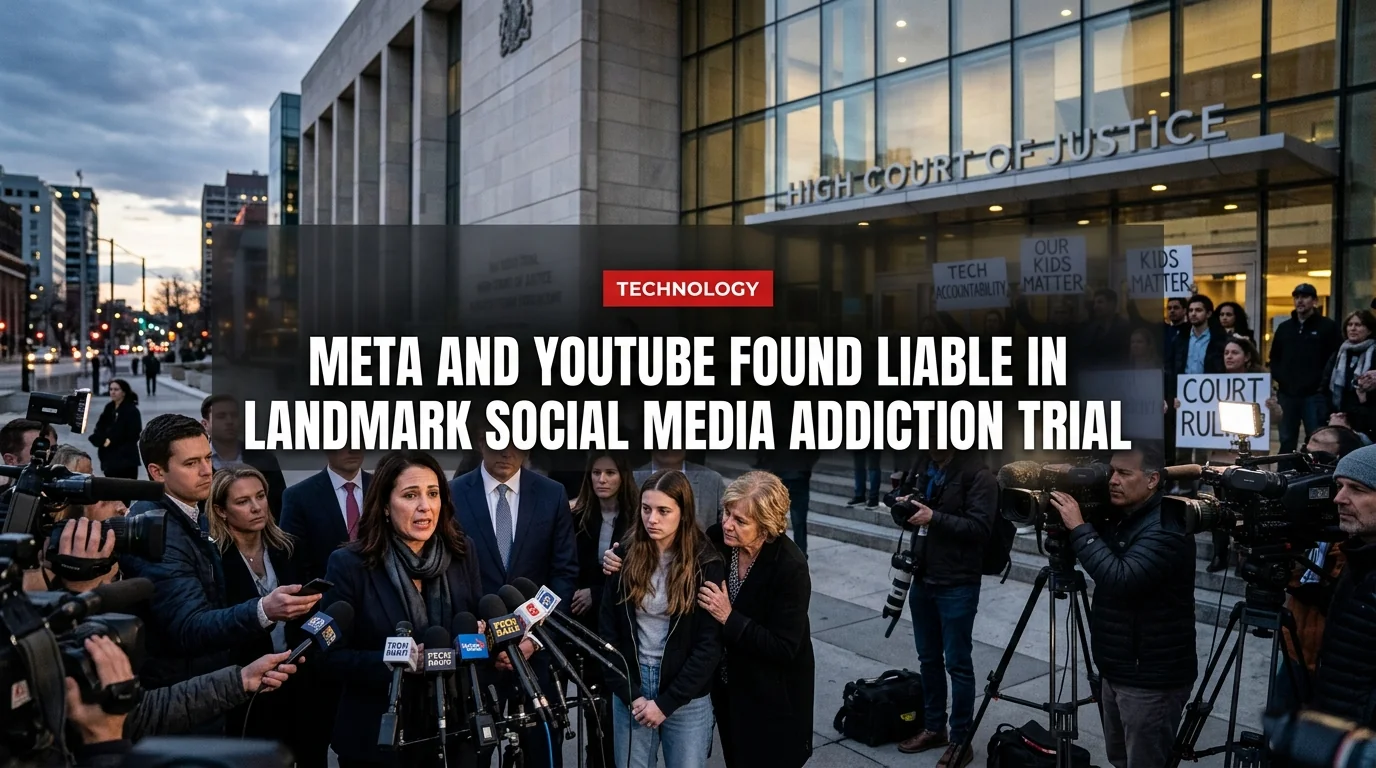
A Los Angeles jury has delivered a historic verdict finding Meta and YouTube liable for negligent platform design in the first-ever social media addiction bellwether trial — a ruling that could reshape the entire tech industry and expose it to billions in damages from over 10,000 pending lawsuits.
The jury awarded plaintiff Kaley, identified as KGM in court filings, $6 million in total damages: $3 million in compensatory damages and $3 million in punitive damages. Meta was assigned 70% of the responsibility, while YouTube bore 30%.
::keyfacts
- Verdict Date: March 25, 2026
- Court: Los Angeles County Superior Court
- Total Damages: $6 million ($3M compensatory + $3M punitive)
- Meta Liability: 70% of damages
- YouTube Liability: 30% of damages
- Pending Similar Lawsuits: Over 10,000 individual cases
- School District Cases: Nearly 800
- State AG Actions: More than 40 states ::/keyfacts
What the Jury Found
The 20-year-old plaintiff alleged she began using YouTube at age 6 and Instagram at age 9, developing an addiction that led to depression, body dysmorphia, and suicidal thoughts. The jury agreed that both companies were negligent in how they designed and operated their platforms, finding that these design choices were a "substantial factor" in causing harm.
Critically, jurors determined that Meta and YouTube knew their platforms could be dangerous to minors but failed to adequately warn users or implement sufficient safeguards.
The Two Verdicts That Shook Silicon Valley
This California verdict landed just one day after an equally devastating ruling in New Mexico, where a separate jury ordered Meta to pay $375 million in civil penalties for violating state consumer protection law and harming children's mental health.
::timeline
- March 24, 2026 | New Mexico jury orders Meta to pay $375 million in civil penalties for child endangerment
- March 25, 2026 | California bellwether jury finds Meta and YouTube liable, awards $6 million in damages
- Pre-trial | TikTok and Snapchat settle with plaintiff before trial begins
- Late 2026 | Additional bellwether trials involving school districts expected to begin ::/timeline
Together, these back-to-back verdicts represent the most significant legal blow the social media industry has faced since Section 230 of the Communications Decency Act was enacted in 1996.
Why This Case Matters More Than the Dollar Amount
The $6 million award itself is modest by Big Tech standards — Meta reported $164 billion in revenue in 2025. But the verdict's real power lies in its bellwether status. Designated specifically to guide the resolution of thousands of similar cases, the ruling sends a clear signal to juries nationwide about how to evaluate claims linking platform design to youth mental health deterioration.
::stats
| Metric | Number |
|---|---|
| Individual lawsuits pending | 10,000+ |
| School district lawsuits | ~800 |
| State attorney general actions | 40+ |
| Potential industry exposure | Billions |
| Meta 2025 revenue | $164 billion |
| Bellwether damages awarded | $6 million |
| ::/stats |
Legal analysts say the verdict will significantly influence settlement negotiations across all pending cases. If even a fraction of the 10,000+ individual cases result in similar per-plaintiff awards, the cumulative financial impact could reach tens of billions of dollars.
The Section 230 Workaround
For decades, tech companies have relied on Section 230 to shield themselves from liability for content posted on their platforms. But plaintiffs in this case successfully argued a crucial legal distinction: they were not suing over user-generated content, but over the design features of the platforms themselves.
Features like infinite scroll, autoplay, push notifications, and algorithmic recommendation systems were presented as deliberately engineered to maximize engagement — and therefore addiction — regardless of the impact on vulnerable users.
::alert warning This legal strategy — targeting platform design rather than content — could bypass Section 230 protections entirely, fundamentally changing how courts evaluate tech company liability. ::/alert
How Meta and YouTube Responded
Both companies expressed disagreement with the verdict and announced plans to appeal.
Meta issued a statement emphasizing that teen mental health is a complex issue influenced by many factors beyond any single application, pointing to its existing safety features including parental controls and screen time limits. YouTube similarly defended its safety measures and content policies for minors.
::proscons
Company Defense Arguments
Arguments For Tech Companies
- Teen mental health is multifactorial
- Platforms have implemented safety features
- Parental controls and age restrictions exist
- Section 230 should provide broader immunity
- Scientific causation is difficult to prove
Arguments Against Tech Companies
- Internal research showed known harms to teens
- Addictive design features deliberately engineered
- Algorithms amplify harmful content to vulnerable users
- Warnings and safety features were inadequate
- Companies prioritized engagement metrics over safety ::/proscons
What Happens Next
The appeals process is expected to take years, meaning immediate changes to social media platforms are unlikely. However, the legal pressure from these verdicts, combined with growing legislative momentum, could force fundamental product changes.
A parallel federal proceeding (MDL 3047) continues in the Northern District of California, and additional bellwether trials involving school district plaintiffs are expected to begin in late 2026. These school district cases could introduce an entirely new category of institutional damages.
::alert info For Parents: If you believe your child has been harmed by social media addiction, the bellwether verdict strengthens potential legal claims. Consult a personal injury attorney familiar with the ongoing MDL 3047 litigation. ::/alert
The Bigger Picture
The social media addiction verdicts arrive at a moment when public trust in Big Tech is at historic lows. A 2026 Pew Research survey found that 72% of American parents believe social media does more harm than good for teenagers. Forty states have now joined legal actions against platforms, and bipartisan support for children's online safety legislation continues to grow in Congress.
Whether through jury verdicts, legislative action, or voluntary product changes, the era of unchecked social media design appears to be ending. The question is no longer whether the industry will be held accountable — it is how much that accountability will cost.
::highlight The social media addiction bellwether trial marks the beginning of what legal experts are calling the "Big Tobacco moment" for Silicon Valley — a reckoning that could fundamentally alter how platforms are designed, regulated, and held liable for their impact on young users. ::/highlight