
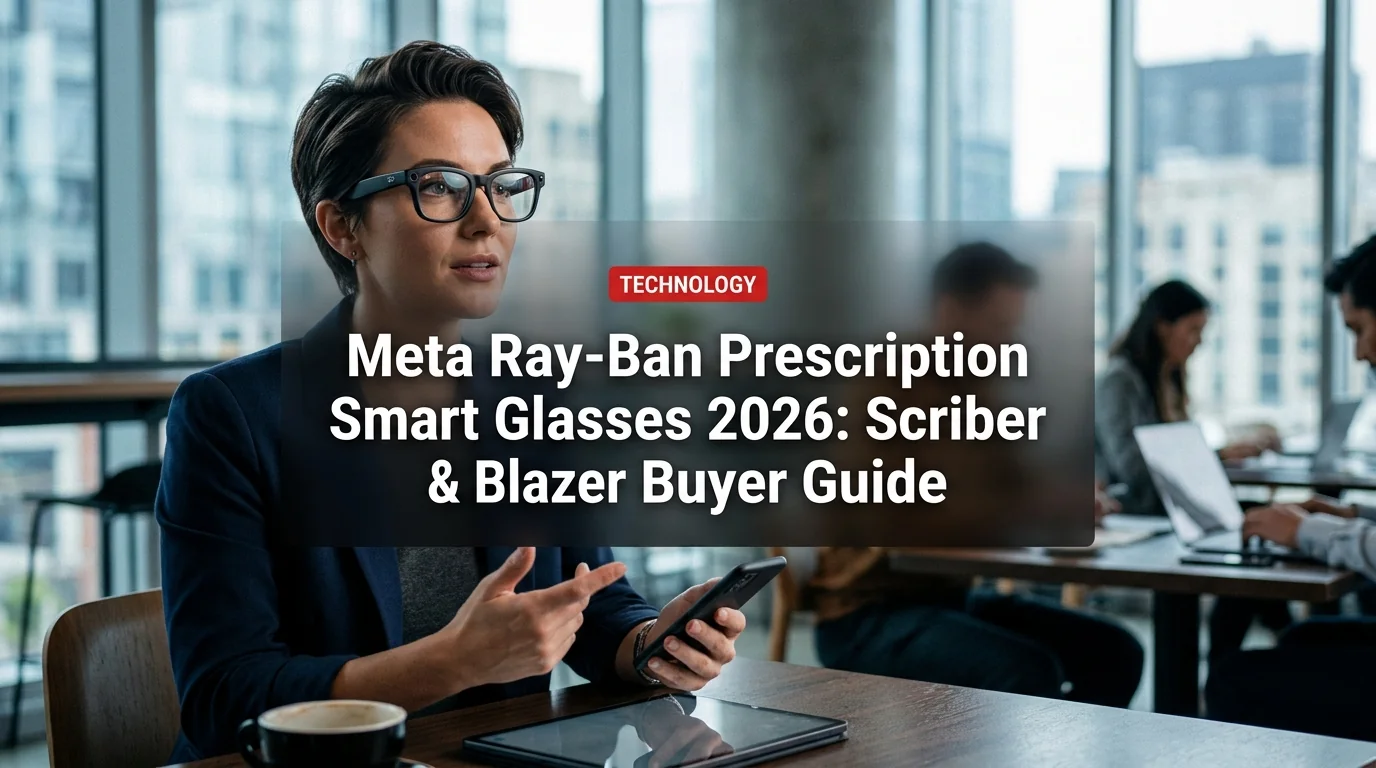
If you wear glasses, you've probably looked at Meta's Ray-Ban smart glasses and thought: not for me. That changes in April 2026. Meta is launching two new models — the Scriber and the Blazer — specifically designed to work with prescription lenses through mainstream optical retailers. Here's the complete buyer guide.
What Are the Scriber and Blazer?
The Scriber and Blazer are not a new generation of Ray-Ban Meta hardware. Think of them as prescription-optimized variants of the existing Ray-Ban Meta AI glasses, built to integrate seamlessly with the traditional eyewear retail system.
Both models are non-display AI glasses — meaning no heads-up display, no projected visuals. What you get is the full suite of smart features the current Ray-Ban Meta line is known for:
- A 12MP ultrawide camera for hands-free photos and 3K video
- Open-ear speakers for calls, music, and AI responses
- Built-in Meta AI for real-time queries, translations, and information
- IPX4 water resistance
- Up to 8 hours of battery life (with 48 additional hours from the charging case)
- Wi-Fi 6 UNII-4 band support — an upgrade over current models
The Blazer comes in regular and large sizes. The Scriber appears to be a single-size offering. Both ship with a charging case.
Why This Is a Big Deal
About 75% of adults in the US require some form of vision correction. The original Ray-Ban Meta glasses had a workaround for prescription wearers — third-party lens services — but it was clunky, required shipping your frames away, and wasn't officially supported.
The Scriber and Blazer change the equation entirely. By partnering with optical retail chains like MyEyeDr. and Target Optical, Meta is inserting smart glasses into the same workflow people already use to buy their prescription frames. Walk in, pick frames, get lenses fitted — except the frames also have a camera, speakers, and an AI assistant.
Scriber vs Blazer: What's the Difference?
Meta hasn't released a detailed spec comparison between the two models, but here's what we know based on FCC filings and reports:
- Single-size frame
- Designed for standard face shapes
- Expected to be the entry option
- Full Meta AI integration
- Regular and large sizes available
- Better fit for larger or wider faces
- Same core tech as Scriber
- May offer more frame style options
Both support prescription lenses. Both include Wi-Fi 6. The choice between them will likely come down to fit, not features.
How to Get Prescription Lenses
This is the part that has historically frustrated prescription wearers. With Scriber and Blazer, there are two paths:
Option 1: In-Store Optical Retailers (Easiest)
MyEyeDr. and Target Optical both officially support Ray-Ban Meta prescription lenses. You can use insurance, FSA, and HSA benefits — a significant advantage over buying online. Walk into a location, try on the frames, submit your prescription, and pick up fully assembled smart glasses.
Option 2: Online Third-Party Services
If you prefer to shop online or want more lens customization, these retailers have been fitting prescription lenses in Ray-Ban Meta frames for years:
- VR-Rock — custom lenses for nearsightedness, farsightedness, and astigmatism
- Lensology USA — "Click & Fit" lenses for at-home installation
- RX-Safety — official Ray-Ban Meta distributor with prescription services
- Glazzers.com — ships lenses to you or does professional fitting
- 39DollarGlasses.com — budget-friendly option with solid reviews
Most online services require your prescription details (SPH, CYL, axis, and pupillary distance). Processing typically takes 3–7 business days.
- Single vision, progressive, and bifocal lens options are available
- Add-ons include anti-reflective, scratch-resistant, UV protection, and photochromic coatings
- Polycarbonate lenses are lightest; high-index recommended for stronger prescriptions
- Online services ship lenses directly for DIY installation in many cases
What Meta AI Actually Does on These Glasses
If you haven't used the current Ray-Ban Meta glasses, here's a quick primer on what Meta AI enables:
Real-time identification: Point your gaze at a restaurant menu, a landmark, or a product, and ask Meta AI what you're looking at. It uses the built-in camera to see what you see.
Hands-free calls and messaging: Answer calls, send messages, and get notifications read aloud through the open-ear speakers — without touching your phone.
Live translation: Meta AI can translate conversations in real time through the speakers, making it genuinely useful for travel.
Music and podcasts: Connect via Bluetooth to play audio directly through the glasses. The open-ear design means you stay aware of your surroundings.
Photo and video capture: The 12MP camera captures hands-free shots and 3K video. Content goes directly to your connected device.
Should You Buy the Scriber or Blazer?
The honest answer depends on your situation.
Buy if:
- You already wear prescription glasses and have been waiting for a smart glasses option that actually works with your Rx
- You're interested in hands-free AI assistance without looking like you're wearing a headset
- You want to capture photos and video without pulling out your phone
- You can use insurance or HSA/FSA benefits to offset the cost
Wait if:
- You want a heads-up display — these don't have one. The Meta Ray-Ban Display glasses at $799 do, but don't yet support prescriptions
- You have a very strong prescription — verify with the retailer that your Rx falls within the supported range before ordering
- You're holding out for the next hardware generation, which is likely to include display features at lower cost
- Finally supports prescription lenses through mainstream retailers
- Wi-Fi 6 upgrade over current models
- Insurance and FSA/HSA compatible at select retailers
- Full Meta AI integration — real-time info, translation, hands-free control
- Lightweight form factor, looks like regular glasses
- No display (non-display models only)
- Price hasn't been officially confirmed — expect $379–$499+
- Strong prescriptions may not be supported
- Meta AI requires a connected phone and data
- Privacy concerns around always-present camera
The Bigger Picture
Meta is making a calculated bet with Scriber and Blazer: that the easiest path to mainstream smart glasses adoption runs through the optical retail industry. By the time most people are comfortable with the idea of AI glasses, the prescription problem will already be solved.
With over 60 million Americans visiting an eye doctor each year, inserting smart glasses into that retail channel is a distribution play as much as a product launch. If the pricing lands under $500 before insurance, expect these to move.
The first-week-of-April launch puts Scriber and Blazer in stores just as spring optical shopping picks up. For prescription wearers who've been watching the smart glasses category from the sidelines, this is your entry point.