
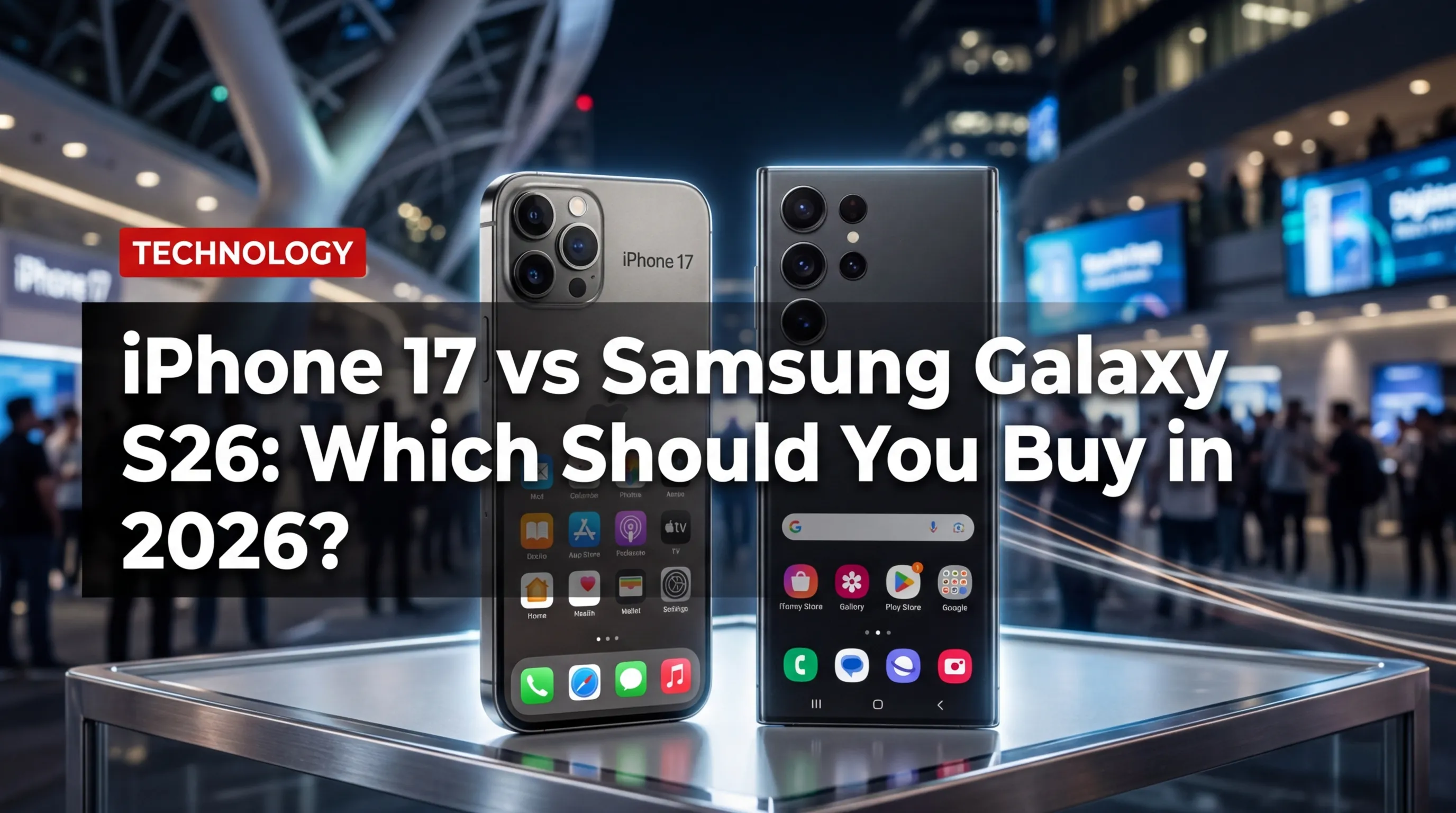
Apple and Samsung have once again gone head-to-head with their 2026 flagship releases. The iPhone 17 and Samsung Galaxy S26 represent the pinnacle of smartphone engineering, each pushing boundaries in AI integration, camera technology, and raw performance. But which one deserves your money?
We break down every major category so you can make an informed decision.
::keyfacts
- The iPhone 17 starts at $1,099 while the Galaxy S26 starts at $899
- Both phones feature AI-native operating systems with on-device large language models
- Samsung offers a 200MP main camera; Apple counters with a 48MP fusion sensor and computational photography
- The iPhone 17 uses Apple's A19 Bionic chip; the Galaxy S26 runs on Snapdragon 8 Elite Gen 2
- Both devices support satellite connectivity and Wi-Fi 7
- Samsung includes an S Pen-compatible stylus slot on the S26 Ultra variant ::/keyfacts
Design and Build Quality
The iPhone 17 marks Apple's most dramatic redesign since the iPhone X. The device adopts a titanium-aluminum hybrid frame with a completely flush rear camera module — no more camera bumps. The front features an under-display Face ID sensor, finally eliminating the Dynamic Island in favor of a full, uninterrupted display. It comes in five colors: Natural Titanium, Black Titanium, Desert Sand, Ocean Blue, and a new Starlight Pearl.
The Samsung Galaxy S26 evolves Samsung's design language with thinner bezels than ever before and a slightly curved "Infinity Edge" display that wraps subtly at the edges. Samsung has moved to a ceramic-titanium composite back panel, making it both scratch-resistant and lightweight. The S26 ships in Titanium Black, Titanium Silver, Titanium Green, and Titanium Violet.
Both phones carry IP68+ water and dust resistance ratings, but Samsung edges ahead with MIL-STD-810H military-grade drop certification on the S26.
Display
Both flagships feature stunning LTPO AMOLED panels, but there are notable differences.
The iPhone 17 sports a 6.3-inch Super Retina XDR display with ProMotion (1-120Hz adaptive refresh rate) and a peak brightness of 3,200 nits outdoors. Apple has introduced a new "Always-On ProMotion" mode that keeps the display active at 1Hz with virtually zero battery impact.
The Galaxy S26 counters with a 6.2-inch Dynamic AMOLED 2X display featuring a 1-120Hz adaptive refresh rate and an industry-leading peak brightness of 3,500 nits. Samsung's anti-reflective coating also makes outdoor visibility slightly better in direct sunlight.
::versus
| Feature | iPhone 17 | Samsung Galaxy S26 |
|---|---|---|
| Display Size | 6.3 inches | 6.2 inches |
| Resolution | 2868 x 1320 (Super Retina XDR) | 2600 x 1200 (Dynamic AMOLED 2X) |
| Refresh Rate | 1-120Hz ProMotion | 1-120Hz Adaptive |
| Peak Brightness | 3,200 nits | 3,500 nits |
| Processor | Apple A19 Bionic (3nm) | Snapdragon 8 Elite Gen 2 (3nm) |
| RAM | 12GB | 12GB |
| Storage Options | 256GB / 512GB / 1TB | 128GB / 256GB / 512GB / 1TB |
| Main Camera | 48MP Fusion | 200MP Wide |
| Ultrawide Camera | 48MP | 50MP |
| Telephoto Camera | 12MP 5x Optical | 50MP 3x Optical |
| Battery | 4,800 mAh | 4,900 mAh |
| Charging Speed | 35W Wired / 25W MagSafe | 45W Wired / 15W Wireless |
| Starting Price | $1,099 | $899 |
| OS | iOS 19 | One UI 8 (Android 17) |
| Weight | 194g | 185g |
| AI Assistant | Apple Intelligence 2.0 | Galaxy AI Pro |
| ::/versus |
Performance and Chipset
The Apple A19 Bionic chip is manufactured on TSMC's second-generation 3nm process. It features a 6-core CPU (2 performance + 4 efficiency), a 6-core GPU, and a massively upgraded 18-core Neural Engine capable of 40 TOPS (trillion operations per second). In benchmarks, it demolishes everything in single-core performance and matches or beats desktop chips from just three years ago.
The Snapdragon 8 Elite Gen 2 powering the Galaxy S26 is Qualcomm's answer, built on Samsung's 3nm GAA process. It features custom Oryon cores delivering a significant multi-core advantage over the previous generation. Its Hexagon NPU delivers 45 TOPS, giving it a slight edge in raw AI processing throughput.
In real-world use, both phones are blazingly fast. App launches, multitasking, and gaming performance are virtually indistinguishable. The difference comes down to ecosystem optimization — iOS apps tend to be better optimized for Apple silicon, while Samsung's One UI 8 gives Android power users more customization.
Camera Systems
This is where the rivalry gets intense.
The iPhone 17 features a triple-camera array: a 48MP main Fusion sensor with a larger f/1.6 aperture, a 48MP ultrawide with autofocus and macro capabilities, and a 12MP telephoto with 5x optical zoom. Apple's computational photography pipeline — now powered by Apple Intelligence 2.0 — produces images that are consistently natural-looking with excellent dynamic range. The new "Photonic HDR" engine processes images through the Neural Engine before they even hit the image signal processor.
The Galaxy S26 leads with a 200MP main sensor (f/1.7), a 50MP ultrawide, and a 50MP telephoto with 3x optical zoom. Samsung's pixel-binning technology produces detailed 12.5MP shots in standard mode, but the full 200MP resolution is available for cropping. Galaxy AI Pro introduces "AI Director" mode, which uses scene understanding to automatically adjust framing, exposure, and timing.
For video, the iPhone 17 supports 8K recording at 30fps and 4K at 120fps with Cinematic Mode. The Galaxy S26 also shoots 8K at 30fps and introduces "AI Stabilization Pro" for handheld footage that rivals gimbal-quality smoothness.
::stats
- iPhone 17 camera scores 157 on DxOMark (as of March 2026)
- Galaxy S26 camera scores 155 on DxOMark
- iPhone 17 video stabilization rated best-in-class for handheld 4K
- Galaxy S26 200MP mode captures 16,320 x 12,240 pixel images
- Both phones support 8K video recording at 30fps ::/stats
AI Features
AI is the defining battleground of 2026 smartphones.
Apple Intelligence 2.0 on the iPhone 17 runs a compact on-device LLM capable of summarization, writing assistance, image generation, and contextual Siri responses — all without sending data to the cloud. The new "Personal Context" feature lets Siri understand your habits, schedule, and preferences to offer proactive suggestions. Apple's commitment to on-device processing means better privacy.
Galaxy AI Pro on the S26 takes a hybrid approach, combining on-device processing with Samsung's cloud AI for more complex tasks. Features include real-time translation in 20 languages during phone calls, AI-powered photo editing that can remove or add objects with startling accuracy, and "Note Assist" which transforms voice memos into structured documents. Samsung also offers "Sketch to Image" generation directly from the S Pen on the Ultra model.
Battery Life
The iPhone 17 packs a 4,800 mAh battery — Apple's largest ever in a standard-size iPhone. Combined with the A19 Bionic's efficiency, expect 12-14 hours of screen-on time. Charging tops out at 35W wired and 25W via MagSafe, reaching 50% in about 25 minutes.
The Galaxy S26 features a 4,900 mAh cell with 45W wired fast charging, hitting 65% in 30 minutes. Screen-on time averages 11-13 hours, slightly behind the iPhone due to the higher-resolution display driving more pixels.
Software and Ecosystem
The iPhone 17 launches with iOS 19, which introduces a redesigned home screen with intelligent widget stacking, a universal search bar accessible from any screen, and deep Apple Intelligence integration throughout the OS. Apple promises 6+ years of software updates.
The Galaxy S26 runs One UI 8 on top of Android 17, offering Samsung's signature customization options alongside Google's latest features. Samsung has committed to 7 years of OS updates and security patches, matching Apple's support timeline.
::proscons
iPhone 17
Pros
- Best-in-class video recording and stabilization
- Superior on-device AI with strong privacy guarantees
- Seamless Apple ecosystem integration (Mac, iPad, Watch, AirPods)
- Longer battery life in real-world testing
- Under-display Face ID eliminates the Dynamic Island
Cons
- $200 more expensive than the Galaxy S26 at base price
- No 128GB option — starts at 256GB
- Slower wired charging (35W vs 45W)
- USB-C but still limited to USB 3.0 speeds on base model
- Less customizable OS compared to Android
Samsung Galaxy S26
Pros
- 200MP camera sensor captures extraordinary detail
- More affordable starting price at $899
- 45W fast charging is the fastest in the flagship segment
- 7 years of guaranteed software updates
- Highly customizable One UI 8 with desktop-mode DeX
Cons
- AI features rely partly on cloud processing (privacy trade-off)
- 3x optical zoom falls short of iPhone's 5x telephoto
- 128GB base storage feels stingy in 2026
- Slightly shorter battery life despite larger battery
- Exynos variant in some markets may underperform ::/proscons
Pricing and Availability
The iPhone 17 starts at $1,099 for the 256GB model, with the 512GB at $1,299 and 1TB at $1,499. Available worldwide from September 2025.
The Samsung Galaxy S26 starts at $899 for 128GB, $959 for 256GB, $1,079 for 512GB, and $1,199 for 1TB. Available worldwide from February 2026.
::alert info Both phones offer trade-in programs that can significantly reduce the price. Apple offers up to $650 for an iPhone 15 Pro Max trade-in, while Samsung offers up to $700 for a Galaxy S24 Ultra. Check carrier deals for additional savings — many carriers offer both phones free with qualifying trade-ins and new lines. ::/alert
The Verdict: Which Should You Buy?
Choosing between the iPhone 17 and Galaxy S26 ultimately comes down to three factors: ecosystem, budget, and priorities.
Buy the iPhone 17 if you are already invested in the Apple ecosystem, prioritize video recording and on-device AI privacy, and do not mind paying a premium for what is arguably the most polished smartphone experience available.
Buy the Galaxy S26 if you want the best value in a flagship phone, prefer Android's flexibility and customization, need the highest-resolution camera sensor on the market, or want faster wired charging speeds.
Both are exceptional phones. There is no wrong choice in 2026 — only the choice that fits your life better.
This article will be updated as new benchmarks, reviews, and real-world testing data become available throughout 2026.