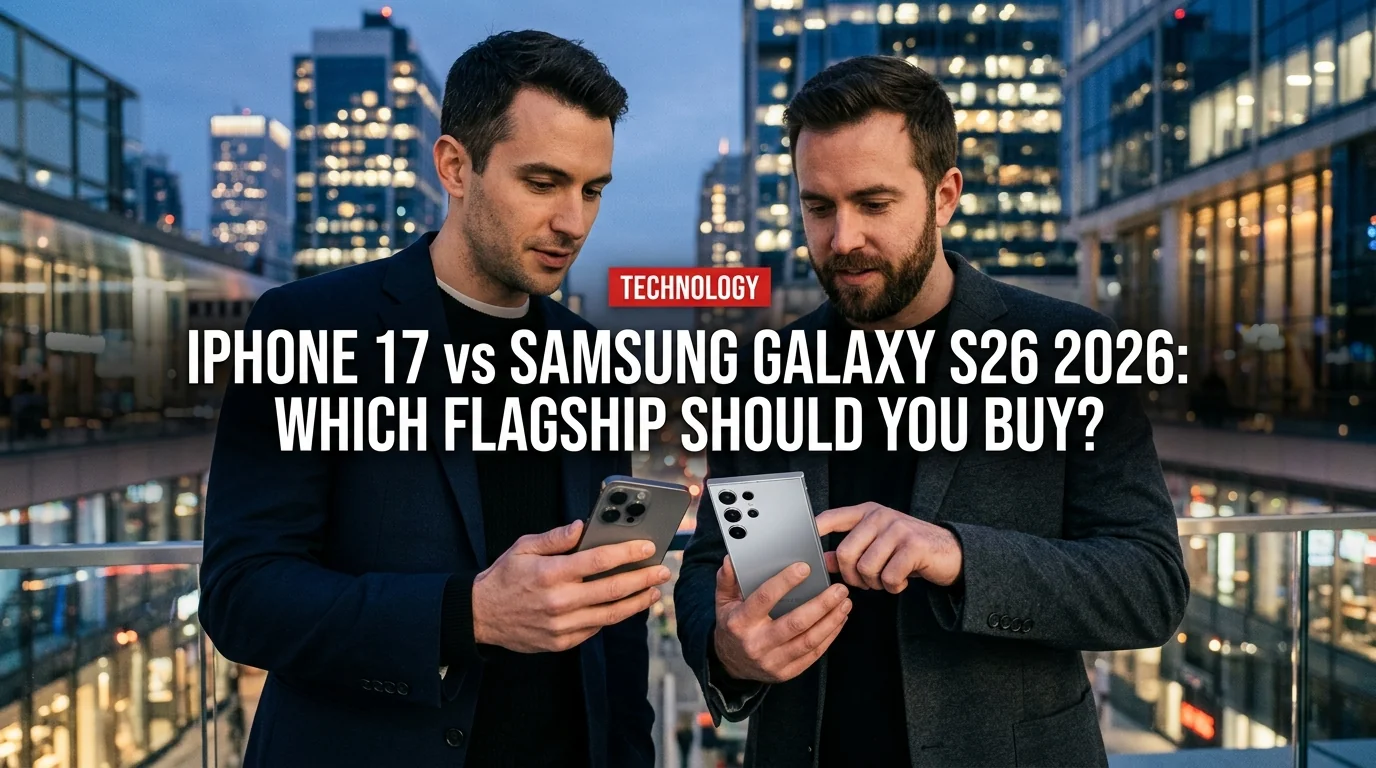
The two biggest smartphone launches of 2026 are finally here — and the gap between them has never been smaller. Apple's iPhone 17 and Samsung's Galaxy S26 both land at around $799, both offer flagship-level cameras, and both ship with AI assistants baked deep into the OS. So which one should you actually buy?
We've broken down every major category to give you a clear, honest answer.
Quick Specs at a Glance
Display: Samsung Wins on Paper, Apple on Color Accuracy
The Galaxy S26 ships with a 6.2-inch Dynamic AMOLED 2X display running at 120Hz adaptive refresh — even on the base model. iPhone 17 is still stuck at 60Hz on the standard model; you need to step up to the Pro to get ProMotion.
For scrolling and gaming, that 120Hz difference is immediately visible. Samsung pulls ahead here.
That said, Apple's OLED calibration is famously precise. The iPhone 17 display is slightly smaller at 6.1 inches but produces some of the most accurate colors on any smartphone. For photographers and video editors who need true-to-life color, Apple remains the reference standard.
Winner: Samsung Galaxy S26 (120Hz at base price)
Performance: Apple A19 vs Snapdragon 8 Elite Gen 2
Both chips are blistering fast in everyday use — you won't notice lag on either phone for anything short of AI-heavy video processing or extended 3D gaming.
In raw benchmarks, the Apple A19 continues to lead in single-core performance and machine learning tasks, which is why Apple Intelligence features feel so snappy. The Snapdragon 8 Elite Gen 2 closes the multi-core gap significantly and pulls ahead in sustained GPU loads.
One important note: Samsung still ships the Exynos 2600 in some markets (primarily Europe). If you're comparing performance, make sure you're looking at the Snapdragon variant.
Winner: Tie (A19 leads single-core; Snapdragon 8 Elite Gen 2 leads sustained GPU)
Camera: Close, But Apple's Video Still Dominates
Both phones shoot stunning photos, but they take different approaches.
The Galaxy S26's 50MP main sensor with wider aperture grabs more light in low-light scenes. Samsung's processing loves vivid, punchy colors — photos look great on social media straight out of the camera.
Apple's 48MP main sensor pairs with a new second-generation ultrawide that dramatically improves macro performance. Where Apple truly separates itself is video: Log format shooting, Cinematic Mode improvements, and class-leading stabilization make the iPhone 17 the clear choice for anyone who shoots video.
- Best-in-class video stabilization
- Accurate, natural color science
- Improved ultrawide macro
- Log video for post-production
- Wider aperture = better night shots
- Vivid, social-media-ready processing
- Telephoto lens on base model (3x)
- More versatile zoom range
- Still no optical zoom on base model
- Less aggressive low-light processing vs Galaxy
- Processing can over-sharpen details
- Video lags behind iPhone for professional use
Winner: Depends on use case — S26 for photos and zoom flexibility; iPhone 17 for video creators.
Battery Life and Charging: Samsung Wins
This isn't close. The Galaxy S26 ships with a larger battery and significantly faster wired charging at 45W — it goes from 0 to 100% in about 65 minutes. The iPhone 17's 25W charging means roughly 100 minutes for a full charge.
Apple does continue to lead on wireless charging efficiency and MagSafe ecosystem depth, but if raw battery performance and fast top-ups matter to you, Samsung is the clear choice.
Winner: Samsung Galaxy S26
AI Features: Two Very Different Visions
Both phones are betting big on AI — but they're implemented very differently.
Apple Intelligence runs most tasks on-device, which means better privacy and faster responses for things like Smart Reply, image cleanup, and writing assistance in any app. It integrates deeply with first-party apps and Siri has finally become genuinely useful thanks to the A19's neural engine.
Galaxy AI (powered by Google Gemini) offers more powerful generative features — real-time translation, generative photo editing, Circle to Search, and a more conversational assistant experience. It relies more on cloud processing, which raises some privacy questions but enables more ambitious features.
- Runs primarily on-device
- Better privacy
- Tightly integrated with iOS apps
- More reliable, less flashy
- Cloud-powered for bigger tasks
- More generative features
- Real-time live translation
- Circle to Search built-in
Winner: Tie — Apple wins on privacy; Samsung wins on feature breadth.
Software and Ecosystem: It Depends on What You Already Own
This is often the real decision point. If you have a Mac, iPad, AirPods, or Apple Watch — the iPhone 17 fits into your life with zero friction. AirDrop, Handoff, Continuity Camera, and iMessage with your contacts all work seamlessly.
If you're an Android user or use Google services heavily, the Galaxy S26 is the obvious fit. It runs the latest Android 16 with One UI 8 on top, which is now one of the cleanest Android skins available. Samsung promises 7 years of OS updates — matching Apple's support commitment.
Price and Value: Who Gets More?
- Both phones start at $799 in the US
- iPhone 17 storage: 128GB base
- Galaxy S26 storage: 256GB base (double the storage at same price)
- Galaxy S26 includes telephoto lens at base tier; iPhone 17 does not
- iPhone 17 Pro adds 120Hz, telephoto, and titanium for $999+
Pure value math favors Samsung: 256GB storage, 120Hz display, and a telephoto camera at the same $799 price as Apple's 128GB/60Hz base iPhone 17.
Which Flagship Should You Buy in 2026?
Buy the iPhone 17 if:
- You're already in the Apple ecosystem
- You shoot video seriously
- Privacy and on-device AI matter to you
- You want longer, more predictable software support
Buy the Galaxy S26 if:
- You want 120Hz at the base price
- Faster charging and longer battery life is a priority
- You want more storage and camera versatility at $799
- You prefer Android's openness and Google services
Final Verdict
In 2026, there is no wrong choice at the flagship tier. Both phones are exceptional and will last you 4+ years with software support. The decision comes down to ecosystem loyalty, whether you prioritize video or photos, and how much 120Hz and fast charging matter in daily use.
If you're buying your first smartphone or switching from an older Android, the Galaxy S26 offers more hardware for $799. If you're upgrading from an older iPhone, the iPhone 17's performance and ecosystem integration make the upgrade seamless.
Either way, you're getting a world-class smartphone. The best phone is the one that fits your world.