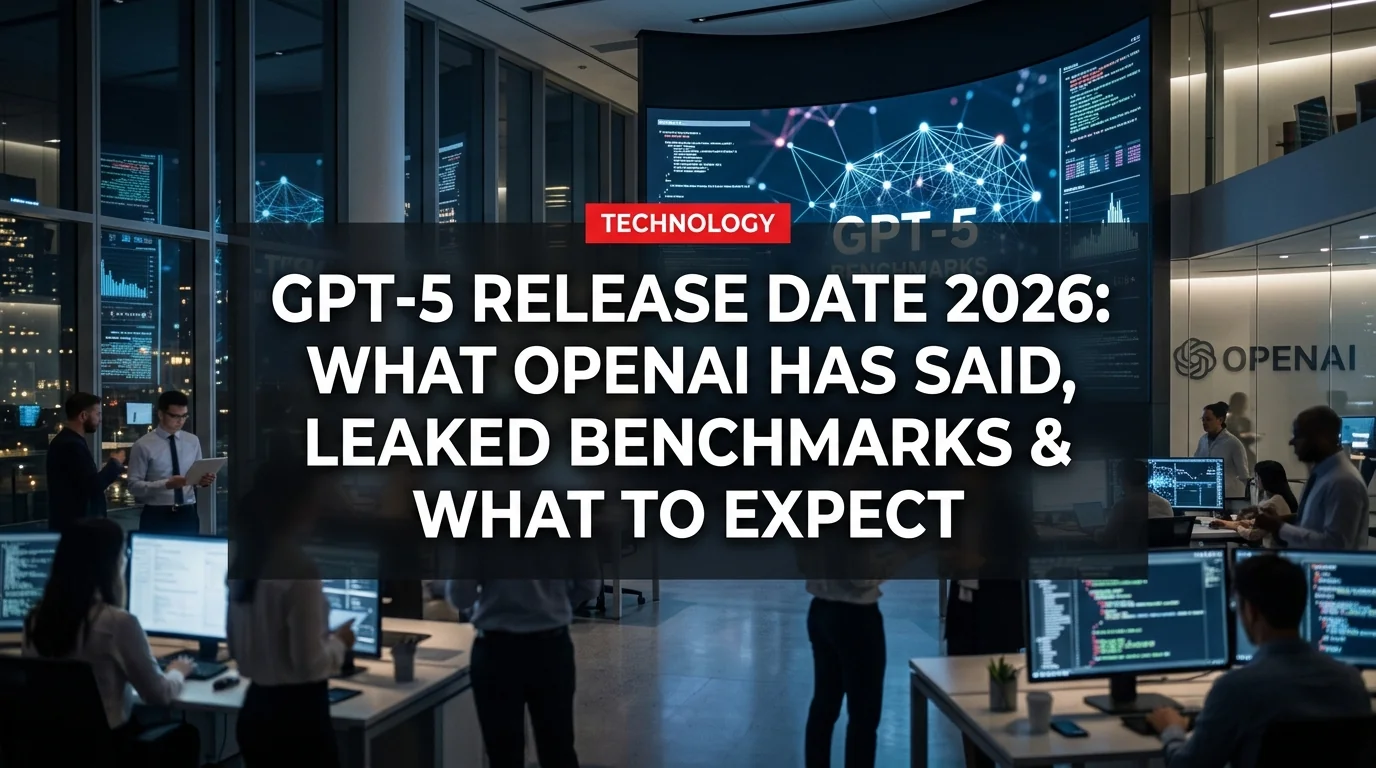
GPT-5 is the most anticipated AI model release of 2026 — and if OpenAI stays on schedule, it could reshape the AI landscape more than any single model since GPT-4 in 2023. Here's everything we know: the release window, what it can do, how it compares to current models, and what it means for you.
GPT-5 Release Date: What We Know
OpenAI has not announced an official GPT-5 release date. However, multiple credible signals point to a mid-to-late 2026 launch window:
- OpenAI has confirmed GPT-5 is in active development
- Internal codename reportedly "Orion" (separate from earlier Orion leaks)
- Benchmark testing reportedly underway as of early 2026
- CEO Sam Altman has referenced a "major model" release for 2026
- Industry analysts expect staged rollout: API first, then ChatGPT integration
- Most likely window: Q3 2026 (July–September)
The pattern from previous OpenAI releases suggests a staged launch: the model typically reaches the API first for developers, followed by a ChatGPT Plus integration within weeks, and then gradual rollout to free-tier users.
What GPT-5 Is Expected to Be
GPT-5 is not a simple incremental upgrade. Based on leaked benchmark data, OpenAI researcher commentary, and industry reporting, GPT-5 is being built as a unified multimodal reasoning model — combining the speed of GPT-4o with the deep reasoning of o3, rather than keeping them as separate products.
The key architectural change: GPT-5 reportedly unifies the "fast" and "slow" thinking modes that currently require separate models (GPT-4o for speed, o3 for deep reasoning). One model, one API call, adaptive compute depending on task complexity.
How GPT-5 Compares to Current OpenAI Models
- Fast, multimodal, great for everyday tasks
- 128K context window
- Limited at complex multi-step reasoning
- Free on ChatGPT (with limits), $20/mo Plus
- Available today
- Unified fast + deep reasoning in one model
- 1M+ context window (estimated)
- Strong at PhD-level problem solving
- Pricing TBD — likely higher API cost
- Est. Q3 2026 release
What About o3 and o4-mini? Will They Be Replaced?
This is the most common question — and the honest answer is: probably not immediately.
OpenAI's current lineup includes GPT-4o (fast, general), o3 (deep reasoning), and o4-mini (cheap reasoning). GPT-5 is expected to eventually replace this fragmented lineup with a single, adaptive model. But given OpenAI's history, expect the older models to remain available at lower price points for cost-sensitive API users for 12–18 months after GPT-5 launches.
For ChatGPT users: o3 will likely remain a Premium feature while GPT-5 becomes the new default for Plus subscribers.
GPT-5 vs Claude 4 and Gemini Ultra 2026
OpenAI won't be alone in 2026. Anthropic's Claude 4 and Google's Gemini Ultra 2.0 are both expected to launch in a similar window, making mid-2026 the most competitive period in AI model history.
Based on current trajectory:
- GPT-5 is expected to lead on coding, reasoning, and multimodal tasks
- Claude 4 is expected to lead on long-form writing, instruction following, and safety
- Gemini Ultra 2.0 is expected to lead on real-time web integration and Google Workspace tasks
The real winner: users, who will have unprecedented AI capability available at multiple price points.
Will GPT-5 Be Free?
Based on OpenAI's pricing history, here's what to expect:
- GPT-5 mini variant likely included in free ChatGPT tier (eventually)
- ChatGPT Plus ($20/mo) will likely include GPT-5 access
- API access available at per-token pricing for developers
- Free tier eventually gets access (6-12 months after launch)
- At launch, GPT-5 will likely be Plus/Pro exclusive only
- API pricing expected to be significantly higher than GPT-4o
- Free tier access may arrive with stricter message limits than GPT-4o
- Pro tier ($200/mo) users will likely get unlimited GPT-5 first
The most realistic scenario: GPT-5 launches as a ChatGPT Pro exclusive, becomes Plus standard within a few months, and reaches a limited free tier within 6–12 months of launch.
What GPT-5 Could Actually Do That GPT-4o Can't
Beyond the spec sheet, here's what a unified reasoning model with a 1M+ context window changes in practice:
1. Full codebase analysis. Feed GPT-5 an entire repository (millions of tokens) and ask it to refactor, debug, or document the whole thing. Current models force you to chunk it manually.
2. Full-length book comprehension. Ask questions about a 500-page PDF with precise citations to page numbers. No summarization gaps, no "I only have the first 128K tokens" limitations.
3. Complex multi-day research. Give GPT-5 a research question and let it reason across dozens of sources simultaneously, not sequentially.
4. Autonomous agentic tasks. GPT-5's architecture is reportedly designed for longer autonomous task chains — the foundation for AI agents that work for hours on a single goal without human check-ins.
When Should You Upgrade or Wait?
If you're currently using ChatGPT free or Plus, here's the practical guidance:
- Using ChatGPT free? Your access to GPT-5 is likely 12–18 months away. Use the current free tier (GPT-4o) in the meantime — it's excellent for most tasks.
- Using ChatGPT Plus ($20/mo)? You'll likely get GPT-5 access within 2-4 months of its release. No action needed now.
- Developer building on OpenAI API? Watch platform.openai.com closely. When GPT-5 hits the API, budget for higher per-token costs, especially for reasoning-heavy tasks.
- Using o3 for deep research? GPT-5 is designed to replace o3's use case. When it launches, evaluate whether the combined model outperforms o3 on your specific tasks before migrating.
Frequently Asked Questions
Is GPT-5 the same as "Orion"? Unconfirmed. OpenAI has used internal codenames that don't always match public release names. The model publicly released as "o3" in late 2024 was not the "Orion" that early leaks referenced. Take codename correlations with skepticism.
Will GPT-5 replace o3? Eventually, likely yes — but not immediately. OpenAI tends to maintain older models at lower prices for API users for a year or more after launching successors.
Can GPT-5 do things humans can't? In narrow domains, possibly. Early reports suggest GPT-5 achieves scores in the 95th–99th percentile on graduate-level science and math benchmarks — territory where it outperforms the vast majority of human experts in those specific tests. General intelligence remains beyond current AI.
Will GPT-5 have internet access? Almost certainly. Web browsing has been standard for OpenAI's flagship models since 2023. GPT-5 will almost certainly include real-time web access.
Bottom Line
GPT-5 is real, it's coming in 2026, and it's a meaningful architectural upgrade — not a minor version bump. The combination of GPT-4o speed and o3-level reasoning in a single model with a million-token context window represents a genuine capability jump.
For most users: wait for Plus access, which should arrive within months of the initial launch. For developers and power users who need the cutting edge: watch OpenAI's API changelog and be ready to test on day one.
The competition from Claude 4 and Gemini Ultra means GPT-5 can't afford to disappoint — and that's good news for everyone.