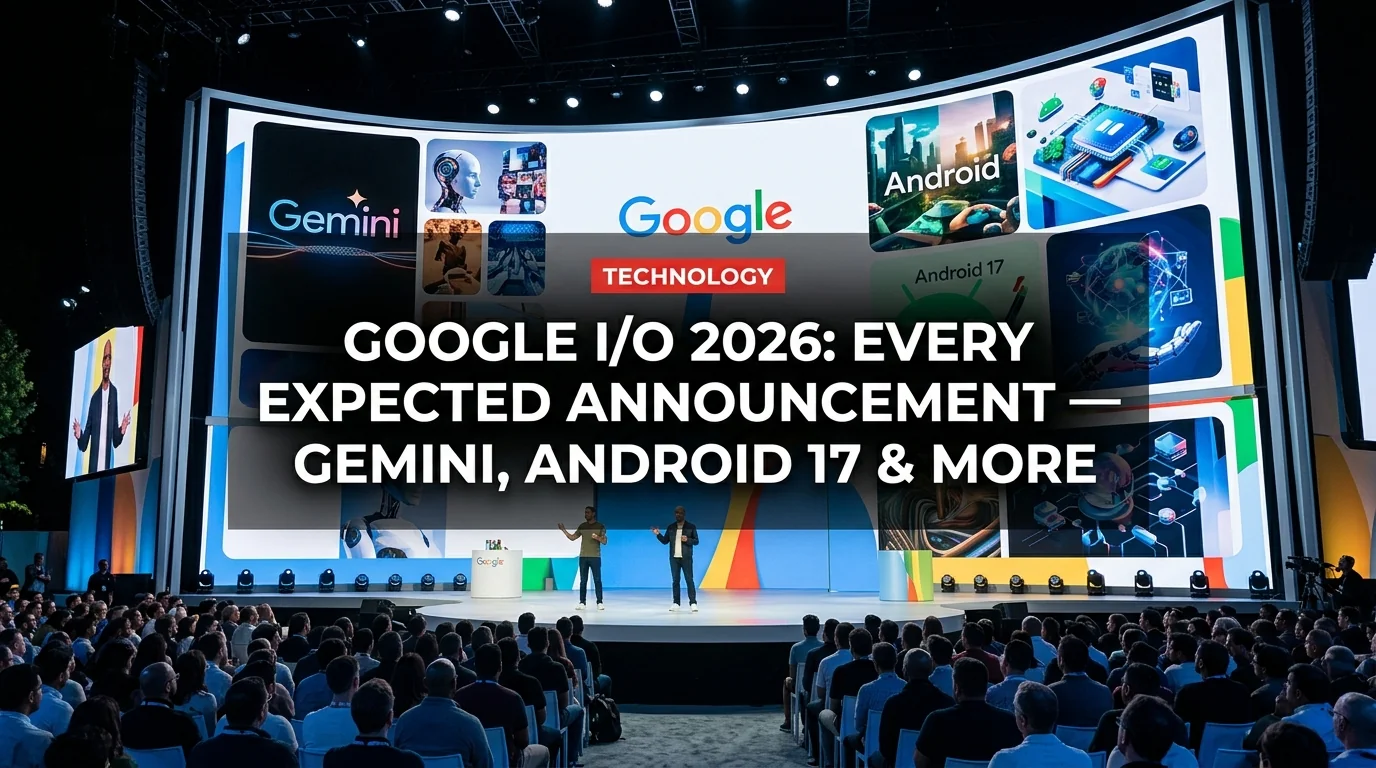

Google I/O 2026 is shaping up to be one of the most AI-packed developer conferences in the event's history. With Google fighting to stay ahead of OpenAI, Apple Intelligence, and Microsoft Copilot, the pressure is on to deliver real, tangible upgrades — not just demos.
Here's every major announcement expected at Google I/O 2026, based on leaks, confirmed developer previews, and patterns from previous years.
What Is Google I/O?
Google I/O is Google's annual developer conference, held each May in Mountain View, California. It's where Google unveils major Android updates, new Pixel hardware, and its biggest AI moves for the year. Past I/O events announced the first Pixel phones, Google Assistant, and the Gemini model family.
2026 is particularly significant. Google is mid-way through a massive AI transformation — Gemini has replaced Google Assistant across most surfaces, Android 16 shipped with AI features baked in, and the Pixel 9 series brought on-device AI to mainstream buyers. I/O 2026 is where all of that gets pushed to the next level.
1. Gemini Ultra 2 — The Big Model Upgrade
The centerpiece of I/O 2026 is almost certainly Gemini Ultra 2, Google's answer to GPT-5 and Claude 4. Google has been positioning Gemini as the brain behind everything from Search to Gmail to Android — and Ultra 2 is expected to bring:
- Significantly improved reasoning and multi-step task completion
- Longer context windows (rumored up to 2 million tokens)
- Better code generation, rivaling GitHub Copilot for developers
- Native video understanding improvements for YouTube and Google Photos
- Cheaper API pricing to compete with OpenAI's enterprise tiers
For consumers, Gemini Ultra 2 means smarter responses in Google Search (AI Overviews), better Workspace summaries in Gmail and Docs, and a more capable Gemini app. For developers, the longer context window and improved API will be the headline.
2. Android 17 — What's New
Android 17 (developer preview expected at I/O) will focus on three areas: AI integration, customization, and satellite connectivity.
AI-first changes expected:
- Deeper Project Astra integration — on-device AI that sees and understands your screen in real time
- Upgraded Circle to Search with document and spreadsheet support
- Gemini as the default assistant on all new Android devices globally
- AI-powered notification summarization (similar to Apple's iOS 18 summaries, but on-device)
Design and UX changes:
- Material You 3 visual overhaul with dynamic theming across more system surfaces
- Improved foldable phone support (Samsung Galaxy Z Fold series)
- Better large-screen tablet optimization (Google's response to Apple's iPadOS gains)
Connectivity:
- Native satellite messaging support (emergency SOS + standard SMS)
- Improved Bluetooth audio stack for spatial audio on Android
- Android 17 Developer Preview expected at Google I/O 2026
- Stable release likely August–September 2026
- Samsung Galaxy S26 and Pixel 10 will be day-one recipients
- Older Pixel 6 and 7 devices may receive the update depending on support windows
3. Pixel 10 — Hardware Reveal
The Pixel 10 series is the hardware centerpiece of I/O 2026. While Google often soft-launches Pixels at Made by Google events in October, developer preview hardware and specs are typically shown at I/O.
What's expected:
- Tensor G5 chip — Google's fifth-generation custom silicon, reportedly built on TSMC's 3nm process for better efficiency and on-device AI
- Pixel 10 Pro with satellite connectivity as standard
- Improved camera system — likely 1-inch main sensor for the Pro
- Temperature sensor return (dropped in Pixel 9 Pro for the US market)
- Pixel 10a teased at the same time, targeting the mid-range segment
- Tensor G5 (TSMC 3nm)
- 1-inch main camera sensor
- Satellite connectivity
- Android 17 day-one
- A19 Pro chip
- ProRes video recording
- Thinner design (Camera Control button)
- Apple Intelligence on-device
4. Project Astra — From Demo to Real Product
Project Astra was Google's jaw-dropping demo at I/O 2024 — an AI assistant that could see through your phone camera, answer questions about objects in real time, and remember context across a session. At I/O 2025, it got a limited rollout.
At I/O 2026, Astra is expected to ship as a mainstream feature inside the Gemini app, available to Gemini Advanced subscribers. Key capabilities:
- Real-time camera analysis (point at anything, ask questions)
- Memory across sessions (what did I show you last week?)
- Desktop screen sharing for Gemini on Chrome
- Integration with Google Lens for shopping, translation, and identification
This directly competes with OpenAI's vision features in ChatGPT and Apple's Visual Intelligence on iPhone 16 and 17.
5. Google Search AI Overviews 2.0
Google's AI Overviews (formerly Search Generative Experience) have been controversial — publishers have complained about traffic loss, and some users have received inaccurate summaries. I/O 2026 is where Google is expected to address both.
Expected changes:
- More source citations and visible links
- AI Overviews on more query types (previously limited)
- Conversational follow-up questions without leaving Search
- Shopping AI integration — direct product comparison in search results
6. Google Workspace AI — Gmail, Docs, Meet
Workspace has been quietly getting Gemini upgrades since 2024. At I/O 2026, expect:
- Gmail: Full email drafting, tone adjustment, and meeting-prep summaries
- Google Docs: Side-by-side AI editor that suggests edits as you write
- Google Meet: Real-time transcription and AI-generated meeting notes with action items, available to all Workspace tiers (not just Enterprise)
- Google Sheets: Natural-language formula generation and data analysis
- Gemini Ultra 2 power at a mid-tier subscription price
- Works across all devices with no hardware requirement
- Deep calendar, email, and Drive integration
- Privacy concerns about AI reading your emails and documents
- Still requires Gemini Advanced or Workspace Business subscription
- Playing catch-up to Microsoft 365 Copilot in enterprise settings
7. Wear OS 5 and Android TV Updates
Smaller platforms also get I/O love:
- Wear OS 5 for Pixel Watch 3 and Galaxy Watch 8 — expect better battery life through AI-optimized workload scheduling, new health sensors API for third-party apps, and Gemini on your wrist
- Android TV / Google TV — Gemini-powered content recommendations replacing the current algorithm; search by mood or genre using natural language
When Is Google I/O 2026?
Google has not officially announced the I/O 2026 date as of April 2026, but based on historical patterns:
Registration opens approximately 6–8 weeks before the event. The keynote streams free on YouTube. Developer sessions are available to registered attendees in person and virtually.
Should You Watch Google I/O 2026?
If you use an Android phone, Gmail, Google Search, or any Google product — yes. The announcements at I/O 2026 will affect how those tools work for the next 12 months. Even if you're on iPhone, Google Search and Workspace updates will touch you.
For developers building apps on Android, Google Cloud, or with the Gemini API, I/O 2026 is the most important event of the year. The new Gemini Ultra 2 APIs and Android 17 developer preview will be available immediately after the keynote.