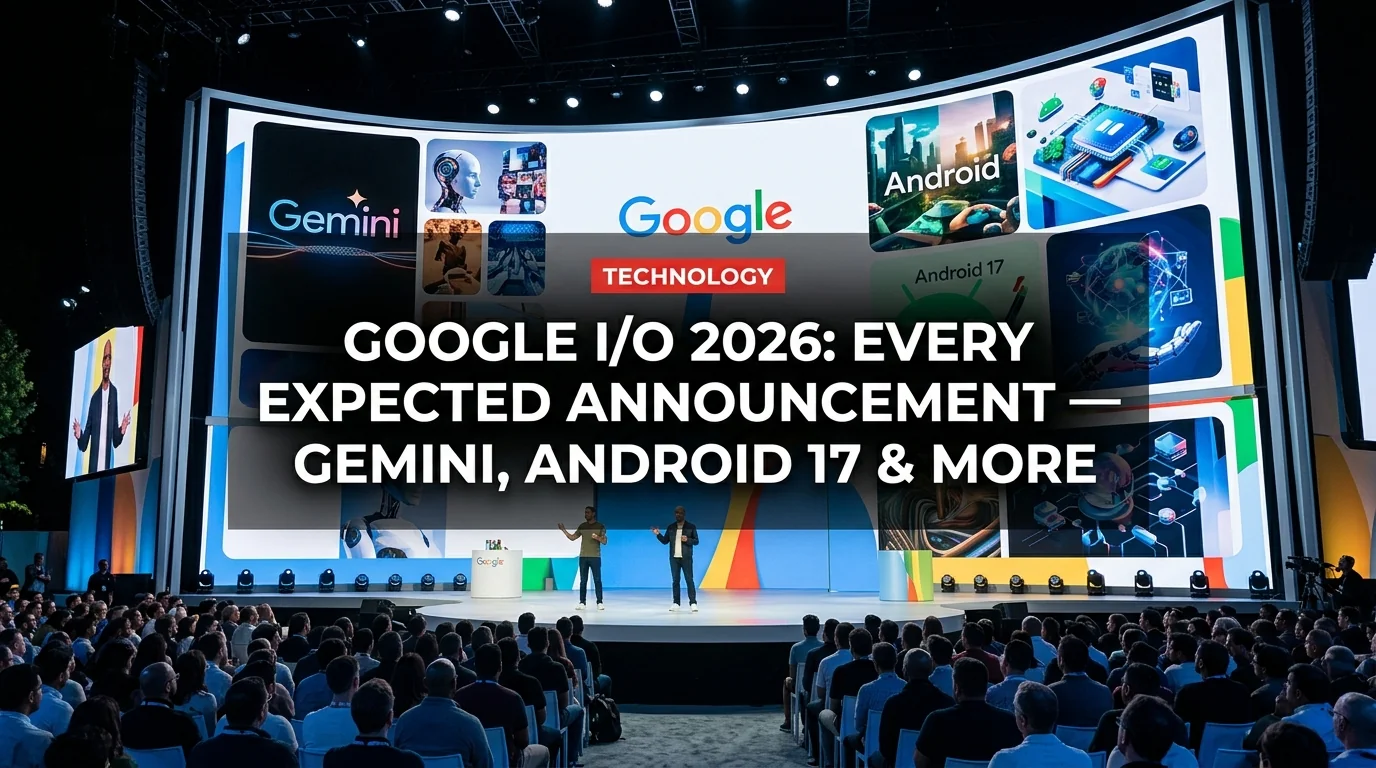
Google I/O 2026 is shaping up to be the most AI-heavy developer conference Google has ever staged. With OpenAI's GPT-5 and Anthropic's Claude 4 setting an aggressive benchmark, Google is under real pressure to show that Gemini is more than a marketing exercise. Here's everything expected at this year's event — from confirmed announcements to well-sourced leaks.
What Is Google I/O?
Google I/O is Google's annual developer conference, typically held in May. It's where the company previews major software releases, introduces new AI capabilities, and shows off upcoming hardware. For consumers, the keynote is the headline event. For developers, the three-day schedule of technical sessions is where the real substance lives.
I/O 2025 was dominated by Gemini 2.0 announcements, AI Overviews upgrades in Search, and the debut of Project Astra — Google's real-time multimodal AI assistant. I/O 2026 is expected to go further on all three fronts.
1. Gemini Ultra 2 — Google's Answer to GPT-5
This is the headline. Gemini Ultra 2 has been in testing at Google DeepMind since late 2025 and is expected to debut at I/O. Based on benchmarks circulating in the ML research community, it shows significant improvements over Gemini 1.5 Ultra in:
- Long-context reasoning (up to 2 million token context window)
- Multimodal understanding (video, audio, and image analysis in a single prompt)
- Code generation — reportedly competitive with Claude 3.7 Sonnet on SWE-bench
- Scientific reasoning — DeepMind's MedGemma and other specialist variants hint at where the core model is headed
2. Android 17 — AI-Native by Default
Android 17 is the software story at I/O 2026. The developer preview has been live since February, and the changes are substantial:
On-device AI everywhere: Android 17 ships with Gemini Nano 3 baked into the OS. This means private, on-device AI for tasks like call screening, message summarization, real-time translation, and predictive text — without sending data to Google's servers.
Smart Reply evolution: The system-wide Smart Reply feature in Android 17 understands conversation context across apps — not just the last message. Expect it to suggest replies in WhatsApp, Gmail, and even dating apps.
Adaptive Performance: Android 17 introduces a new power management layer that uses on-device AI to predict what you're about to do next and pre-load resources accordingly. Early testers report meaningful battery life improvements.
Updated design language: Material You 3 is expected to debut alongside Android 17, with a more refined look for widgets, lock screen, and notification shade.
Full release timeline: Android 17 developer previews are ongoing through spring; stable release expected September 2026.
3. Pixel 10 — First Look Expected
Google typically uses I/O to tease upcoming hardware, and 2026 should be no different. The Pixel 10 series — Pixel 10, 10 Pro, and 10 Pro Fold — is expected to launch in October, but a preview at I/O is likely.
Key expected specs based on leaks:
- Tensor G5 chip — built on TSMC's 3nm process, a departure from Samsung fabs
- Improved thermal management — a longstanding criticism of Pixel devices
- Camera system redesign — reportedly a new sensor arrangement moving away from the camera bar
- Satellite connectivity — similar to iPhone's emergency SOS via satellite
- Pixel 10 is expected in October 2026, with a teaser likely at I/O in May
- Tensor G5 is Google's first chip made on TSMC process nodes
- The Pixel 10 Fold is expected to slim down significantly vs the 9 Pro Fold
- A new Pixel Watch 4 and Pixel Buds Pro 2 may also appear at I/O
4. Project Astra — From Demo to Reality
Project Astra was the most impressive demo at I/O 2025 — a real-time AI assistant that could see through your phone camera, understand your environment, and answer questions conversationally. The question is: when does it actually ship?
Expect I/O 2026 to answer that. Google is expected to announce:
- Astra integration into Google Lens — point your camera at anything for real-time AI context
- Astra in Google Maps — AI-powered AR walking directions with real-time commentary
- Astra for Workspace — real-time AI assistance during Google Meet calls, with live transcription, action item detection, and follow-up drafting
5. Google Search — AI Overviews 2.0
AI Overviews launched in 2024 to controversy and confusion. By I/O 2026, Google has had time to iterate significantly. Expected announcements:
AI Mode expansion: Google's experimental AI Mode — a ChatGPT-style conversational interface inside Search — is expected to exit the Labs waitlist and roll out broadly.
Multi-step reasoning in Search: Ask a complex question like "compare mortgage rates for a $400K home in Austin vs Denver, factoring in property taxes" and get a structured, sourced breakdown.
Shopping AI: AI-powered product comparison and price tracking integrated directly into Search results — a direct response to Amazon's AI shopping features.
6. Google Workspace — Gemini Gets Deeper
Gemini for Workspace is already embedded in Gmail, Docs, Sheets, and Meet. At I/O 2026, expect Google to show off the next generation:
- Notebook LM Pro — the AI research tool that lets you upload documents and have conversations with them is getting upgraded with better citation accuracy, longer document support, and new export formats
- Gemini in Google Sheets — formula generation, data analysis, and chart creation from natural language
- Gmail Priority Inbox 2.0 — AI that learns your actual work patterns (not just keywords) to surface what matters
- Gemini Ultra 2 could finally close the gap with GPT-5 and Claude 4
- Android 17's on-device AI is a genuine privacy win
- Project Astra demos are consistently impressive
- Google has a track record of impressive I/O demos that take years to ship
- AI Overviews rollout showed Google can still stumble on real-world deployment
- Pixel hardware remains a niche product despite strong reviews
7. Google Cloud & Vertex AI
For developers and enterprises, the Vertex AI announcements are often the most consequential part of I/O. In 2026, Google Cloud is expected to announce:
- Gemini Ultra 2 API access — with expanded rate limits and reduced pricing for high-volume enterprise users
- Agent Builder upgrades — easier deployment of multi-step AI agents for business workflows
- BigQuery + Gemini — natural language queries across massive datasets without writing SQL
- Security AI — Chronicle Security's AI layer upgraded to handle zero-day threat detection at scale
How to Watch Google I/O 2026 Live
Google streams the full keynote on its YouTube channel — no registration required. The developer keynote typically starts at 10:00 AM PT. For the full session schedule, Google publishes a web app at io.google in the weeks leading up to the event.
The Bigger Picture: Google vs. Everyone
Google I/O 2026 takes place at a pivotal moment. OpenAI has shipped GPT-5 and an autonomous agent platform. Anthropic's Claude 4 is the tool of choice for developers who prioritize reliability. Microsoft has Copilot embedded in Windows, Office, and GitHub.
Google's advantage is distribution — no company has more surfaces where AI can show up: Search, Gmail, Maps, YouTube, Android, Chrome, Workspace. The I/O question isn't whether Google has impressive AI. It's whether they can close the gap between demo and reality, and whether Gemini Ultra 2 can be the first Google AI model that developers genuinely prefer over the competition.
The bar is higher than it's ever been. I/O 2026 will tell us whether Google clears it.