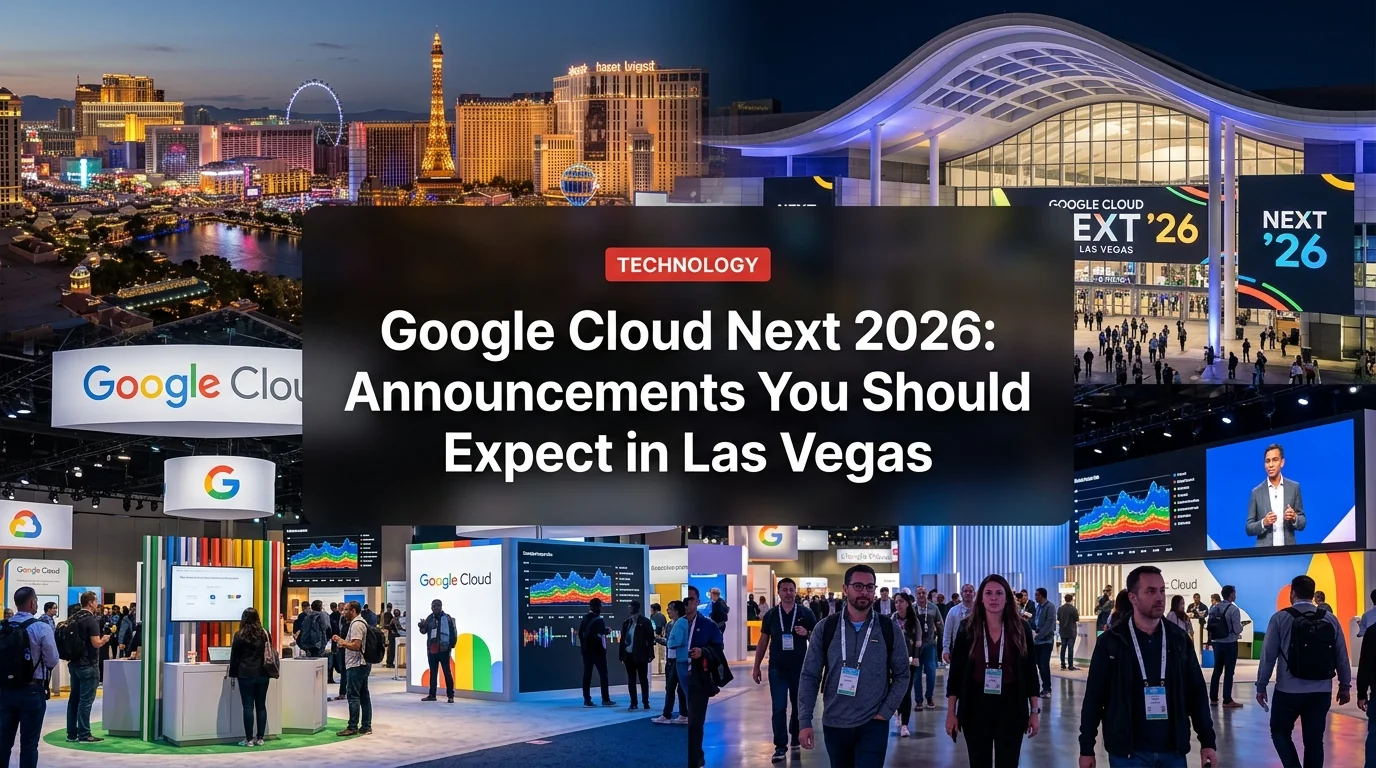
Google Cloud Next 2026 is three weeks away, and the cloud infrastructure landscape looks nothing like it did 12 months ago. Agentic AI has moved from experimental to enterprise-ready, Gemini 3.1 Pro is already in preview on Vertex AI, and the battle between Google Cloud, AWS, and Azure has never been closer. Here's everything expected at Next '26 — April 22–24 at Mandalay Bay Convention Center in Las Vegas.
What Is Google Cloud Next?
Google Cloud Next is Google's annual developer and enterprise conference — the equivalent of AWS re:Invent or Microsoft Ignite for the Google Cloud ecosystem. Each year, Google uses the keynote to unveil new products, price drops, and partnership announcements that shape the year ahead.
Next '25 (held in Las Vegas last spring) introduced the first Agent Development Kit (ADK) and the A2A protocol, set the direction for multimodal AI across Workspace, and launched Gemini 3.0 Pro for enterprise. This year, the bar is higher.
1. Gemini 3.2 Pro — The Model Upgrade Everyone Is Waiting For
Gemini 3.1 Pro entered preview on Vertex AI in February 2026 with a 2-million-token context window and significantly improved code generation. At Next '26, Google is widely expected to announce Gemini 3.2 — with faster inference, lower cost per token, and tighter grounding via Google Search integration.
What developers actually care about:
- Native tool use improvements (structured JSON output, multi-tool chaining)
- Cheaper Flash tier for high-volume applications
- Multimodal upgrades — better video understanding in Gemini 3.2 Flash
2. Agentic AI Going Mainstream — ADK 2.0 and A2A Protocol Updates
The biggest theme of Next '26 is agentic AI — AI that doesn't just answer questions but actually does work. Google launched the Agent Development Kit (ADK) at Next '25, but real-world adoption has been patchy. Expect ADK 2.0 to address the main friction points:
- Better orchestration — more reliable handoffs between agents in multi-step workflows
- A2A v2 protocol — improved Agent-to-Agent communication for multi-vendor agent ecosystems
- Production-ready guardrails — compliance hooks, audit logging, and human-in-the-loop controls built in
This is the session to watch if you're building any enterprise automation. Google will likely announce design partners — expect names from banking, healthcare, and logistics.
3. Vertex AI Platform Overhaul
Vertex AI is Google's unified ML platform, and it's been the fastest-growing part of Google Cloud. At Next '26, expect a significant platform update:
- Model Garden expansion with 200+ third-party models (including Llama 4, Mistral Large 3, and Command R+)
- New Vertex AI Agent Engine for deploying production agents without custom infrastructure
- Grounded generation improvements — citations from Google Search or your own data stores
- AutoML Vision and Tables updates for no-code enterprise ML
For developers, the most practical change will likely be Vertex AI Studio 2.0 — a redesigned prompt engineering and evaluation interface that replaces the current patchwork of tools.
4. AI-Powered Security — The Agentic SOC
Google's security portfolio (Mandiant + Chronicle + Security Command Center) is finally getting a coherent AI layer. The "Agentic SOC" concept previewed at Next '25 turns alert triage into an automated workflow — AI agents investigate incidents, correlate signals, and escalate only when human judgment is needed.
Next '26 announcements expected:
- Chronicle SIEM 3.0 with AI-assisted investigation playbooks
- Mandiant AI threat intelligence integrated into Vertex AI Security
- Real-time anomaly detection across BigQuery, Cloud Storage, and GKE
For enterprise security teams, the pitch is a 60–80% reduction in mean time to investigate (MTTI) on common alert classes.
5. Gemini Across Google Workspace — The Productivity Push
Google Workspace has 3 billion users. Embedding Gemini deeply into Docs, Sheets, Meet, and Gmail is Google's clearest path to AI revenue at scale. At Next '26:
Expect announcements around:
- NotebookLM Enterprise — the research tool goes fully enterprise with SSO, data residency controls, and team sharing
- Gemini in Google Meet — real-time multilingual captions and auto-generated meeting summaries pushed to Docs
- Google Sheets AI formulas — natural language to formula generation that goes beyond the current SHEETS_FUNCTION preview
6. Infrastructure: TPU v5e Pricing, GPU Availability, and Carbon Goals
Cloud infrastructure is less glamorous but financially critical. Expect Google to announce:
- TPU v5e price cuts — Google has been undercutting NVIDIA H100 pricing; Next '26 may extend that to A3 Mega instances
- Hyperdisk ML GA — the high-performance storage tier for AI workloads exits preview
- Net-zero progress update — Google has committed to 24/7 carbon-free energy by 2030; expect an annual progress report here
For AI startups, watch the GPU availability commitments. Google Cloud's reservation system for H100 and H200 clusters has improved but still trails AWS. A firm SLA announcement would be significant.
7. Partner Ecosystem Announcements
Google Cloud Next always ends with a flurry of partner announcements. In 2025, that included Salesforce Einstein + Vertex AI, SAP Joule on Google Cloud, and a strategic deal with Accenture. For 2026, expect:
- A deeper Salesforce Agentforce + ADK integration (the two agentic platforms need a bridge)
- ServiceNow + Vertex AI for IT automation workflows
- A major healthcare AI announcement — Google has been investing heavily in Med-PaLM and clinical data pipelines
- Agentic AI tools are maturing fast — real enterprise deployments possible in 2026
- Gemini's price-to-performance ratio is legitimately competitive with GPT-4o
- Vertex AI consolidates ML infrastructure that used to require 4-5 separate tools
- ADK and A2A adoption has been slower than Google anticipated
- Workspace AI features still feel bolted-on vs. Microsoft Copilot's deeper Office integration
- Google Cloud's market share (~12%) still trails AWS (31%) and Azure (21%) significantly
How to Watch Google Cloud Next '26
The opening keynote streams free at cloud.withgoogle.com/next on April 22 at 9:00 AM PT (12:00 PM ET, 5:00 PM BST). Individual sessions are available on-demand after the conference. In-person registration for Las Vegas is still open but filling fast.
For developers: the ADK and Vertex AI Agent Engine sessions on April 23 are the technical highlights to block out. For business decision-makers: the Workspace and security keynote sub-tracks on April 22 afternoon will drive the most immediate procurement conversations.
Bottom Line
Google Cloud Next '26 arrives at an inflection point. The AI hype cycle is giving way to ROI pressure — enterprises want agents that actually work, models that cost less per query, and security they can justify to their boards. Google's stack has never been more competitive, and Next '26 is where they'll either prove the pieces fit together or expose the gaps. Either way, it's three days worth watching.