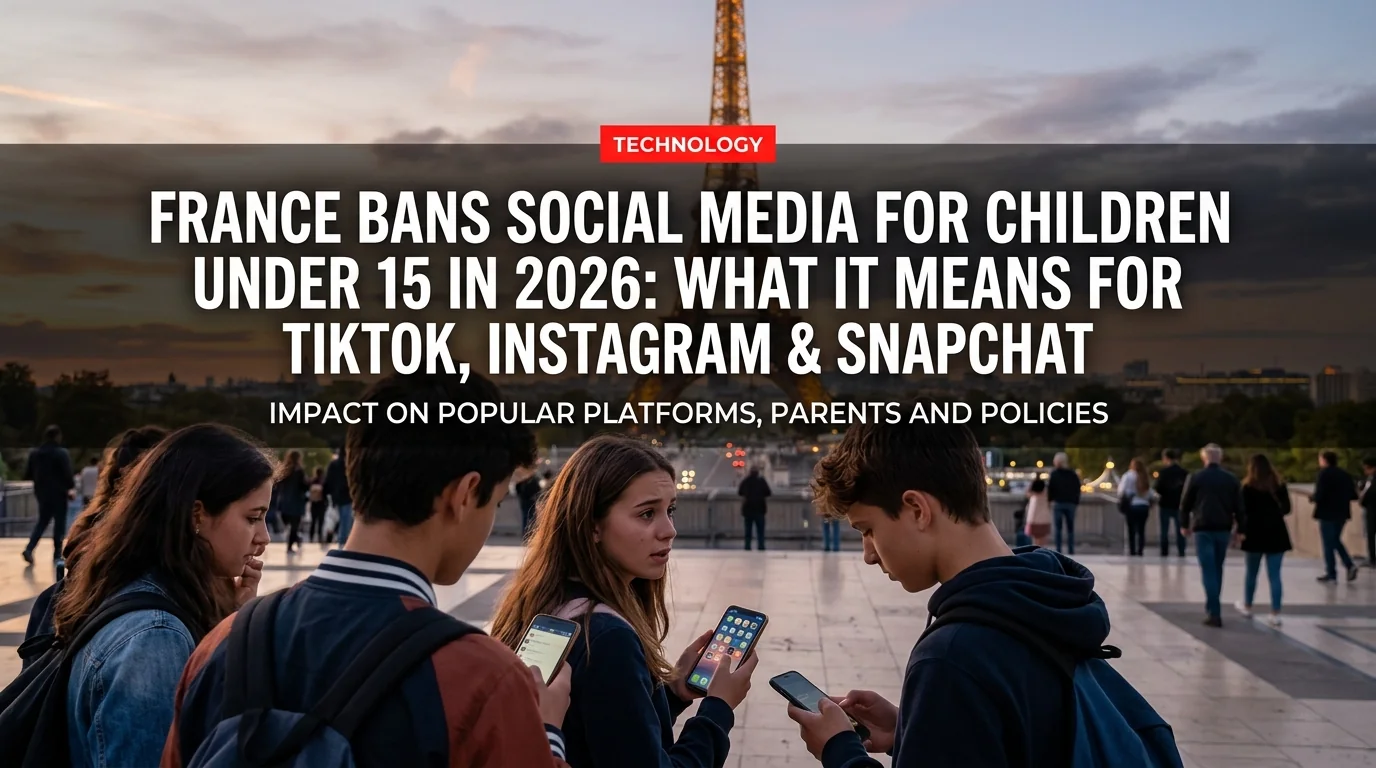
France has taken one of the boldest steps in the global push to protect children online: the French Senate approved a bill in April 2026 that would ban children under 15 from accessing social media platforms like TikTok, Instagram, and Snapchat. If the legislation passes into law — which requires reconciliation between the Senate and National Assembly — platforms could be barred from onboarding new users under 15 as early as September 2026.
This is not a soft parental advisory. This is a hard block, backed by fines that could reach 6% of a platform's global annual revenue under the EU's Digital Services Act (DSA) framework.
What the Law Actually Does
The legislation introduces a two-tier system. Here's how it breaks down:
Tier 1 — Full Ban: Platforms classified as harmful to a child's "physical, mental, or moral development" will be completely off-limits for users under 15. No workarounds. No parental override.
Tier 2 — Parental Consent: Other platforms — those not deemed explicitly harmful — may still allow under-15 access, but only with verified parental consent.
Exempt categories: Educational platforms and online encyclopedias (think Wikipedia, Khan Academy) are exempt from the restrictions entirely.
- Age threshold: Under 15 years old
- National Assembly vote: January 26, 2026
- Senate vote: April 1, 2026
- New accounts enforcement target: September 1, 2026
- Existing accounts deadline: December 31, 2026
- Maximum fine: 6% of global annual turnover
- Exemptions: Educational platforms, online encyclopedias
Which Platforms Are Affected?
While the law doesn't name platforms explicitly, the targets are obvious. TikTok, Instagram, Snapchat, X (formerly Twitter), and YouTube are all in scope. These are the platforms French teenagers use most — and the ones facing the steepest compliance burden.
Each platform will be required to implement a robust, privacy-preserving age verification system. This is technically challenging: verifying age without collecting sensitive identity documents at scale is an unsolved problem for much of the industry.
France is currently participating in an EU pilot program for a privacy-preserving age verification blueprint, but a comprehensive EU-level solution isn't expected until early 2027 — meaning France may be enforcing a law before the tools to enforce it properly exist.
- Strong protection for children's mental health
- Reduces cyberbullying exposure for minors
- Sets a legal precedent other EU countries may follow
- Backed by strong public support in France
- DSA fines give the law real teeth
- Age verification technology still immature at scale
- VPNs and workarounds easy for tech-savvy teens
- Senate and Assembly versions still need reconciliation
- May conflict with EU law (DSA harmonization concerns)
- Enforcement timeline may slip if verification tools aren't ready
Why This Matters Beyond France
France isn't acting alone. In December 2025, Australia implemented a social media ban for children under 16 — currently the strictest in the world. The UK has tightened its Online Safety Act to include strict age assurance requirements. The US is debating the KOSA (Kids Online Safety Act) at the federal level.
France's move is particularly significant because it sits inside the EU, where the Digital Services Act already creates a single regulatory layer for platforms. A French law that references DSA enforcement mechanisms could effectively become a template for pan-European children's online safety rules.
"This isn't just a French story," said one Brussels-based tech policy analyst. "If France makes this work at the national level, the Commission will be watching closely."
The Age Verification Problem
The biggest unanswered question is how. How do you verify that a new TikTok user is 15 or older without:
- Collecting sensitive ID documents (passports, national IDs) at massive scale
- Creating privacy nightmares and data breach risks
- Building systems that determined teenagers will immediately find ways around?
France's participation in the EU age verification pilot program is meant to address this. The proposed solution involves a trusted third-party identity layer — similar to how a bar uses a bouncer rather than collecting your ID to keep forever. But the technology is still being built.
In the meantime, critics point out that motivated 14-year-olds have always found ways to lie about their age online. Without a foolproof technical solution, enforcement falls back on platforms self-policing — and their track record there is not inspiring.
What Happens Next
For the law to take effect, a joint parliamentary committee must reconcile the National Assembly's version (a full ban) with the Senate's version (a two-tier system with parental consent exceptions). If negotiators agree on a compromise text — which is likely given cross-party support for the principle — the bill could be signed into law within weeks.
Platforms will then have until September 2026 to block new under-15 signups and until the end of 2026 to deactivate existing accounts that don't comply. Given the complexity of verifying age across hundreds of millions of accounts, the December deadline may prove aspirational.
For parents and teens in France, the practical reality is that enforcement will be imperfect — at least at first. But the law establishes a clear legal standard, and once age verification technology matures (likely tied to the EU digital identity framework), it will become much harder to simply lie about your age to get on TikTok.
The Bigger Picture: Children's Digital Rights
The debate over children and social media has shifted dramatically in the last two years. The release of Jonathan Haidt's The Anxious Generation in 2024 gave the movement academic and cultural momentum. Australia's sweeping ban showed it could actually be done. And now France — one of Europe's largest economies — is following with its own version.
The question is no longer whether governments will regulate social media access for minors. The question is how strict the rules will be, how enforceable they are, and whether they'll actually make teenagers safer — or just push them to less-regulated corners of the internet.
For now, France is betting that the answer is to draw a hard line at 15. The world is watching to see if it holds.