
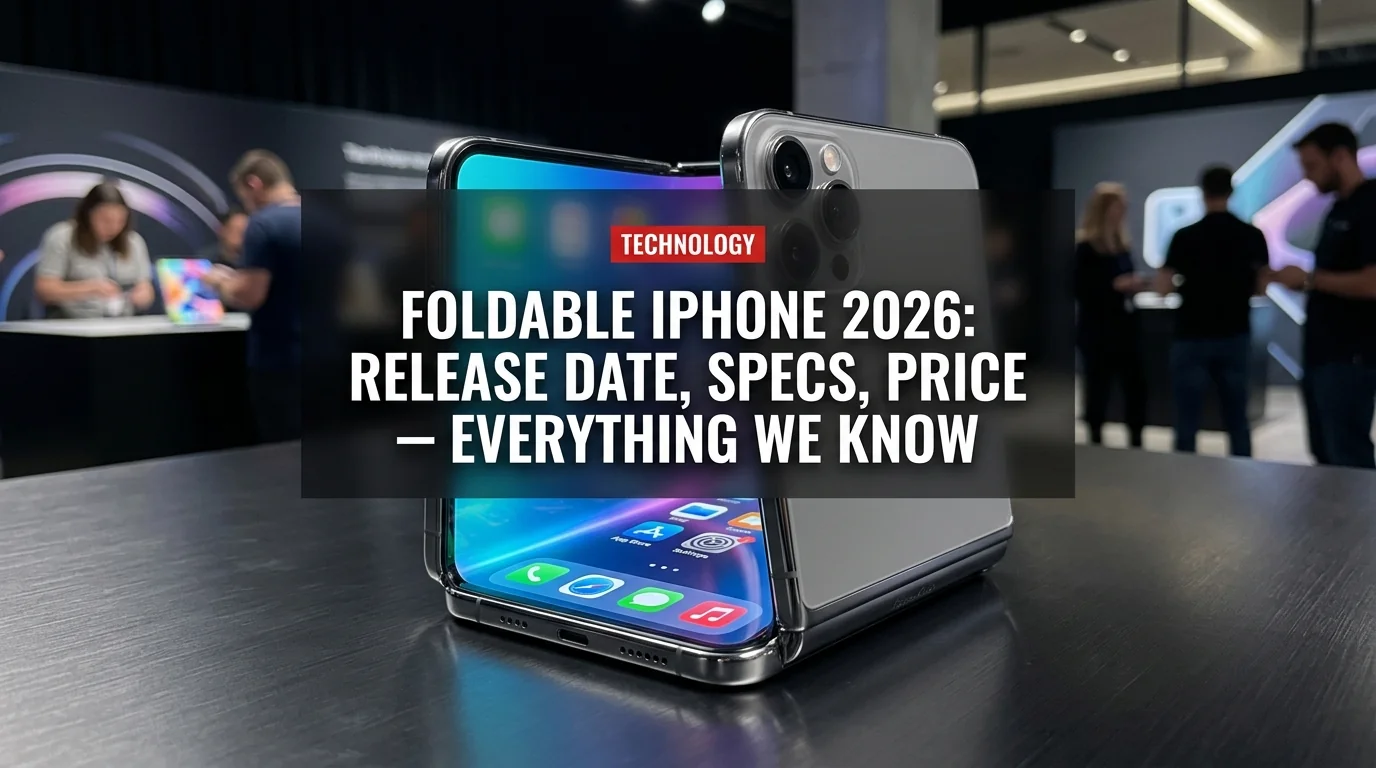
Apple's long-rumored foldable iPhone is finally taking shape. After years of patents, leaks, and analyst speculation, industry consensus now points to a late 2026 launch for what could be the most significant iPhone redesign since the iPhone X in 2017.
Here's everything we know — from confirmed supply chain details to pricing, specs, and how it stacks up against Samsung's Galaxy Z Fold.
- **Announcement:** September 2026 (alongside iPhone 18 Pro)
- **Shipping:** December 2026, possibly early 2027
- **Starting price:** $1,999–$2,500
- **Internal display:** 7.8 inches (unfolded)
- **Design:** Book-style horizontal fold
- **Chip:** A20 Pro (2nm process)
Why Apple Is Late to Foldables — and Why It Doesn't Matter
Samsung launched its first Galaxy Fold in 2019. Huawei, Motorola, and Google followed. Apple sat out for seven years.
That's not unusual. Apple entered the MP3 market four years after the first players. The iPhone arrived six years after PDA phones. The Apple Watch launched three years after Android Wear. In every case, Apple's late entry redefined the category.
KEY STAT: IDC projects Apple will capture 22% unit share and 34% of market value in its first year in the foldable segment.
Nabila Popal, Senior Research Director at IDC, put it bluntly: "Apple tends to be a catalyst for mainstream adoption. This will mark a turning point for the foldable segment."
Release Date: September Reveal, December Shipping
The iPhone Fold will be announced in September 2026 at Apple's annual keynote, sharing the stage with the iPhone 18 Pro lineup. But don't expect to buy one immediately.
Barclays analyst Tim Long reported that mass shipments are likely delayed to December 2026 due to early-stage yield challenges at Foxconn's Guanlan facility in China. TF International Securities analyst Ming-Chi Kuo corroborated this, noting that hinge production remains the bottleneck.
Some analysts, including Jeff Pu at Haitong International Securities, suggest retail availability could slip into early 2027 if yield rates don't improve by Q3.
Design and Display: Book-Style, Not Clamshell
Apple chose a book-style horizontal fold — the same form factor as Samsung's Galaxy Z Fold series. Bloomberg's Mark Gurman first described it as a "passport-style" design.
The internal OLED panel comes exclusively from Samsung Display, selected for its edge in minimizing screen creases — still the single biggest complaint about foldable phones. The ultra-thin glass (UTG) cover is supplied by China's Lens Technology.
The hinge is a joint effort between Foxconn and Taiwan's Shin Zu Shing (SZS), with additional components from US-based Amphenol. Ming-Chi Kuo reports hinge costs have dropped to $70–$80 per unit — critical for Apple's margin targets.
Full Specs Breakdown
| Spec | iPhone Fold (Rumored) | Galaxy Z Fold 6 |
|---|---|---|
| Internal Display | 7.8" OLED | 7.6" OLED |
| External Display | 5.5" | 6.3" |
| Processor | A20 Pro (2nm) | Snapdragon 8 Gen 3 |
| RAM | 12GB LPDDR5X | 12GB |
| Storage | 256GB / 512GB / 1TB | 256GB / 512GB / 1TB |
| Rear Camera | Dual 48MP | 50MP + 12MP + 10MP |
| Authentication | Touch ID (side button) | Fingerprint (side) |
| Thickness (folded) | ~9.2mm | 12.1mm |
| Battery | ~5,000mAh | 4,400mAh |
| Starting Price | $1,999 | $1,799 |
Pricing: Premium Territory
Expect the iPhone Fold to start at $1,999 for 256GB, stepping up to $2,199 for 512GB and $2,399 for 1TB. That's $200 more than the Galaxy Z Fold 6 at launch.
Despite the sticker shock, Apple's margins tell a different story. The estimated bill of materials (BOM) sits at $759 — about 4% lower than Samsung's Galaxy Z Fold SE at $790. That gives Apple a projected gross margin of 58–64%, significantly higher than the standard iPhone 16's 47%.
What the Critics Are Saying
Not everyone is sold. The $2,000+ price tag and missing Face ID are polarizing.
- Apple's thinnest foldable design at 4.6mm unfolded
- Larger 7.8" internal display than any Samsung Fold
- Superior gross margins suggest long-term pricing flexibility
- iOS ecosystem integration (expected foldable-optimized iPadOS features)
- Apple's "late but better" track record
- No Face ID — side-button Touch ID feels like a downgrade
- $2,000+ starting price limits mass adoption
- No telephoto lens (dual 48MP only)
- December shipping means limited holiday availability
- First-gen product — crease durability unproven
PCMag's Lance Whitney captured the skeptic view: "I'd rather not go through the hassles of being among the first to grapple with a foldable iPhone, especially with an eye-popping price tag."
The Competition: Samsung Isn't Waiting
Samsung and Huawei have both accelerated their 2026 roadmaps in response. Samsung is pushing its Galaxy Z Trifold — a tri-fold design — to maintain a technological lead. Huawei continues expanding its Mate X series in China.
But the numbers favor Apple. IDC forecasts 15–20 million iPhone Fold units shipped in the first 12–18 months. For context, Samsung shipped roughly 10 million foldables total in 2024. Apple's entry alone is expected to grow the global foldable market by 30% year-over-year in 2026.
What's Coming After the First Fold
Apple isn't stopping at one device. Reports already indicate:
- iPhone Fold 2 (2027): Second-generation model timed for the iPhone's 20th anniversary
- Foldable iPad/MacBook (2027–2028): A 20.3-inch foldable MacBook is rumored
- WWDC 2026 (June): Software previews of foldable-optimized "Home OS" and iPadOS features
The foldable iPhone isn't just a product launch. It's Apple's opening move in a multi-year hardware transformation — and the biggest bet the company has made since the iPhone X. Whether you buy one in December or wait for Gen 2, the smartphone market will never look the same.
Sources: Barclays Research, IDC Worldwide Quarterly Mobile Phone Tracker, TF International Securities (Ming-Chi Kuo), Bloomberg (Mark Gurman), 9to5Mac, CNET, MacRumors