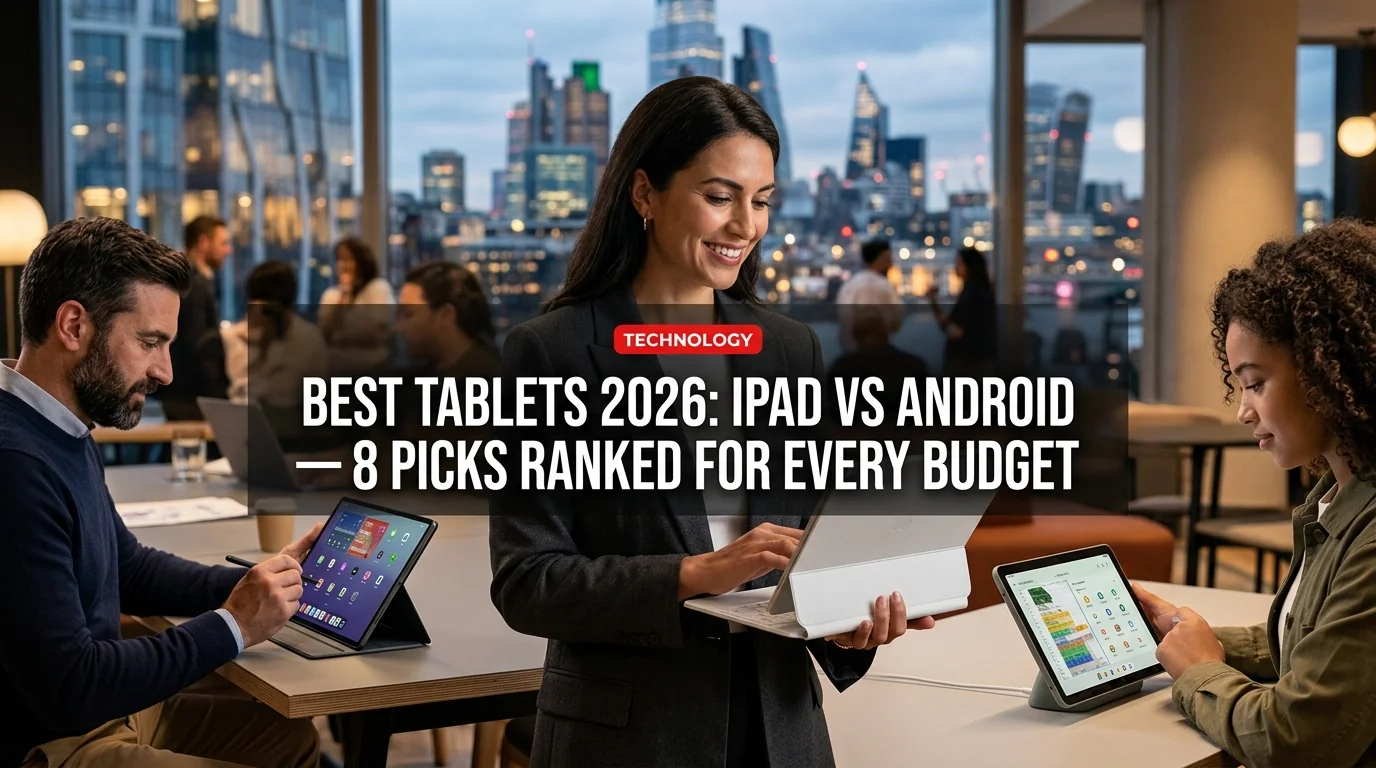
The tablet market in 2026 is more competitive than it's been in years. Apple still dominates with the M4-powered iPad Pro, but Samsung's Galaxy Tab S10 series, Google's Pixel Tablet 2, and even budget options from Amazon have never been better. Whether you're shopping for a creative workhorse, a portable office, or a screen to keep the kids busy on a road trip, there's a tablet built for your exact use case — and budget.
We've tested and ranked the 8 best tablets available in 2026, from the ultra-premium to the surprisingly affordable.
1. Apple iPad Pro M4 (2026 Edition) — Best Overall
The iPad Pro M4 remains the gold standard for tablets in 2026. Powered by Apple's M4 chip — the same silicon found in MacBook Pro — it handles everything from 4K video editing to 3D design without breaking a sweat. The Ultra Retina XDR OLED display is jaw-dropping: 2752×2064 resolution with ProMotion 120Hz and support for Apple Pencil Pro.
Apple also expanded iPadOS 18's Stage Manager this year, making split-screen multitasking genuinely productive. Pair it with the Magic Keyboard Folio and you have a device that legitimately replaces a laptop for most users.
Best for: Creative professionals, power users, video editors Starts at: $999 (11-inch) / $1,299 (13-inch)
- M4 chip is genuinely laptop-class performance
- Best display of any tablet — OLED with 120Hz ProMotion
- Apple Pencil Pro support for creatives
- Excellent software ecosystem and longevity
- Very expensive, especially with accessories
- iPadOS still has some desktop limitations
- No USB-A port (Thunderbolt/USB-C only)
2. Samsung Galaxy Tab S10 Ultra — Best Android Tablet
Samsung's Galaxy Tab S10 Ultra is the flagship Android experience in 2026. The 14.6-inch Dynamic AMOLED 2X display with 120Hz is stunning for content consumption, and the Snapdragon 8 Elite chip keeps performance neck-and-neck with iPad Pro for most tasks. The included S Pen is a huge value add — no extra purchase needed.
Dex Mode, Samsung's desktop interface, has matured significantly and makes this a real productivity option when connected to a monitor. The dual front cameras are ideal for video calls, and the 11,200mAh battery comfortably lasts a full workday.
Best for: Android power users, multitaskers, S Pen enthusiasts Starts at: $1,199
3. Apple iPad Air M3 — Best Mid-Range Tablet
For most people, the iPad Air M3 hits the sweet spot. You get Apple's M3 chip (plenty fast for everything except pro video work), the same 60Hz Liquid Retina display, USB-C with Thunderbolt speeds, and Apple Pencil Pro compatibility — all starting $400 cheaper than the Pro.
The 2026 model comes in 11-inch and 13-inch sizes. The 13-inch iPad Air is especially compelling: massive screen, M3 performance, and a price that undercuts the iPad Pro by $500.
Best for: Students, casual creatives, everyday productivity Starts at: $599 (11-inch) / $799 (13-inch)
4. Samsung Galaxy Tab S10+ — Best Large Android Under $1,000
The Galaxy Tab S10+ offers a 12.4-inch Dynamic AMOLED 2X display, Snapdragon 8 Elite, 12GB RAM, and S Pen support — all for $999. It's the most balanced premium Android tablet available: big enough to be productive, light enough to hold one-handed, and powerful enough for anything.
Best for: Android fans who want large-screen productivity without paying Ultra prices Starts at: $999
5. Google Pixel Tablet 2 — Best for Google Ecosystem
The Pixel Tablet 2, launched in early 2026, is Google's most polished tablet yet. Powered by the Tensor G5 chip (same as Pixel 9 Pro), it offers the fastest Android updates, best-in-class Google AI integration (Gemini on-device), and a unique charging speaker dock that turns it into a smart home hub when idle.
The 11-inch IPS display isn't as flashy as Samsung's OLED, but colors are accurate and the 2560×1600 resolution is sharp. If you're deep in Google's ecosystem — Gmail, Drive, Meet, YouTube Premium — this tablet feels purpose-built.
Best for: Google loyalists, smart home users, Gemini AI users Starts at: $499 (with dock)
6. Microsoft Surface Pro 11 — Best for Windows Users
If you need a real Windows PC in tablet form, the Surface Pro 11 with Snapdragon X Elite is the answer. Full Windows 11, Copilot+ AI features, and a 13-inch 2880×1920 display make this the closest thing to a true laptop replacement. The detachable keyboard cover (sold separately) completes the experience.
The Snapdragon X Elite delivers impressive performance and excellent battery life — we got 14 hours in real-world mixed use. The ARM-based chip has some app compatibility quirks, but Microsoft's compatibility layer handles most apps well by 2026.
Best for: Business users, Windows diehards, anyone needing full desktop apps Starts at: $1,099
- Runs full Windows 11 — no app limitations
- Snapdragon X Elite chip with Copilot+ AI
- Up to 14 hours battery life
- Keyboard cover and Surface Pen sold separately ($280+ extra)
- Supports LTE/5G models for mobile connectivity
7. Samsung Galaxy Tab A9+ — Best Mid-Range Android
Not everyone needs a flagship. The Galaxy Tab A9+ offers an 11-inch 90Hz LCD display, Snapdragon 695, and 8GB RAM for just $279. It handles streaming, light gaming, browsing, and video calls without issue. DeX mode is present (lite version), and the four-speaker setup with Dolby Atmos is genuinely impressive for the price.
Best for: Casual users, kids, secondary tablets Starts at: $279
8. Amazon Fire HD 10 (2026) — Best Budget Tablet
At $149, the Amazon Fire HD 10 2026 is the best value screen you can buy. The 10.1-inch 1080p display, 3GB RAM, and Fire OS are enough for Prime Video, Netflix, YouTube, reading, and casual browsing. Amazon loaded it with Alexa and it doubles as a smart display on its dock.
The app ecosystem is limited (no Google Play by default), and performance is modest — but for the price, nothing comes close.
Best for: Kids, gift giving, Amazon Prime households, casual readers Starts at: $149
iPad vs Android: How to Choose in 2026
- Best app ecosystem for tablets
- Longer software support (5-6 years)
- Apple Pencil is best-in-class stylus
- Seamless integration with iPhone/Mac
- Premium build quality across the lineup
- More customizable interface
- Better multitasking on Samsung (DeX)
- S Pen included with Tab S10 series
- More variety in screen sizes and prices
- Better Google app integration
Which Tablet Should You Buy?
Here's the fast answer based on your use case:
- Best overall: Apple iPad Pro M4 — no compromise performance
- Best value: Apple iPad Air M3 (13-inch) — near-Pro power, $500 less
- Best Android: Samsung Galaxy Tab S10 Ultra — flagship Android experience
- Best for work: Microsoft Surface Pro 11 — full Windows, real laptop replacement
- Best budget: Amazon Fire HD 10 2026 — $149, does what it says
- Best for kids: Samsung Galaxy Tab A9+ — durable, affordable, parental controls
- Best Google experience: Pixel Tablet 2 — Gemini AI, smart home integration
- Best large Android under $1K: Samsung Galaxy Tab S10+
The Bottom Line
In 2026, the iPad Pro M4 is still the best tablet money can buy — but "best" doesn't mean "right for you." The iPad Air M3 offers 90% of that experience at a much lower price point. Android fans will love the Galaxy Tab S10 series, especially for the included S Pen. And if you want Windows, the Surface Pro 11 is finally compelling hardware.
The biggest takeaway: there are more genuinely excellent tablets available today than ever before. Whatever your budget and use case, something on this list will make you wonder why you ever used a phone for everything.