
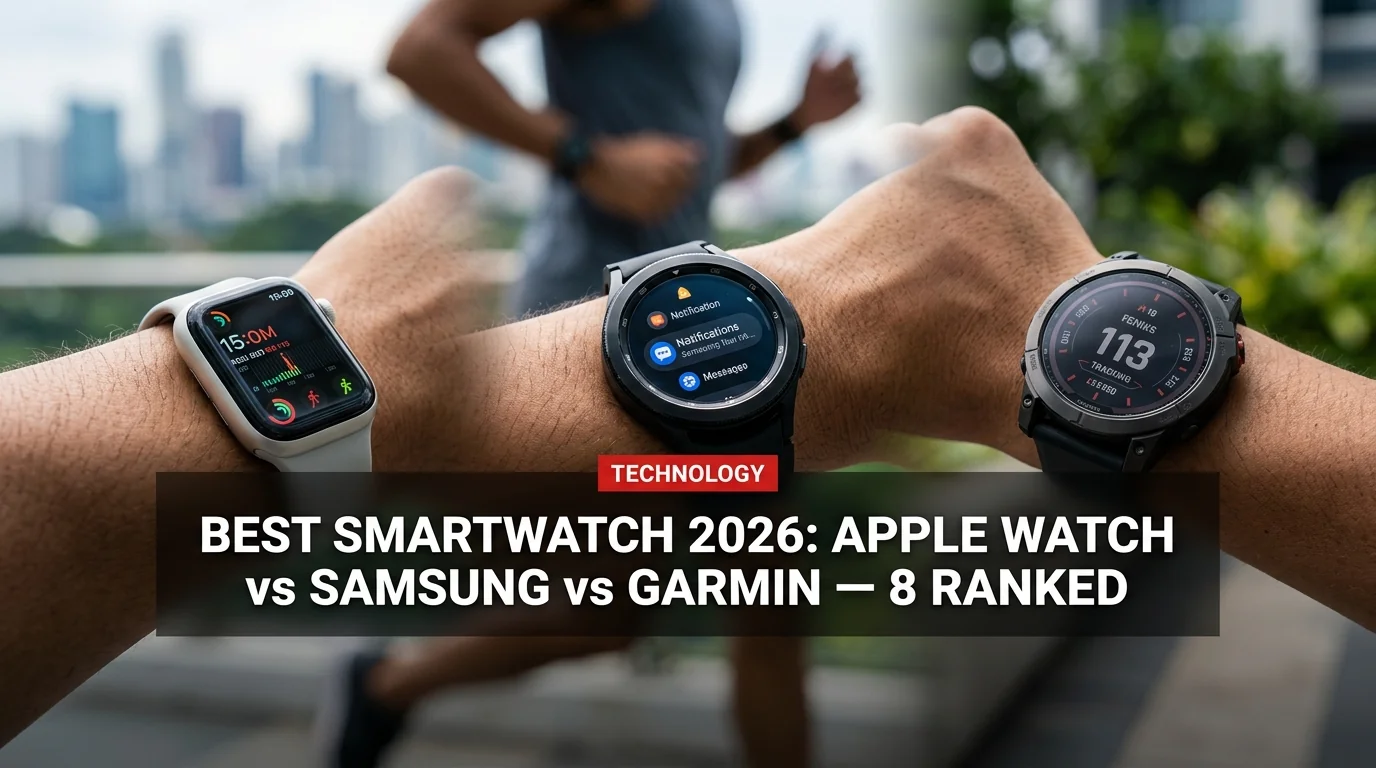
Smartwatches have become genuinely useful in 2026 — not just notification mirrors, but health monitors, fitness coaches, and navigation tools that matter. The problem? There are more options than ever, and the price gap between a $200 budget watch and a $800 ultra-endurance model is enormous.
We ranked eight of the best smartwatches you can buy right now, covering flagship, fitness, Android, and budget categories. Whether you want the best health tracking, the longest battery life, or the best value, here's where to put your money.
Quick Rankings
Here's the shortlist before we dive in:
- Apple Watch Ultra 3 — Best overall (iPhone users)
- Samsung Galaxy Watch 8 Ultra — Best overall (Android users)
- Garmin Fenix 8 — Best for serious athletes
- Google Pixel Watch 3 — Best value for Android
- Apple Watch Series 11 — Best everyday Apple watch
- Garmin Venu 4 — Best health-focused mid-range
- Samsung Galaxy Watch FE — Best budget Samsung
- Apple Watch SE (3rd gen) — Best budget Apple
1. Apple Watch Ultra 3 — Best Overall for iPhone Users
Price: $799 | Battery: 36–72 hours | OS: watchOS 11
The Apple Watch Ultra 3 is the best smartwatch money can buy — if you have an iPhone. Apple refined the Ultra formula with a slightly lighter titanium case, improved dual-frequency GPS, and a new wide-angle depth sensor for diving and outdoor use. The 49mm Always-On Retina display remains class-leading in brightness (up to 3,000 nits), readable even in direct sunlight.
Battery life hits 36 hours in standard mode and up to 72 hours in Low Power Mode — a real improvement over Ultra 2's 60-hour ceiling. The Action Button is still one of the best hardware additions Apple has ever made: instantly launchable workouts, compass waypoints, or Siri with a single press.
Health features include ECG, blood oxygen, skin temperature sensing, and crash detection. The new wrist temperature trend tracking (added in Ultra 2) gets smarter algorithms in Ultra 3, giving more accurate cycle tracking and illness early detection.
Who it's for: Serious athletes, hikers, swimmers, and iPhone users who want the absolute best.
Verdict: Worth the premium if you'll use the rugged build and dual GPS. Otherwise, the Series 11 gives 85% of this at half the price.
2. Samsung Galaxy Watch 8 Ultra — Best Overall for Android
Price: $649 | Battery: 48 hours | OS: Wear OS 5 / One UI Watch
Samsung's Galaxy Watch 8 Ultra picks up where the 7 Ultra left off — and fixes its main complaint: battery life. The new Exynos W1000 chip cuts power draw significantly, delivering 48 hours of real-world use with always-on display enabled. That's class-leading for a round-face premium watch.
The titanium squircle frame looks polarizing but feels premium. Health tracking is now on par with Apple: continuous heart rate, ECG, blood pressure monitoring (requires calibration), body composition, and a sleep apnea detection feature certified by health regulators.
The Galaxy AI integration is standout: on-device translation, smart workout coaching, and automatic workout detection now work faster and more accurately. It pairs best with Samsung Galaxy phones but works fine with any Android device.
Who it's for: Android users, Samsung Galaxy phone owners, fitness-focused users who hate the Apple ecosystem.
3. Garmin Fenix 8 — Best for Serious Athletes
Price: $899 | Battery: 16 days (smartwatch) / 46 days (GPS off) | OS: Garmin OS
If you run marathons, do triathlons, or spend serious time outdoors, the Garmin Fenix 8 is in a different league. No other watch gives you 16 days of battery in smartwatch mode combined with the most accurate multi-band GPS on the market.
Fenix 8 adds a built-in speaker and microphone for the first time, meaning you can take calls and use voice commands without your phone nearby. The new sapphire glass lens (standard on higher tiers) is nearly scratch-proof. Training status, recovery advisor, and VO2 max estimates from Garmin are still the gold standard among serious endurance athletes.
The trade-off: Garmin OS feels outdated compared to watchOS or Wear OS. App selection is limited. Notifications work but aren't elegant. The Fenix 8 is a GPS device that happens to send texts, not a smartwatch that also tracks GPS.
Who it's for: Ultra-endurance athletes, hikers, military, anyone who needs 2+ weeks of battery without compromise.
- 16-day battery life in smartwatch mode
- Most accurate multi-band GPS available
- Built-in speaker/mic (new in Fenix 8)
- Sapphire glass, titanium case options
- Best-in-class training load and recovery metrics
- $899 starting price
- Garmin OS lacks third-party apps
- Bulky on smaller wrists
- Not ideal for everyday smartwatch use
4. Google Pixel Watch 3 — Best Value for Android
Price: $349 (41mm) / $399 (45mm) | Battery: 24 hours | OS: Wear OS 4
The Pixel Watch 3 represents Google finally getting smartwatches right. Battery life improved dramatically from its predecessors — 24 hours with always-on display on the 45mm model. The polished aluminum case and Gorilla Glass 5 screen make it the most elegant non-Apple smartwatch available.
Fitbit integration (Google owns Fitbit) means best-in-class sleep tracking, stress monitoring, and readiness scores. The Running Coach feature — powered by Fitbit algorithms — gives real-time form feedback and suggested training plans that actually adapt to your history.
For the price, the health sensor suite is exceptional: heart rate, SpO2, ECG, skin temperature. Google Maps navigation with turn-by-turn haptics works seamlessly. The 45mm size especially makes battery anxiety much more manageable.
Who it's for: Android users who want a premium look without Samsung's price tag, Fitbit fans upgrading to a proper smartwatch.
5. Apple Watch Series 11 — Best Everyday Apple Watch
Price: $399 | Battery: 24 hours | OS: watchOS 11
For most iPhone users, the Series 11 is the right answer — not the Ultra. Apple refined the Series 11 with a thinner aluminum case, faster S11 chip, and the same health sensors as the Ultra (minus dual GPS and depth sensing). You get ECG, blood oxygen, crash detection, and fall detection at half the Ultra's price.
The new carbon neutral aluminum options and updated band colors make it the most personalization-friendly Apple Watch yet. Connectivity is identical: LTE, WiFi 6, Bluetooth 5.3, and Ultra Wideband for precise iPhone finding.
Battery life at 24 hours is still the one glaring limitation. Heavy GPS users (outdoor runs, hikes) will need to charge daily. Apple hasn't solved this, and Samsung and Garmin have lapped them here.
Who it's for: Most iPhone users. The everyday sweet spot between price and performance.
6. Garmin Venu 4 — Best Health-Focused Mid-Range
Price: $449 | Battery: 10 days (without GPS) | OS: Garmin OS
The Garmin Venu 4 targets health-obsessed users who want Garmin's sensor accuracy without the Fenix's athletic intensity. The AMOLED display is gorgeous — one of the best screens Garmin has shipped. You get Body Battery energy monitoring, stress tracking, sleep stages, Pulse Ox, and women's health features in a stylish package.
Battery life hits 10 days in smartwatch mode, 5 days with always-on display enabled. That's dramatically better than Apple or Samsung while still delivering a usable smart experience. Garmin Connect app has improved meaningfully — syncing health insights to third-party apps like Strava, Apple Health, and MyFitnessPal is now seamless.
Who it's for: Health-focused buyers who want great sensors and multi-day battery without the rugged Fenix bulk.
7. Samsung Galaxy Watch FE — Best Budget Samsung
Price: $199 | Battery: 40 hours | OS: Wear OS / One UI Watch
The Galaxy Watch FE brings Samsung's health platform to a budget price without significant compromise on sensors. You still get ECG, blood oxygen, blood pressure (with calibration), and Samsung's excellent sleep tracking. The design borrows from the Galaxy Watch 4 — proven and comfortable.
40-hour battery life is excellent at this price. Android compatibility is broad, not just Samsung phones. The trade-off is an older Exynos chip that feels slower in menus, no LTE option, and a plastic build that doesn't match the premium feel of the Galaxy Watch 8 series.
Who it's for: Android users on a budget who want Samsung's health features without the $600+ price tag.
8. Apple Watch SE (3rd Gen) — Best Budget Apple
Price: $249 | Battery: 18 hours | OS: watchOS 11
Apple's budget pick loses ECG and blood oxygen sensing compared to the Series 11 but keeps crash detection, fall detection, heart rate monitoring, and the full watchOS 11 experience. The S9 chip makes it fast. The Retina display looks sharp. It works with every iPhone accessory and every Apple Watch band.
For kids, teens, or anyone who wants an iPhone companion without health obsession, the SE 3rd gen makes perfect sense. Just don't buy it if you care about ECG or blood oxygen — pay the $150 extra for the Series 11.
Who it's for: First-time smartwatch buyers, kids/teens, Apple ecosystem users who don't need advanced health tracking.
Head-to-Head Comparison
- Best-in-class display brightness
- Dual-frequency GPS
- Deep iPhone/iOS integration
- 36–72 hr battery
- $799
- Best Android health platform
- Blood pressure monitoring
- 48 hr battery
- Galaxy AI features
- $649
Which Smartwatch Should You Buy in 2026?
Buy the Apple Watch Ultra 3 if: You have an iPhone, do serious outdoor sports, and want the best screen and GPS money can buy. The premium is justified for athletes and adventurers.
Buy the Samsung Galaxy Watch 8 Ultra if: You're on Android and want the best possible health platform. Blood pressure monitoring alone sets it apart from every other option at this tier.
Buy the Garmin Fenix 8 if: Battery life is non-negotiable. If you're training for a marathon, thru-hiking, or deploying somewhere remote, nothing else competes.
Buy the Apple Watch Series 11 if: You want 90% of the Ultra's smarts at half the price. This is the right Apple Watch for most people.
Buy the Google Pixel Watch 3 if: You're on Android and want premium looks with Fitbit's sleep tracking at a more reasonable price than Samsung.
- Apple Watch Ultra 3 leads on display, GPS, and iOS integration
- Samsung Galaxy Watch 8 Ultra is the best smartwatch for Android users in 2026
- Garmin Fenix 8 is unmatched for battery life — up to 16 days
- Budget picks (Watch SE, Galaxy Watch FE) deliver health basics for under $250
- Blood pressure monitoring is now available on Samsung, pending FDA clearance in the US
- Always-On Displays now standard across all flagship models
Final Verdict
The 2026 smartwatch market is mature, competitive, and genuinely split by ecosystem. iPhone users should strongly consider the Series 11 as their default, upgrading to the Ultra 3 only if they push it with outdoor sports. Android users now have a genuinely excellent choice in the Galaxy Watch 8 Ultra — Samsung's health platform has closed the gap with Apple.
For anyone who needs serious battery life for training or travel, Garmin remains in a class of its own. The Fenix 8's 16-day battery isn't a marketing claim — it's a life-changer for athletes who hate charging.
Whatever you choose, 2026's smartwatches are the most health-capable, longest-lasting, and most genuinely useful they've ever been.