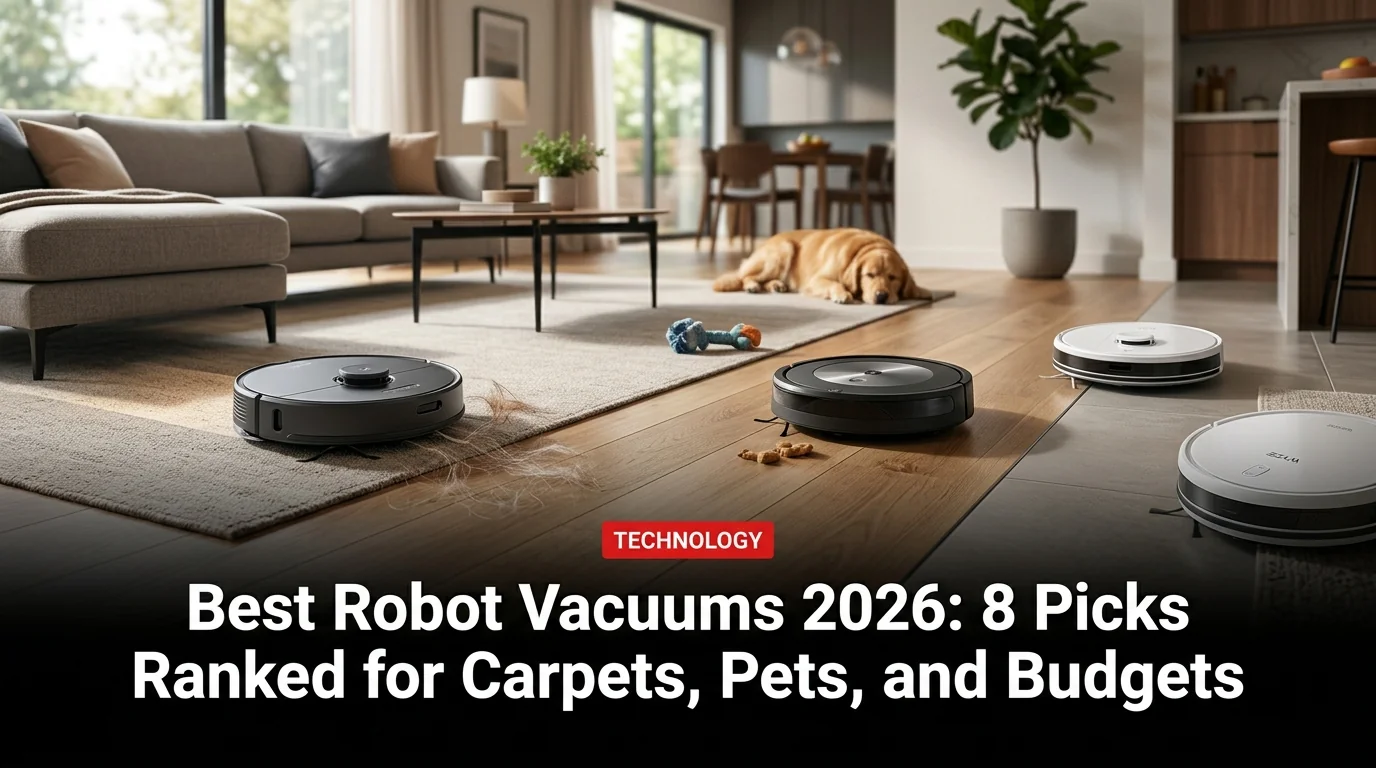
Robot vacuums have gotten genuinely good. What used to be a gimmick that bumped into furniture and missed corners has evolved into smart, self-emptying machines with AI obstacle avoidance and precision room mapping. But with prices ranging from $150 to $1,800, picking the right one matters.
We ranked the 8 best robot vacuums of 2026 based on suction power, navigation accuracy, mopping capability, battery life, and real-world usability — including the tariff-adjusted prices you'll actually pay.
Our Top 8 Robot Vacuums of 2026
1. Roborock S8 MaxV Ultra — Best Overall
Price: ~$1,499 | Suction: 10,000 Pa | Self-empty: Yes | Mop: Yes
The Roborock S8 MaxV Ultra earns the top spot because it does everything exceptionally well. The 10,000 Pa suction handles thick carpet pile, the AI-powered ReactiveAI 3.0 camera system recognizes and avoids over 70 object types (including pet waste — a major win), and the all-in-one dock washes, dries, and refills the mop pad automatically.
You can leave this robot alone for weeks. The dock empties debris, washes mop pads with hot water, and dries them to prevent mildew. The only catch is the price tag — and finding a spot for the dock, which is about the size of a small microwave.
Best for: Large homes, pet owners, people who want full automation.
2. Ecovacs Deebot X8 Pro Omni — Best for Pet Hair
Price: ~$1,199 | Suction: 12,500 Pa | Self-empty: Yes | Mop: Yes
If pet hair is your primary problem, the Ecovacs X8 Pro Omni's 12,500 Pa suction — the highest on this list — makes it the specialist pick. The rubber brush roller doesn't tangle with long fur the way bristle brushes do, and the AIVI 3D obstacle detection reliably spots food bowls, toys, and the occasional dog.
The mopping system uses a mechanical scrubbing action rather than just dragging a wet pad, which handles dried mud and sticky paw prints better than competitors. Battery life at around 180 minutes means it can do a 3,000 sq ft home without returning to dock.
Best for: Homes with multiple pets, especially dogs and long-haired cats.
- Highest suction on the market (12,500 Pa)
- Tangle-free rubber brush for pet hair
- Excellent mop scrubbing on hard floors
- 180-minute battery covers large homes
- Dock is bulky and requires 2ft clearance
- App has a learning curve
- Expensive, especially post-tariff
3. iRobot Roomba Combo j9+ — Best for Mixed Flooring
Price: ~$1,099 | Suction: 6,000 Pa | Self-empty: Yes | Mop: Yes
Roomba's j9+ solves the biggest robot vacuum frustration: getting a wet mop near carpet. Its retractable mop lifts automatically when the robot transitions from hard floor to carpet — no manual switching, no wet carpet edges.
The PrecisionVision Navigation identifies 80+ obstacle types, and iRobot's CleanBase dock holds 60 days of debris. iRobot's mapping is the most mature in the industry after decades of refinement, and the integration with Google Home, Alexa, and Apple Home is flawless.
Suction isn't quite at Roborock or Ecovacs levels, but it's more than adequate for medium-pile carpet and everyday dust.
Best for: Homes with lots of carpet-to-hardwood transitions.
4. Roborock Q8 Max+ — Best Mid-Range
Price: ~$699 | Suction: 5,500 Pa | Self-empty: Yes | Mop: Yes
The sweet spot between performance and price. The Q8 Max+ packs a self-emptying dock, solid 5,500 Pa suction, and the same LiDAR-based mapping as Roborock's flagship into a package that doesn't require a second mortgage.
It lacks the AI camera obstacle avoidance of premium models (relying on structured light instead), so you'll want to do a quick toy-pickup before running it. The mop lifts when over carpet, and the dock empties every run. For most apartments and medium homes, this is all you need.
Best for: Most people. Apartments, 2-3 bedroom homes, anyone on a sensible budget.
5. Dreame L10s Ultra Gen 2 — Best Mopping Performance
Price: ~$999 | Suction: 7,000 Pa | Self-empty: Yes | Mop: Yes
Dreame has been quietly building the best mopping technology in the industry. The L10s Ultra Gen 2 uses dual side-by-side rotating mop pads that spin at high speed and apply downward pressure — it genuinely scrubs floors rather than wiping them.
For homes with tile or sealed hardwood that gets genuinely dirty (kitchens, bathrooms where it can reach), the mopping performance beats everything else on this list. Suction is competitive at 7,000 Pa, and the dock handles full maintenance automatically.
Best for: Hard floor homes, kitchens, anyone who hates mopping.
6. Shark Matrix Plus 2-in-1 — Best for Small Apartments
Price: ~$449 | Suction: 4,000 Pa | Self-empty: Yes | Mop: Yes
Shark's Matrix Plus doesn't have the raw power or AI smarts of the premium picks, but it nails the essentials for smaller spaces at a reasonable price. The Matrix Clean Home Mapping creates a grid-based cleaning pattern that ensures full floor coverage, and the self-empty base holds 45 days of debris.
The companion app is genuinely intuitive, and Shark's customer support in the U.S. is easier to reach than most Chinese brands' support. At under $450 with a self-emptying dock, it's hard to argue with.
Best for: Apartments under 1,200 sq ft, first-time robot vacuum buyers.
7. Eufy X10 Pro Omni — Best Budget Self-Empty
Price: ~$599 | Suction: 8,000 Pa | Self-empty: Yes | Mop: Yes
At $599 with a self-emptying, self-washing dock, the Eufy X10 Pro Omni offers specs that would have cost $1,200 in 2023. The 8,000 Pa suction is strong enough for thick carpet, the AI obstacle avoidance works well, and Eufy's app is clean and easy to use.
The trade-off is build quality that feels one step below Roborock and iRobot, and a smaller debris bin in the dock (30 days vs 60). It also requires Wi-Fi 2.4GHz, which trips up people on newer mesh networks.
Best for: Value hunters who want premium features without the premium price.
8. iRobot Roomba Vac Essential — Best Under $200
Price: ~$179 | Suction: 2,500 Pa | Self-empty: No | Mop: No
If you just need a robot that vacuums on a schedule and doesn't require babysitting, the Roomba Vac Essential does the job. No mapping, no app required — set a schedule with the physical button, and it does random-pattern cleaning while you're at work.
It won't wow you, but for a studio apartment or a second home you want to keep tidy, it's reliable, repairable, and cheap enough to not stress about.
Best for: Minimalists, second homes, people who want zero tech complexity.
Buying Guide: What to Look for in 2026
Suction power (Pa): For carpets, you want 5,000 Pa minimum. Pet hair on thick carpet needs 7,000+. Hard floors are fine with 2,000–4,000 Pa.
Navigation type: LiDAR (laser) mapping is the gold standard — accurate, fast room learning, works in the dark. Camera-based (vSLAM) is cheaper but struggles in low light. Gyroscope/random-bounce (Roomba Vac Essential) is basic but reliable.
Self-emptying dock: Worth it if you don't want to empty the bin after every run. The dock holds 30–60 days of debris. Expect to pay $150–$300 more for this feature.
Mopping capability: Check if the mop lifts when over carpet (critical) and whether the dock washes the mop pads (strongly recommended — a mop that doesn't get washed just smears dirt around).
Obstacle avoidance: AI cameras are significantly better than structured light at recognizing small objects, cables, and pet waste. If you have kids or pets, pay for this feature.
- Robot vacuum market grew 24% in 2025, now a $7.4B global industry
- Top-tier models now have AI that recognizes 70+ object types
- Tariffs added $80–$250 to average robot vacuum prices in 2026
- Self-emptying docks reduce required maintenance to every 30–60 days
- LiDAR navigation creates accurate floor maps in as little as one run
Frequently Asked Questions
Are robot vacuums worth it in 2026? Yes — if you're realistic about what they do. They keep floors consistently clean between manual vacuums. They don't replace a deep clean, but they dramatically reduce how often you need one. Most owners report vacuuming manually half as often after buying a robot.
Which robot vacuum is best for pet hair? The Ecovacs Deebot X8 Pro Omni wins on raw suction and tangle-resistant brush design. The Roborock S8 MaxV Ultra is a close second with better obstacle avoidance (including AI pet waste detection).
Do robot vacuums work on thick carpet? Yes, but you need sufficient suction — 5,000 Pa minimum, 7,000+ for plush or shag carpet. Models with carpet boost mode automatically increase suction when they detect carpet.
Can a robot vacuum replace a regular vacuum? For most people with hard floors and low-pile carpet: yes, 90% of the time. For homes with high-pile carpet, stairs (robots can't do stairs), or heavy debris: no — use both.
How long do robot vacuums last? Premium models (Roborock, iRobot, Ecovacs) typically last 4–7 years with brush and filter replacements. Budget models average 2–3 years. Replacement parts are the bigger cost consideration than the initial price.
The Bottom Line
For most people, the Roborock Q8 Max+ at $699 is the sweet spot — self-emptying, strong suction, reliable mapping, and competitive mopping without the flagship price tag.
If budget isn't a concern and you want the most autonomous experience possible, the Roborock S8 MaxV Ultra is genuinely impressive — run it for a month and you'll wonder how you ever lived without it.
And if you're just testing the waters, the Roomba Vac Essential at $179 is a low-risk entry point that does what it says.