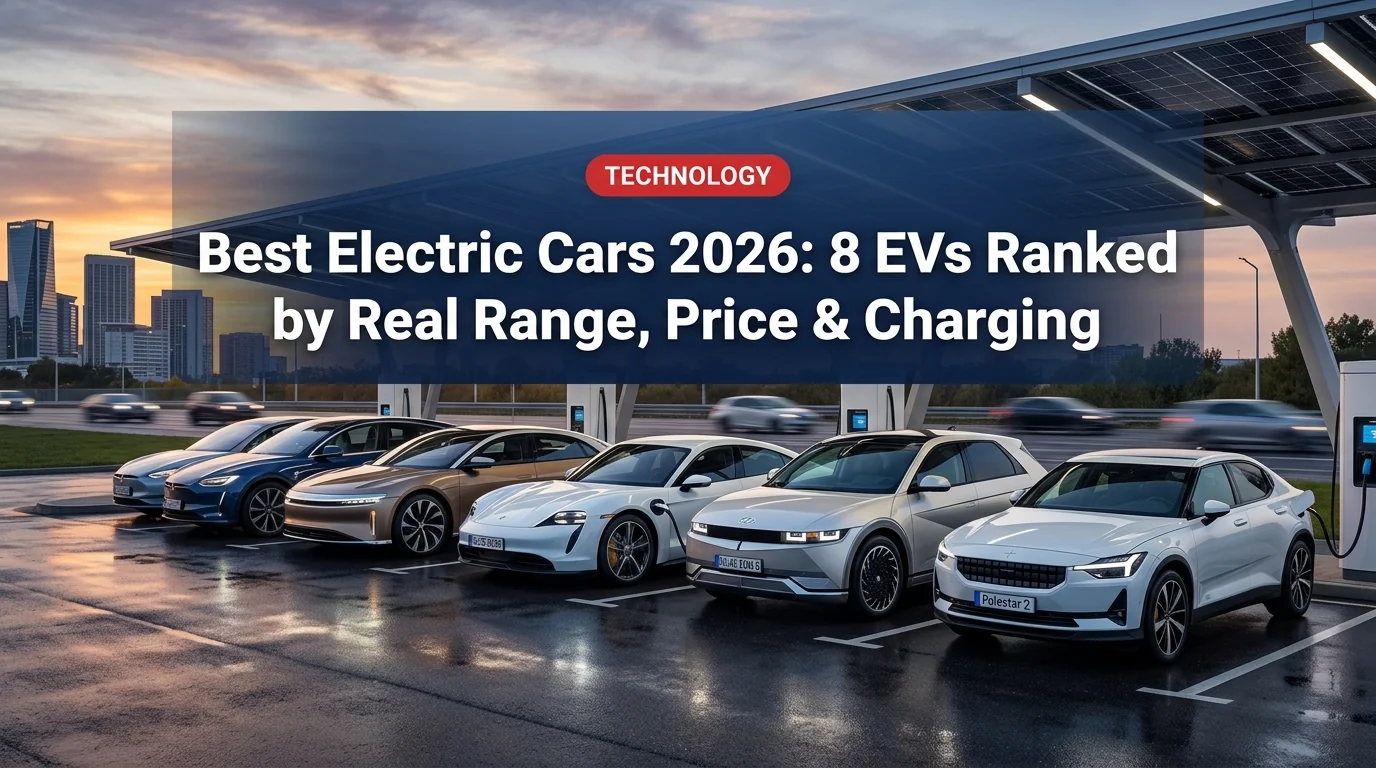
Buying an electric car in 2026 is genuinely exciting — and genuinely confusing. Ranges have climbed past 300 miles on mid-priced models, charging networks finally cover most of the US, and prices have come down. But import tariffs introduced in 2025 pushed some models up by $3,000–$8,000, reshuffling the value rankings overnight.
We cut through the noise and ranked the eight best EVs available right now based on real-world range (not EPA estimates), total cost of ownership over five years, charging speed, and what it's actually like to live with one day-to-day.
How We Ranked These EVs
EPA range numbers are optimistic by 10–15%. We weight real-world range figures from owner data and independent tests. Total cost includes purchase price minus federal tax credit (where applicable), estimated electricity cost over 5 years, and insurance averages. Charging score reflects network coverage, peak charging speed, and plug-in simplicity.
1. Hyundai Ioniq 6 — Best Overall
Starting price: $38,615 | Real-world range: ~330 miles (RWD)
The Ioniq 6 remains the sweet spot of the EV market in 2026. Its 800V architecture charges from 10% to 80% in about 18 minutes on a 350kW charger. The aerodynamic design (0.21 Cd) is genuinely efficient rather than just a talking point. With the $7,500 federal tax credit still applying to the base trim, you're looking at an effective price under $32,000.
The interior is polarizing — minimalist to the point of sparse — but the driving range and charging speed are hard to beat at this price.
2. Tesla Model Y (Refreshed) — Best Charging Network
Starting price: $44,990 | Real-world range: ~310 miles (Long Range RWD)
The refreshed Model Y, which arrived in late 2025, fixed most of the original's fit-and-finish complaints. The interior is now genuinely premium. But the real reason to buy a Tesla in 2026 is still the Supercharger network — 15,000+ stations in North America with consistent 250kW speeds.
The over-the-air update cadence means the car you have in two years will meaningfully outperform the one you bought. The mandatory FSD subscription is still annoying. Domestic assembly means tariffs haven't hit Tesla pricing as hard as rivals.
3. Chevrolet Equinox EV — Best Value
Starting price: $34,995 | Real-world range: ~280 miles
The Equinox EV is the most important EV of the decade precisely because it's boring in the best possible way. It looks like a normal Chevy crossover, costs less than a loaded Camry, and covers 280 miles between charges. GM's manufacturing efficiency keeps it under the $35,000 threshold for the full federal tax credit — even after 2025's tariff rounds.
The DC fast charging max of 150kW is behind the Ioniq 6 and Model Y, meaning road trips need more stops. But for the 90% of drivers who charge at home, that's irrelevant.
- Lowest price of any credible long-range EV
- Qualifies for full $7,500 federal tax credit
- Normal crossover design with no learning curve
- Solid GM dealer network for service
- 150kW max charging speed trails rivals
- Interior materials feel economy at this price
- Limited DC fast charger network vs Tesla Superchargers
4. Kia EV6 GT — Best Performance EV Under $65K
Starting price: $42,600 (standard) | $62,900 (GT) | Real-world range: ~285 miles
The EV6 GT is the closest thing to a sports car in this list. Dual motors push 576 hp, hitting 0–60 in 3.4 seconds. The 800V architecture is shared with the Ioniq 6, so charging is fast. For drivers who want an EV that's genuinely fun to drive — not just economical — this is the answer.
Note: South Korean EV tariffs added roughly $4,500 to EV6 pricing in 2025. The GT is still competitive at its price, but the standard EV6 now faces stiff value competition from domestic rivals.
5. Ford Mustang Mach-E (2026 Update) — Best for Ford Ecosystem Users
Starting price: $42,995 | Real-world range: ~295 miles
The 2026 Mach-E update added a larger 98 kWh battery and improved charging management software. The result is a 10% range bump and better cold-weather performance. Ford's BlueOval Charge Network now includes 19,000+ Level 2 and DC fast chargers.
If you already own a Ford F-150 or use FordPass, the integrated experience is genuinely good. If you're coming from outside the Ford ecosystem, the Ioniq 6 or Model Y offer more for similar money.
6. BMW iX xDrive50 — Best Luxury EV
Starting price: $87,100 | Real-world range: ~310 miles
The iX remains the benchmark for luxury EVs that aren't a Lucid. The 11.5kW onboard charger means overnight Level 2 charging goes faster than any rival. The interior uses sustainable materials without looking like a science project. BMW's driving dynamics translate well to an electric platform.
Tariffs hurt BMW more than most — the iX is assembled in Germany, adding roughly $7,000 to its 2025 MSRP. At $87K it's expensive but not outrageous for what's delivered.
7. Rivian R2 — Best New EV of 2026
Starting price: $45,000 (est.) | Real-world range: ~300 miles (projected)
The R2 is the most anticipated EV launch of 2026. Rivian's smaller, more affordable sibling to the R1S starts at roughly $45,000 and targets the same family crossover buyer as the Model Y. Early deliveries began Q1 2026 with mostly positive reviews: solid range, Rivian's adventurous design language scaled down nicely, and access to both the Rivian Adventure Network and Tesla Superchargers via adapter.
It's too early for long-term reliability data, but initial quality reports are encouraging. Worth waiting for if you're in the market now.
8. Honda Prologue — Best for Honda Loyalists
Starting price: $47,400 | Real-world range: ~275 miles
The Prologue is a decent first EV for Honda loyalists — familiar interior ergonomics, reliable brand, GM Ultium platform underneath. But Honda's EV ecosystem is still developing, and at $47,400 you can get more range and better charging from the Ioniq 6 or Equinox EV. The Prologue makes the list as a safe choice for buyers who don't want to stray far from what they know.
Tariff Impact: What You Need to Know
The 2025 tariff rounds created a two-tier EV market. Domestically assembled EVs (Tesla, Chevy, Ford, Rivian) avoided the worst of the increases. Korean and German imports (Ioniq 6, EV6, BMW iX) absorbed $3,500–$8,000 in added costs — some passed to buyers, some absorbed by manufacturers.
The Ioniq 6 still offers the best value despite the tariff hit, but its price advantage over the Equinox EV has narrowed significantly. If tariff relief comes in H2 2026 (possible, not guaranteed), Korean EV pricing could reset again.
Which EV Should You Buy?
- Best value under $35K: Chevy Equinox EV — boring, brilliant, affordable
- Best overall: Hyundai Ioniq 6 — fastest charging, longest range per dollar
- Best road trip car: Tesla Model Y — Supercharger network is still unmatched
- Best performance: Kia EV6 GT — 576hp, 0-60 in 3.4s under $65K
- Best luxury: BMW iX — premium without trying too hard
- Best new arrival: Rivian R2 — most exciting debut of 2026
The EV market in 2026 has reached a tipping point: these are no longer compromised cars for early adopters. They're better in most daily-use metrics than their gas equivalents. The question is no longer "should I buy an EV" — it's which one fits your budget, charging setup, and driving patterns.
If you charge at home and drive under 200 miles a day, almost any car on this list will serve you well for years.