
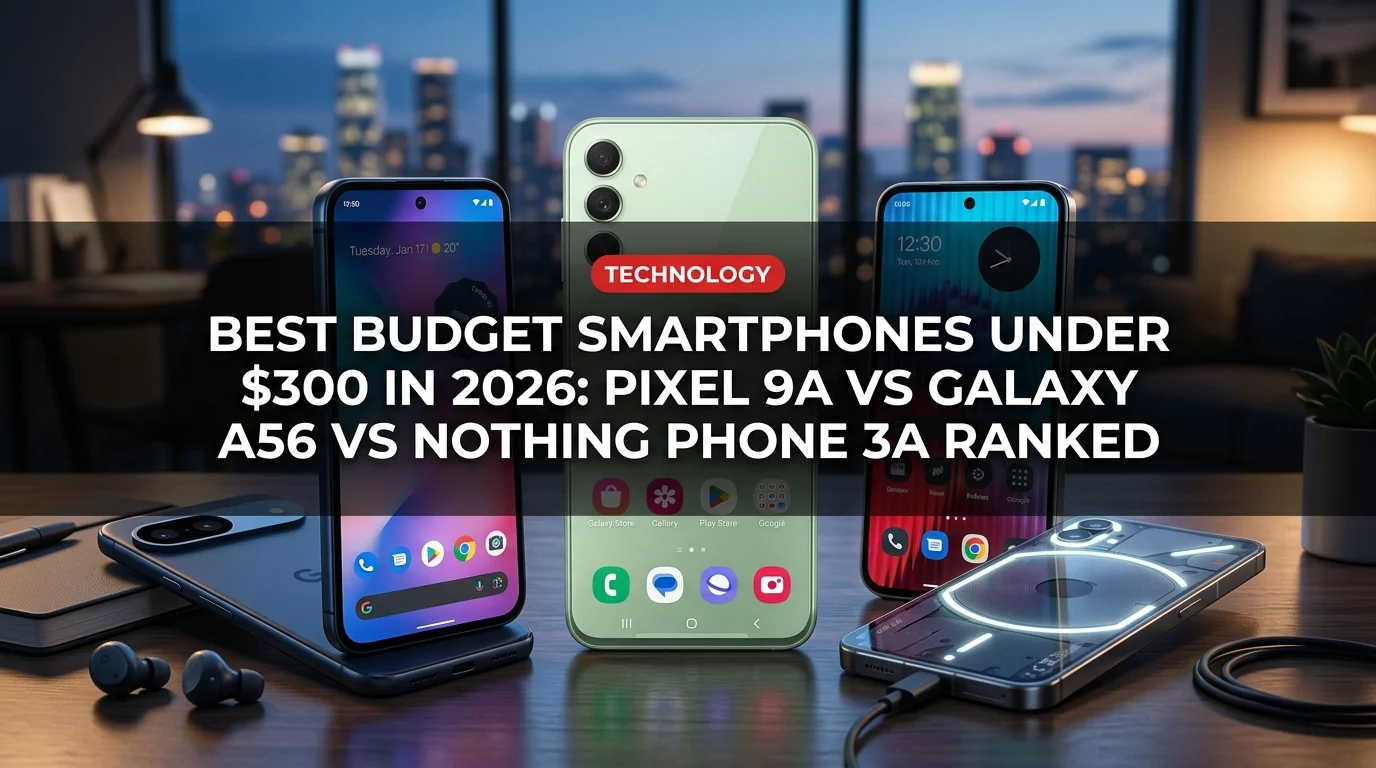
You don't need to spend $1,000 to get a great smartphone in 2026. The budget phone market has never been stronger — OLED displays, 120Hz refresh rates, 5,000mAh batteries, and multi-year software support are now table stakes below $300. The question isn't whether cheap phones are worth buying anymore. It's which one to buy.
We ranked the best smartphones under $300 available in March 2026, comparing them on the five things that actually matter: camera performance, display quality, battery life, processing speed, and long-term software support.
::stats Budget Phone Market 2026 | OLED displays below $300: 8+ models | Avg software support: 5.4 years | Best value price point: $249-$279 | Flagship feature parity: ~85% ::
#1 Google Pixel 9a — Best Overall ($249)
The Pixel 9a is the easiest recommendation in the budget phone market. At $249 — down from its original $499 launch price — it delivers camera performance and software longevity that rivals phones costing twice as much.
The 6.3-inch Actua pOLED display runs at up to 120Hz with 2,700 nits peak brightness. It's sharp, vibrant, and punchy — no complaints at this price. The Google Tensor G4 chip isn't the fastest on the market, but it handles daily tasks, AI features, and photography processing without breaking a sweat.
Where the Pixel 9a truly dominates is the camera. The 48MP main sensor with OIS paired with a 13MP ultrawide captures consistently excellent shots, especially in low light thanks to Google's Night Sight computational photography. No other phone under $300 comes close to this camera experience.
The 5,100mAh battery regularly delivers all-day battery life. Add in IP68 water resistance, seven years of guaranteed OS and security updates, and an in-display fingerprint sensor, and this is the most compelling value proposition in smartphones today.
The catch: Only 23W wired charging (no fast charge like competitors). Plastic back. No telephoto lens.
::proscons Pixel 9a Pros | Best-in-class camera under $300 | 7 years of updates | IP68 water resistance | Great OLED display | $249 street price Pixel 9a Cons | Slow 23W charging | Plastic build | No telephoto | Tensor G4 runs warm ::
#2 Samsung Galaxy A56 — Best Display ($299)
Samsung's Galaxy A56 has the best screen of any phone under $300. Full stop. The 6.6-inch Super AMOLED panel at 120Hz with Gorilla Glass Victus+ protection hits 1,800 nits peak brightness and renders colors beautifully. If you watch a lot of video, stream content, or spend hours scrolling, this display will make you happy every single day.
The Exynos 1580 processor paired with up to 12GB RAM keeps things snappy for everyday use. Samsung's One UI 7 is polished and feature-rich, with Samsung Galaxy AI features baked in — though some AI tools require a Samsung account.
The triple camera system — 50MP main + 12MP ultrawide + 5MP macro — is solid across the board, though not quite at Pixel 9a levels for computational photography. The 5,000mAh battery with 45W fast charging is a significant advantage over the Pixel: you can go from 0 to 100% in under an hour.
MicroSD expansion (up to 1TB) is a genuine differentiator for anyone who needs storage flexibility. Samsung promises six years of updates, and IP67 water resistance is included.
The catch: At $299, it's $50 more than the Pixel 9a. The Exynos 1580 occasionally shows its limits in intensive gaming.
::versus Pixel 9a vs Galaxy A56 | Camera: Pixel 9a wins | Display: Galaxy A56 wins | Charging speed: Galaxy A56 wins (45W vs 23W) | Storage expansion: Galaxy A56 wins (microSD) | Software longevity: Pixel 9a wins (7yr vs 6yr) | Price: Pixel 9a wins ($249 vs $299) ::
#3 OnePlus Nord 5 — Best Performance ($299)
If raw speed matters to you — gaming, multitasking, heavy app usage — the OnePlus Nord 5 is the performance champion under $300. The Snapdragon 7+ Gen 3 paired with 12GB RAM makes this the fastest phone in the sub-$300 segment by a clear margin.
The 6.5-inch AMOLED display at 120Hz looks great, and the party trick is charging: 100W SUPERVOOC can take the phone from dead to fully charged in under 30 minutes. That's flagship charging speed at budget pricing.
The camera system delivers good shots but tends toward over-saturated processing — more vibrant than accurate. OxygenOS is clean and fast, though OnePlus's update commitment (four years of major OS updates) trails both Samsung and Google.
The catch: Shorter software support than competitors. Camera processing isn't as natural as Pixel. Limited availability in some markets.
#4 Nothing Phone 3a — Best Design ($279)
The Nothing Phone 3a is the wild card. Its translucent back with the Glyph Interface LED system makes it the most visually distinctive phone in this price range — and the only one you'd actually get compliments on in public.
Under the hood, the Snapdragon 7s Gen 3 handles daily tasks fine. The 6.77-inch AMOLED at 120Hz with 3,000 nits peak brightness is legitimately impressive — the brightest screen on any phone in this comparison. The triple camera (dual 50MP + 8MP) performs well, especially for a mid-range device.
50W fast charging, 5,000mAh battery, and IP64 water resistance round out the package. Nothing OS 3.1 is clean and minimal, refreshingly free of bloatware.
The main limitation: IP64 vs IP67/IP68 on competitors means less water protection. And at $279, you're paying a slight premium for the design that comes at the cost of some camera versatility.
#5 Motorola Moto G Power 5G (2026) — Best Battery Life (~$250)
For battery-obsessed users, the Moto G Power 5G (2026) is the answer. Its 5,200mAh cell regularly delivers two full days of use between charges — something no other phone in this group can claim. The 6.7-inch 120Hz display is good, wireless charging and NFC are included, and the vegan leather back gives it a premium feel.
Motorola's software stays close to stock Android, making it fast and clean. The tradeoff: shorter update support (two to three years) compared to Pixel or Samsung, and the camera system, while capable, isn't a highlight.
::chart bar Battery Life (Hours Screen-on Time) | Moto G Power 5G: 13.5 | Pixel 9a: 11.2 | Galaxy A56: 10.8 | OnePlus Nord 5: 10.1 | Nothing Phone 3a: 10.4 ::
Full Specs Comparison
| Phone | Price | Chipset | RAM | Display | Battery | Charging | Updates |
|---|---|---|---|---|---|---|---|
| Pixel 9a | $249 | Tensor G4 | 8GB | 6.3" OLED 120Hz | 5,100mAh | 23W | 7 years |
| Galaxy A56 | $299 | Exynos 1580 | 8/12GB | 6.6" AMOLED 120Hz | 5,000mAh | 45W | 6 years |
| OnePlus Nord 5 | $299 | SD 7+ Gen 3 | 12GB | 6.5" AMOLED 120Hz | 5,000mAh | 100W | 4 years |
| Nothing Phone 3a | $279 | SD 7s Gen 3 | 8/12GB | 6.77" AMOLED 120Hz | 5,000mAh | 50W | 3 years |
| Moto G Power 5G | $250 | Dimensity 7025 | 8GB | 6.7" IPS 120Hz | 5,200mAh | 30W | 2 years |
Which Should You Buy?
::keyfacts Who Should Buy What | Best camera + longest support: Pixel 9a ($249) | Best display + expandable storage: Galaxy A56 ($299) | Best gaming performance + fastest charging: OnePlus Nord 5 ($299) | Best design + brightness: Nothing Phone 3a ($279) | Best battery life: Moto G Power 5G (~$250) ::
For most people, the Pixel 9a at $249 is the clear winner. The combination of camera quality, AI features, IP68 water resistance, and seven years of updates is simply unmatched at this price point. You're getting a phone that will stay current and secure through 2032.
If the Pixel's slow charging is a dealbreaker — or you need expandable storage — the Galaxy A56 earns its $299 asking price with a superior display and 45W charging. The OnePlus Nord 5 is the right call if you play a lot of games or need a full charge in 30 minutes.
The budget phone category has never been more competitive. Any of these five devices will serve you well for years to come.
::alert info Prices current as of March 2026. The Pixel 9a is frequently on sale at Amazon, Best Buy, and Google Store. Check carrier deals — T-Mobile and Verizon regularly offer the Pixel 9a for free on new activations. ::