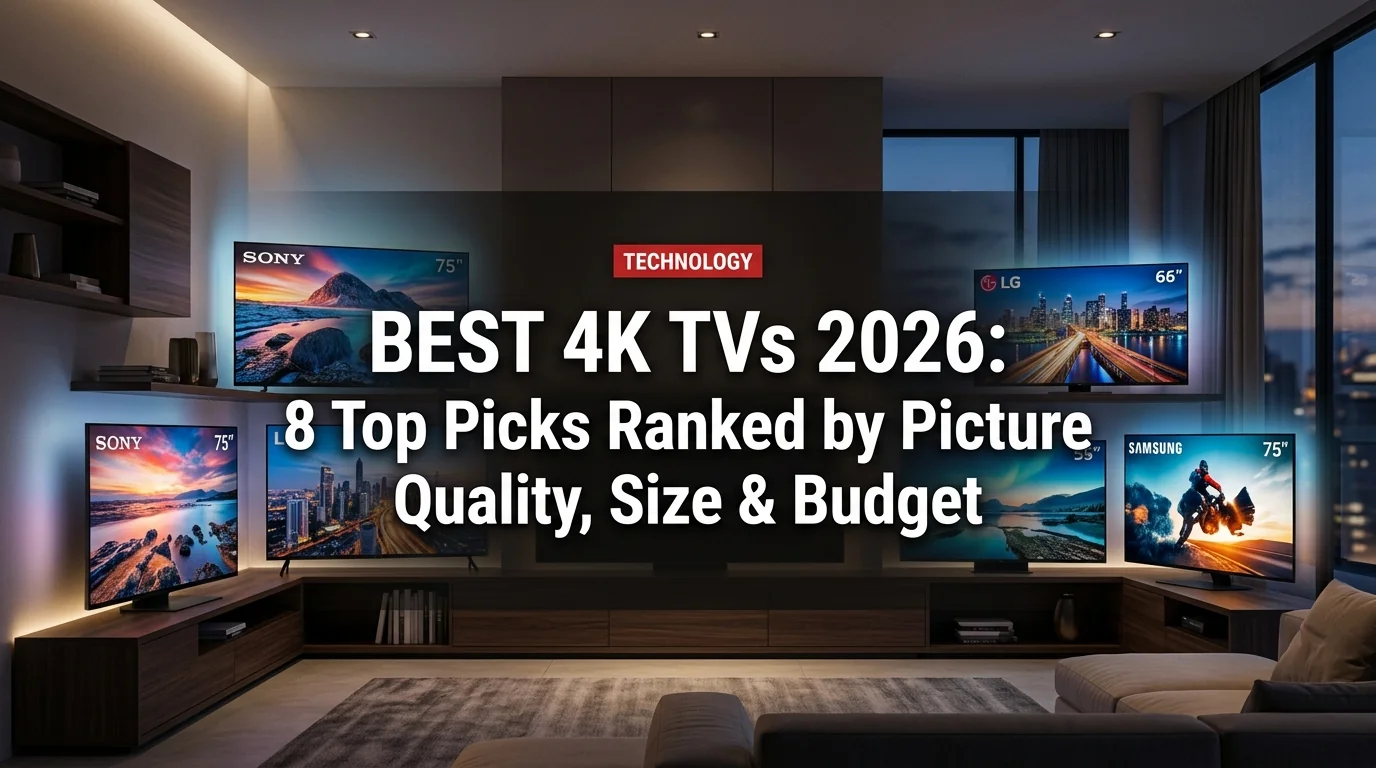
Buying a 4K TV in 2026 has never been more complicated — or more rewarding. OLED panels have hit new brightness records, QD-OLED screens now rival OLED blacks at a lower price, and even budget brands like TCL and Hisense have closed the gap on flagship models. After analyzing specs, expert reviews, and real-world performance data, we ranked the eight best 4K TVs you can buy right now.
How We Ranked These TVs
We evaluated each TV across five categories: picture quality (including HDR peak brightness, black levels, and color volume), gaming performance (input lag, refresh rate, VRR support), smart platform usability, value for money, and audio quality. Every pick has been rated by professional reviewers at major publications and cross-referenced against real owner feedback.
1. LG C5 OLED — Best Overall 4K TV 2026
The LG C5 OLED remains the gold standard for most buyers in 2026. LG's latest-generation a11 AI processor pushes brightness higher than its predecessors — OLED evo panels now hit a measured peak of around 1,300 nits on small highlights — while retaining the perfect black levels that make OLED the undisputed king for dark-room movie watching.
The C5 ships with four HDMI 2.1 ports (all 4K@144Hz capable), built-in Nvidia G-Sync compatibility, AMD FreeSync Premium Pro, and VRR support. For gamers, it's still the benchmark. LG's webOS 25 is snappier than ever and the Magic Remote remains the best TV remote on the market.
Sizes: 42", 48", 55", 65", 77", 83" | Price range: $1,099–$3,499
- Perfect black levels, infinite contrast ratio
- Four full-bandwidth HDMI 2.1 ports
- Best-in-class for gaming (G-Sync, FreeSync, 144Hz)
- Excellent webOS smart platform
- Risk of burn-in with static content over years
- Thinner bright-room HDR performance vs QLED rivals
- Premium pricing vs. equivalent QLED options
2. Samsung S95F QD-OLED — Best for Bright Rooms
Samsung's 2026 QD-OLED panel in the S95F is a genuine rival to LG's C5. The key difference: Samsung's QD-OLED tech combines quantum dot filters with OLED emitters to produce 25–30% higher peak brightness than traditional OLED — measured at up to 1,800 nits on some highlights — while preserving near-perfect blacks.
The result is a TV that holds its own in daylit rooms where traditional OLED washes out. Color volume is extraordinary, particularly in the reds and oranges that OLED historically struggles with. The trade-off: only two full HDMI 2.1 ports (vs LG's four), and Samsung's Tizen OS is slightly less fluid than webOS.
Sizes: 55", 65", 77" | Price range: $1,299–$3,299
3. Sony Bravia 9 OLED — Best for Movies & Cinema
Sony's Bravia 9 is the choice for cinephiles who prioritize color accuracy and film-maker intent over raw brightness. Sony's XR Cognitive Processor applies content-aware scene optimization that outperforms LG and Samsung's AI processing for nuanced cinema content. The Acoustic Surface Audio+ system — where the screen itself vibrates to produce sound — delivers spatial audio that makes the built-in speakers genuinely impressive.
Netflix Calibrated Mode, IMAX Enhanced certification, and Dolby Atmos/DTS:X support round out a TV that feels designed by people who love movies.
Sizes: 55", 65", 77" | Price range: $1,799–$4,499
4. Samsung QN90D Neo QLED — Best Non-OLED TV
If burn-in risk concerns you, or you watch TV in a very bright room, the Samsung QN90D Neo QLED is the answer. Its Mini-LED backlighting produces a class-leading 2,000+ nits peak brightness — nearly double what most OLEDs achieve — making HDR content pop in ways OLED simply can't match in daylight.
The QN90D uses Samsung's Neural Quantum Processor 4K for upscaling, which handles 1080p streaming content exceptionally well. The anti-reflection coating is the best in the business. The downside is visible blooming around bright objects on dark backgrounds — an inherent limitation of LCD technology that OLED avoids entirely.
Sizes: 43", 50", 55", 65", 75", 85" | Price range: $799–$3,199
5. TCL QM891G — Best Value OLED Alternative
TCL's QM891G uses a Mini-LED panel with over 5,000 local dimming zones — more than most competitors at any price — to approximate OLED-like contrast at a significantly lower cost. It hits around 1,600 nits peak brightness and supports Google TV, making app access seamless.
For buyers who want an OLED-adjacent experience without the premium price tag, the QM891G is the 2026 value leader. Gaming specs are solid: 4K/144Hz, HDMI 2.1, VRR, and FreeSync Premium Pro. Some blooming is visible in high-contrast scenes, but it's less distracting than competing Mini-LED sets.
Sizes: 55", 65", 75", 85", 98" | Price range: $649–$1,999
6. Hisense U8N — Best Budget Premium Pick
Hisense's U8N continues the brand's remarkable value story. With Mini-LED backlighting, up to 1,500 nits peak brightness, a 144Hz panel, and Google TV built in, it's hard to believe this TV costs under $700 for the 55" size. Hisense's ULED technology applies over a dozen picture enhancement algorithms that genuinely punch above the U8N's price class.
It lacks the black-level depth of OLED and has some local dimming inconsistency, but for everyday TV watching, sports, and casual gaming, the U8N delivers far more than its price suggests.
Sizes: 55", 65", 75", 85" | Price range: $549–$1,299
- Hisense U8N: Best picture quality under $700 for a 55"
- TCL QM891G: Best step-up from budget — 5,000+ local dimming zones
- Samsung QN90D: Zero burn-in risk + industry-leading brightness
- LG C5 OLED: Best all-rounder for dark rooms and gaming
- Sony Bravia 9: Best for movie accuracy and cinephiles
7. LG QNED87 — Best Mid-Range LCD
For buyers who need a reliable TV under $700 but want a premium brand name, LG's QNED87 hits the sweet spot. It uses quantum dot + NanoCell LCD technology for improved color accuracy over standard LED TVs, runs the full webOS platform, and supports 4K/120Hz gaming on its HDMI 2.1 port. Picture quality can't match Mini-LED sets, but it's a solid daily-driver TV from a trusted brand.
Sizes: 43", 50", 55", 65", 75", 86" | Price range: $499–$1,199
8. Amazon Fire TV Omni QLED — Best Smart Features Budget Pick
Amazon's own-brand TV line has matured significantly. The Fire TV Omni QLED Series packs a decent QLED panel, Alexa built-in, ambient mode, and hands-free voice control at prices that undercut every other brand on this list. Picture quality is a step below Hisense and TCL at similar sizes, but if deep Amazon ecosystem integration and hassle-free smart TV features matter most to you, it's genuinely worth considering.
Sizes: 43", 50", 55", 65", 75" | Price range: $329–$849
OLED vs QLED vs Mini-LED: Which Should You Buy in 2026?
- Perfect black levels — true infinite contrast
- Best for dark rooms, movies, gaming
- Slight burn-in risk with static content
- LG C5 / Sony Bravia 9 / Samsung S95F
- Far brighter — better in sunlit rooms
- Zero burn-in risk
- Some blooming in high-contrast scenes
- Samsung QN90D / TCL QM891G / Hisense U8N
The short answer: OLED if you control your lighting, QLED/Mini-LED if your room is bright. The gap between the two technologies has narrowed dramatically in 2026, but OLED still wins on pure black-level depth and the QD-OLED/Neo QLED options are now genuinely competitive on brightness.
Buyer's Guide: What Size TV Do You Need?
A common mistake is buying too small. Industry guidelines recommend:
- 6–8 feet viewing distance → 55–65" TV
- 8–10 feet viewing distance → 65–75" TV
- 10+ feet viewing distance → 77–85"+ TV
With 4K resolution, you can sit closer than with 1080p without seeing pixels. Don't be afraid to go one size larger than you think you need.
Our Pick by Budget
- Under $500: Amazon Fire TV Omni QLED (55")
- $500–$800: Hisense U8N (55") or LG QNED87 (65")
- $800–$1,200: TCL QM891G (65") or Samsung QN90D (55")
- $1,200–$2,000: LG C5 OLED (55") — the sweet spot pick
- $2,000+: Sony Bravia 9 OLED or Samsung S95F QD-OLED
The best 4K TV you can buy in 2026 is the one that matches your room, your habits, and your budget. For most people, the LG C5 OLED at the 65" size hits the ideal intersection of price, picture quality, and gaming performance. But if brightness is your priority, the Samsung QN90D Neo QLED makes a compelling case — especially with its zero burn-in guarantee.