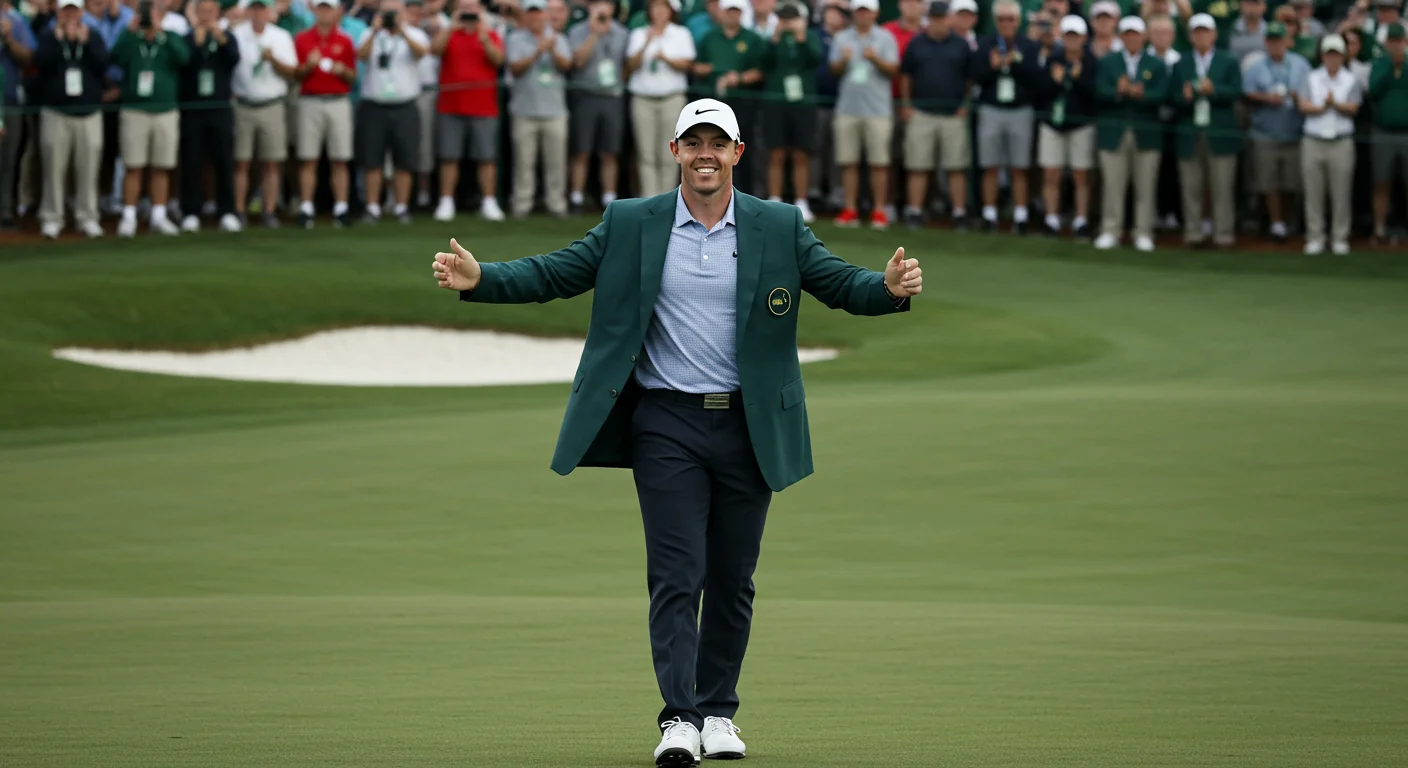
Rory McIlroy wrote his name into golf's rarest record books on Sunday afternoon at Augusta National, becoming only the fourth player in the 90-year history of the Masters Tournament to win back-to-back Green Jackets. Edging world No. 1 Scottie Scheffler by a single stroke with a final-round 71 for a 12-under-par total of 276, McIlroy's composure under pressure sealed one of the most historic victories the sport has ever witnessed.
From Six Shots Clear to One-Shot Thriller
McIlroy had looked untouchable through the first two rounds, building a Masters-record six-shot lead after 36 holes. But Augusta National — golf's most unforgiving stage — had other ideas. A rocky start on Sunday sent the 36-year-old Northern Irishman tumbling into a tie for fourth early in the final round, sending shockwaves through the Augusta galleries and living rooms worldwide.
What separated McIlroy from mere mortals, however, was what happened next. Drawing on the hard lessons of collapse and heartbreak that defined years of near-misses at Augusta, McIlroy steadied, regrouped, and clawed his way back to the top of the leaderboard. A closing stretch of pars and clutch shot-making sealed the deal, capping the round with a bogey that still proved enough to win by one over Scheffler, who shot a final-round 69.
Justin Rose, himself a former Masters runner-up, finished in a share of third place — making this a Sunday finale befitting the 90th edition of golf's most prestigious major.
Golf's Most Exclusive Club
In winning back-to-back Masters titles, McIlroy joins an extraordinarily short list. Only three men had ever defended the Green Jacket before him: Jack Nicklaus (1965–66), Nick Faldo (1989–90), and Tiger Woods (2001–02). That McIlroy's name now sits alongside those three legends tells you everything about what Sunday's victory means for his legacy.
The victory also takes McIlroy's major tally to six, matching Nick Faldo's career total and reigniting the inevitable debate about just how high he can climb among golf's all-time greats. Tiger Woods holds the all-time record with 15 majors, with Jack Nicklaus at 18. McIlroy, still in his mid-thirties and in the form of his career, now looms as a genuine threat to those historical marks in a way previously unthinkable during the wilderness years he spent chasing his first Masters.
The Prize Money
Alongside the glory, McIlroy's wallet grew considerably heavier. The 2026 Masters purse increased to $22.5 million — up from $21 million in 2025 — making it the richest edition in the tournament's history. McIlroy took home $4.5 million as champion, adding to a Augusta earnings record he already owned.
His total career earnings at The Masters now exceed $12 million, surpassing Tiger Woods and Phil Mickelson to become the highest earner in the tournament's 90-year history.
- McIlroy is the 4th player ever to win back-to-back Masters titles
- His 6 majors now matches Nick Faldo on the all-time list
- He is the all-time leading money earner in Masters history
- The 2026 purse of $22.5M is a Masters record
- Scheffler, despite finishing runner-up, remains world No. 1
The Road Back: What Made This Defense Possible
For much of his career, McIlroy's relationship with Augusta National was defined by tragedy. The 2011 collapse — when he held a four-shot lead heading into the final round before imploding to an 80 — haunted him for over a decade. His first Masters win in 2025 was the culmination of years of psychological work and tactical refinement at a course that had broken his heart repeatedly.
Defending that title, as history shows, is even harder. The added weight of expectation, the recalibrated approach that rivals use against the champion, and the mental burden of trying not to repeat rather than simply trying to win — these factors have derailed far greater champions than McIlroy.
That he overcame Sunday's early wobble — the ghost of 2011 briefly reawakened — speaks to a mental fortitude that only emerges from genuine suffering. McIlroy had earned the right to that composure the hard way.
What's Next: The Grand Slam Is On
With the Masters now secured for the second consecutive year, the golf world's attention turns immediately to what McIlroy might accomplish across 2026's remaining major calendar.
The PGA Championship at Quail Hollow (May), the US Open at Oakmont (June), and The Open Championship at Royal Portrush (July) all await. McIlroy has already won each of those three majors at least once. The prospect of a calendar Grand Slam — all four majors in the same year — is now being uttered openly for the first time since Tiger Woods in 2000.
Whether McIlroy can sustain this level across three more grueling majors over four months is golf's defining question for 2026. Based on Sunday's performance — hanging on with iron will when Augusta nearly took him down again — the smart money says don't bet against him.
The Verdict
This was not McIlroy's most clinical Masters victory. It was something better: a test of character that he passed in front of millions of witnesses. The six-shot lead, the Sunday wobble, the one-shot win — it had everything Augusta National demands of its champions.
At 36, with six majors, a Masters earnings record, and a second consecutive Green Jacket, Rory McIlroy is playing the best golf of his life. The conversation about where he ranks among the all-time greats is no longer a future hypothetical. It is happening right now, in real time, on the grandest stages the sport has to offer.
Sunday at Augusta was just the latest chapter.