
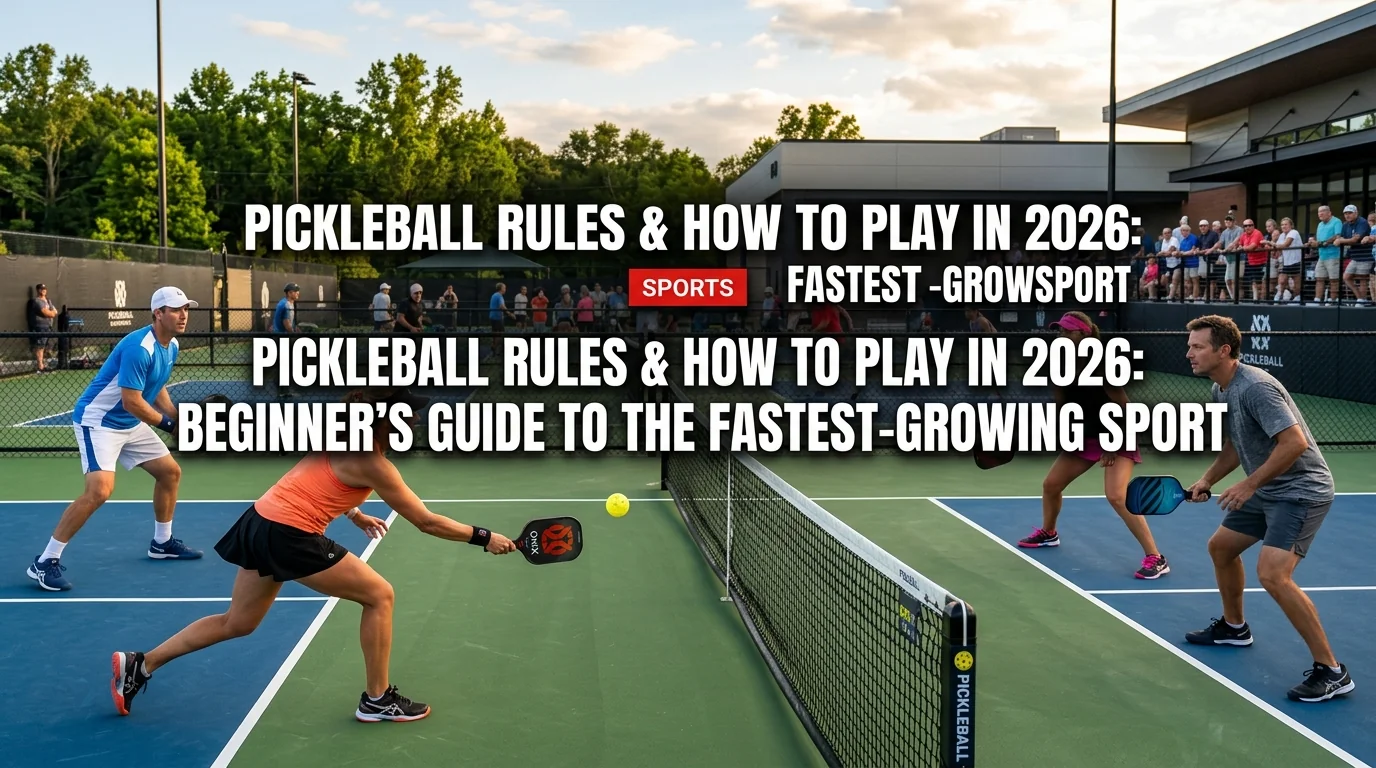
Pickleball Rules & How to Play in 2026: Beginner's Guide to the Fastest-Growing Sport
Pickleball is the fastest-growing sport in the United States — and it's not slowing down. Searches for "how to play pickleball" have grown over 155% in the past two years, driven by millions of first-timers discovering what regular players already know: it's easy to learn, immediately fun, and genuinely competitive once you develop skills. This guide covers every rule, how courts work, what equipment you need, and how to play your first game.
What Is Pickleball?
Pickleball is a paddle sport that combines elements of tennis, badminton, and ping-pong. It's played on a court roughly the size of a doubles badminton court — about a quarter the size of a tennis court — using solid paddles and a plastic wiffle ball. Games are typically played to 11 points.
The sport was invented in 1965 in Washington State, spent decades as a backyard game, and exploded into mainstream popularity in the early 2020s. Today you'll find dedicated pickleball courts at gyms, community centers, parks, and purpose-built facilities across the country.
The Court: What You Need to Know
A standard pickleball court is 20 feet wide by 44 feet long — same dimensions for both singles and doubles play.
Key zones:
- Baseline: The back line you serve from
- Service areas: Two service boxes on each side, separated by a center line
- Non-Volley Zone (NVZ) / "The Kitchen": A 7-foot zone on each side of the net where you cannot volley the ball (hit it out of the air). This is the most important rule in pickleball.
- Net: Sits 36 inches high at the sidelines and 34 inches at the center — slightly lower than tennis
- Court: 20 ft × 44 ft (same for singles and doubles)
- Net height: 34 inches at center, 36 at sidelines
- Non-Volley Zone (Kitchen): 7 feet on each side of the net
- Service boxes: Two per side, separated by center line
- Standard game: First to 11 points, win by 2
Basic Rules: How a Point Works
Serving
- The serve is always underhand — you must contact the ball below your waist
- The paddle must be moving upward at contact (an upward arc)
- You serve diagonally, to the opponent's service box across the net
- The serve must clear the Non-Volley Zone (kitchen) and land in the service box
- You only get one serve attempt (unlike tennis's two)
- In doubles, both players on a team serve before the serve passes to the other team — except at the start of the game, where only one player serves first
The Double Bounce Rule (Two-Bounce Rule)
This is one of pickleball's defining rules:
- After the serve, the receiving team must let the ball bounce once before returning
- Then the serving team must also let that return bounce once before hitting it
- After those two bounces, either team can volley the ball (hit it out of the air) or let it bounce
This rule prevents instant-attack serving and creates the rallying, strategic style of play pickleball is known for.
The Non-Volley Zone (The Kitchen)
- You cannot volley the ball while standing in the kitchen or touching the kitchen line
- You CAN enter the kitchen to hit a ball that has bounced
- If your momentum carries you into the kitchen after a volley — even if you hit the ball from outside — it's a fault
- This rule forces players to either dink (soft shots into the kitchen) or stay back and rally — it's the tactical heart of the game
Faults
A fault stops the rally and ends the point. You commit a fault when:
- The ball goes out of bounds
- The ball hits the net
- You volley from the kitchen or step into the kitchen after volleying
- The serve lands in the kitchen
- You violate the double bounce rule
- The ball bounces twice before you hit it
Scoring: How Points Are Counted
Pickleball uses rally-serve scoring in recreational play (only the serving team can score a point), though professional and tournament play now uses rally scoring (either team can score on any rally):
Recreational / traditional scoring:
- Only the serving team scores points
- If the serving team wins the rally, they score a point
- If the receiving team wins the rally, they win the serve (a "side-out")
- Games are typically played to 11, win by 2
- Tournaments often use best-of-3 games to 11
Score calling in doubles: Before every serve, call three numbers: your score – opponent's score – server number (1 or 2)
Example: "5-3-2" means your team has 5, opponents have 3, and you're the second server on your team.
Equipment: What You Need to Start
Paddle
- Solid paddle (not strung like tennis)
- Materials range from wood (cheapest) to graphite and carbon fiber (higher performance)
- Standard size: up to 24 inches combined length + width, no more than 17 inches long
- Budget pick: Any composite paddle in the $30-50 range is fine for beginners
- Mid-range (recommended): $80-130 graphite or fiberglass paddle from Selkirk, Paddletek, or JOOLA
Ball
- Plastic wiffle-style ball with holes
- Outdoor balls: Harder plastic, 40 holes, more durable
- Indoor balls: Softer plastic, 26 larger holes, slower and quieter
- Balls cost $2-5 each; buy a pack of 6 to start
Shoes
- Court shoes (tennis or pickleball-specific) are recommended
- Running shoes have too much heel drop for lateral movements and increase ankle injury risk
- Dedicated pickleball shoes from Nike, New Balance, or K-Swiss are widely available in 2026
Key Shots Every Beginner Should Learn
Dink: A soft shot that arcs over the net and lands in the opponent's kitchen. The most important shot in pickleball — master this and you'll hold your own in any game.
Third-shot drop: After the serve and return, the third shot is usually a soft drop into the kitchen. This neutralizes the returning team's advantage and lets the serving team advance to the kitchen line.
Drive: A hard, flat groundstroke. Useful for variety but overusing it at the kitchen line is a common beginner mistake.
Lob: A high shot aimed over opponents at the net, designed to push them back. Effective against players who camp the kitchen line.
Erne: An advanced shot where you jump around the kitchen post to volley — legal as long as you don't touch the kitchen line.
Playing Your First Game: Step-by-Step
- Flip to decide who serves first — the serving team starts at the baseline
- Call the score before each serve ("0-0-2" to start)
- Serve diagonally underhand into the opponent's service box, clearing the kitchen
- Let it bounce — both sides must bounce the ball once after the serve before volleying
- Work toward the kitchen line — both teams try to control the non-volley zone
- Dink and wait for opportunities — be patient, don't smash every ball
- First to 11 wins by 2 — switch sides when the leading team reaches 6
Where to Play in 2026
- USA Pickleball's court finder: Find courts near you at usapickleball.org/places-to-play
- Pickleball Central: Lists public and private courts nationally
- Local parks: Many have converted tennis courts with portable pickleball nets
- Gyms: Planet Fitness, LA Fitness, and YMCA locations added courts in 2024-2025
- Dedicated clubs: Chicken N Pickle, Lifetime Fitness, and independent clubs now operate in most major metros
Open play: Most facilities offer "open play" sessions where you show up, get in line, and play with whoever is there. It's the fastest way to meet players and get real game experience as a beginner.
Official Rules Resources
- USA Pickleball Official Rulebook 2026: usapickleball.org — the authoritative rules source
- IFP (International Federation of Pickleball): International tournament rules
- Tournament formats: Most recreational and amateur tournaments use single or double elimination; national-level events use round-robin pools
Pickleball's learning curve is genuinely gentle — most beginners are having real fun within their first hour. The depth comes later: shot placement, kitchen positioning, and the psychological game of dinking. Start with the basics, find an open play session near you, and you'll see why millions of people got hooked.