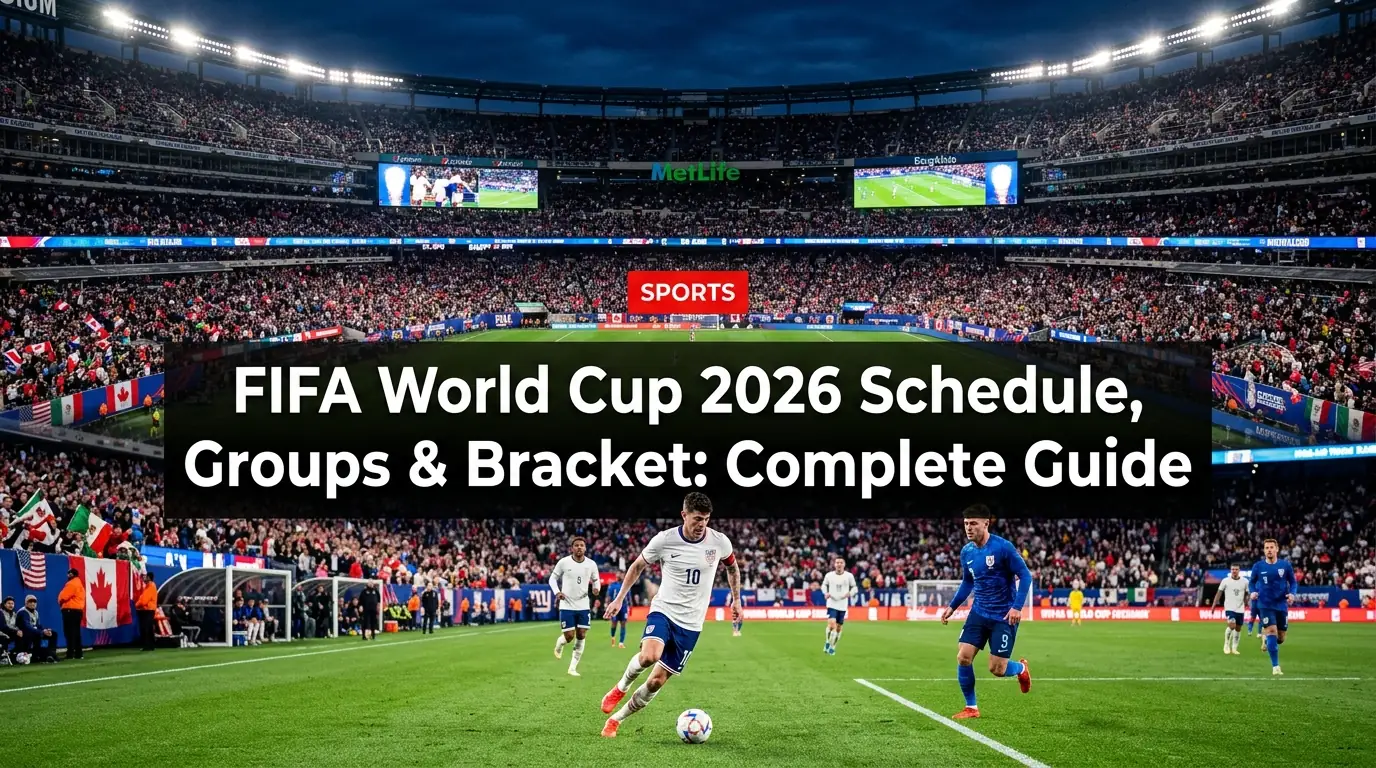
The FIFA World Cup 2026 is the biggest sporting event in history — and it's almost here. For the first time, 48 teams will compete across three host nations: the United States, Canada, and Mexico. With 104 matches spread across 16 cities and 39 stadiums, this is a World Cup unlike any before it. Here's everything you need to know about the schedule, groups, bracket, and where to watch.
Key Dates at a Glance
- June 11, 2026 — Opening match, Mexico City (Estadio Azteca)
- June 11 – July 2, 2026 — Group stage (all 48 teams, 12 groups)
- July 4–7, 2026 — Round of 32 begins
- July 9–12, 2026 — Round of 16
- July 14–15, 2026 — Quarter-finals
- July 17, 2026 — Semi-finals
- July 19, 2026 — Final, MetLife Stadium, New Jersey
The New 48-Team Format Explained
This is the first World Cup to feature 48 teams — up from the 32-team format used since 1998. Here's how the expanded tournament works:
- 12 groups of 4 teams play a round-robin in the group stage
- The top 2 teams from each group advance automatically (24 teams)
- The 8 best third-place finishers also advance, giving 32 teams total
- From there, it's a straight single-elimination bracket through the Round of 32, Round of 16, quarter-finals, semi-finals, and the final
The extra round means more matches, more drama, and more nations competing in the knockout stage than ever before. Critics worried the format would water down competition — but early signs suggest Group F and Group H are set to produce upsets.
Host Cities and Venues
The 2026 World Cup uses 16 cities across the three host nations. Here's the breakdown:
Group Stage Schedule Overview
The group stage runs for three weeks, from June 11 through July 2. Each of the 12 groups plays its three matchdays across a 12-day window, with the final matchday of each group played simultaneously to prevent collusion.
Group Stage Matchday Windows:
- Matchday 1: June 11–17
- Matchday 2: June 17–23
- Matchday 3: June 26 – July 2 (simultaneous final matches per group)
The USA, Mexico, and Canada all enter as automatic qualifiers by virtue of being host nations. All three are placed in separate groups.
Knockout Bracket
After the group stage, the 32 advancing teams enter a clean single-elimination bracket:
Teams to Watch in 2026
With 48 teams, the World Cup field includes nations making their debut alongside perennial powerhouses. Here's a snapshot of the favorites:
- Brazil returns with a new generation led by Endrick and Vinicius Jr.
- France are defending runners-up with Mbappé still in his prime at 27
- England finally have the squad depth to go the distance
- Argentina defend their 2022 title — though it may be Messi's farewell
- Germany rebuilt under a new manager after 2022 exit
- 48 teams means more variance and potential for upsets
- Travel distances between North American host cities could fatigue teams
- USA, Mexico, and Canada get home-crowd boost — tricky for favourites early
How to Watch FIFA World Cup 2026
Broadcast rights vary by country. Here's who has the rights in key markets:
United States:
- Fox Sports and Telemundo have US broadcast rights
- Fox Sports (English-language), Telemundo / Universo (Spanish)
- Streaming via Fox Sports App and Peacock (for Telemundo matches)
United Kingdom:
- ITV and BBC share the rights — most matches will be on free-to-air TV
- Streaming via ITVX and BBC iPlayer
Canada:
- CTV, TSN, RDS, and TVA Sports
Australia:
- Optus Sport (subscription) and SBS (free-to-air)
Mexico:
- Televisa and TV Azteca
Ticket Information
FIFA opened ticket sales in phases throughout 2024 and 2025. Most group-stage allocation is exhausted, but resale marketplaces and official last-minute ballot draws are still active. Check FIFA's official ticketing portal for availability.
Why This World Cup Is Historic
Beyond the record 48 teams, this tournament breaks records on almost every metric:
- 104 matches — up from 64 in Qatar 2022
- 3 host nations — unprecedented co-hosting at this scale
- ~5 million tickets available — the largest allocation in World Cup history
- Estimated $11 billion economic impact across North America
- First World Cup where VAR and semi-automated offside technology will be fully standardized across all 104 matches
For football fans in North America, this is a once-in-a-generation event — the last time the USA hosted was in 1994. Whether you're attending in person or streaming from home, the 2026 World Cup promises to be the most-watched sporting event ever broadcast.