
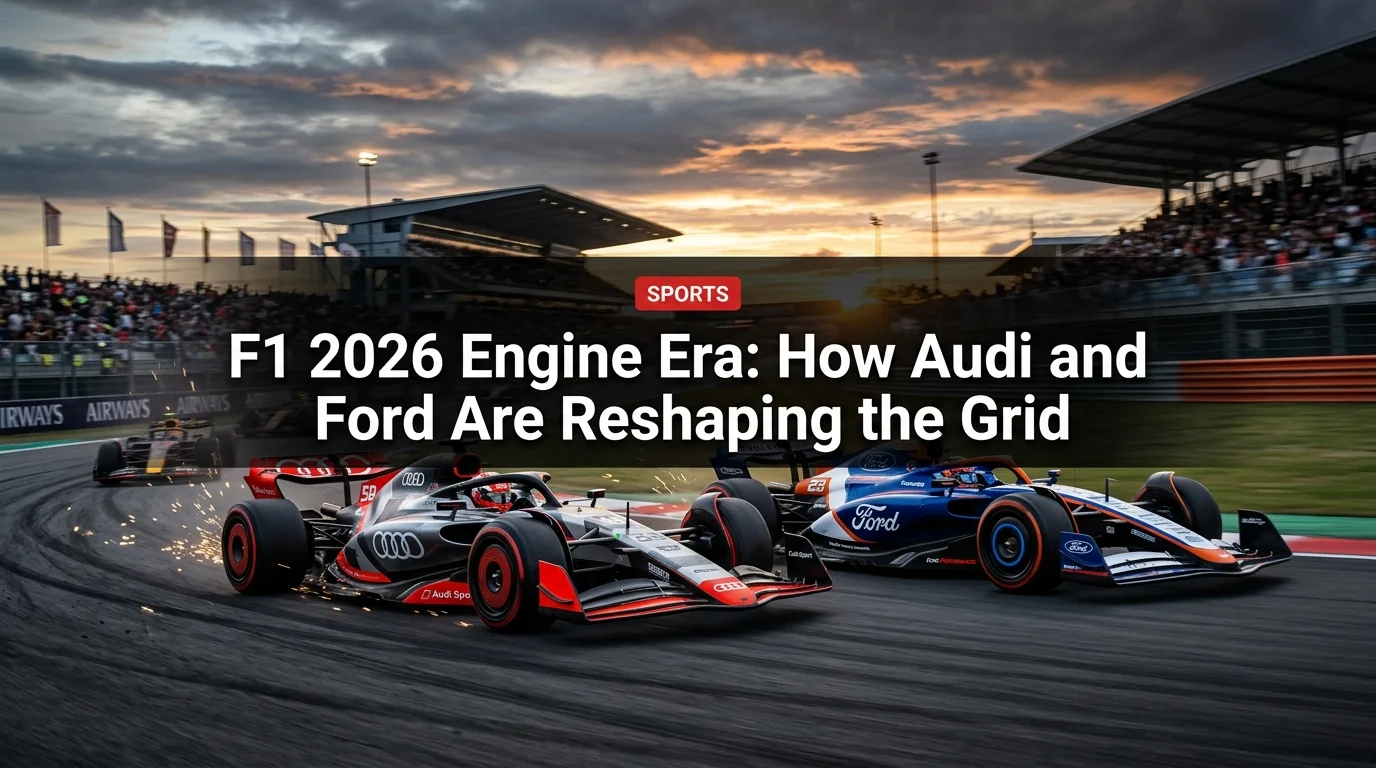
Formula 1's 2026 season marks the most radical technical upheaval the sport has seen in decades. Two automotive giants — Audi as a full works team and Ford as Red Bull's engine partner — have joined the grid under regulations that fundamentally rewrite how an F1 car makes power. The result is a season where the old order is under siege.
The Biggest Rule Change Since the Hybrid Era
The 2026 regulations eliminate the infamous MGU-H (Motor Generator Unit-Heat), a brutally complex component that kept new manufacturers out of the sport for a decade. In its place, the FIA has designed a power unit architecture that splits output nearly 50/50 between the internal combustion engine and electric motor.
The cars are also physically transformed: 10 cm narrower, 20 cm shorter in wheelbase, and equipped with active front and rear wings that switch between "Z-mode" (maximum downforce for corners) and "X-mode" (minimum drag for straights). It is the death of DRS as we knew it — replaced by a system that rewards racecraft over proximity.
Audi vs Ford: Two Very Different Entry Strategies
The two new manufacturers couldn't have taken more divergent paths onto the grid.
- 100% acquisition of Sauber Motorsport
- Builds own chassis (Hinwil, Switzerland) and power unit (Neuburg, Germany)
- Branded as "Audi Revolut F1 Team"
- Drivers: Nico Hülkenberg, Gabriel Bortoleto (rookie)
- Backed by Qatar Investment Authority minority stake
- First-ever F1 entry for Audi
- Partners with Red Bull Powertrains (RBPT)
- Provides battery cell tech, electric motors, and software
- Branded as "Red Bull Ford" power unit
- Powers both Red Bull Racing and VCARB
- Returns to F1 for first time since 2004 (Jaguar/Cosworth era)
- Third-most successful engine manufacturer in F1 history (176 wins)
Audi is betting everything — building from scratch with a full factory team. Ford is playing it smart, bolting their EV expertise onto the most successful team of the last four years.
The Season So Far: Early Signals
The 2026 season opened at the Australian Grand Prix on March 8, and the early races have already exposed the gap between ambition and execution.
Audi's debut has been a baptism by fire. Pre-season testing revealed "teething issues" with the energy recovery system — not unusual for a brand-new power unit, but painful when every race weekend is a learning opportunity that can't be wasted. Red Bull Ford, by contrast, has shown strong reliability from day one, benefiting from staff who carried over institutional knowledge from the Honda partnership.
The Power Unit Cost Cap
The financial architecture of the new era is as significant as the technical one. The FIA has set a power unit cost cap at $130 million for 2026, up from the $95 million transitional limit. Both Audi and RBPT receive "newcomer" capital expenditure allowances — a financial runway designed to prevent established manufacturers like Mercedes and Ferrari from running away with the development race.
KEY STAT: Audi and Red Bull Ford receive a ~$15M newcomer allowance above the standard $130M power unit cost cap — a critical lifeline for catching up to Mercedes and Ferrari.
The "Mario Kart" Controversy
Not everyone is thrilled. Max Verstappen has been the most vocal critic of the 50/50 power split, comparing the new energy management dynamic to a video game.
The complaint isn't trivial. Under the new rules, drivers must actively manage electrical deployment — burning through the battery on straights for overtakes but potentially running out of power at critical moments. It adds a strategic dimension that purists either love or hate.
Ford CEO Jim Farley offered a different perspective, framing the new regulations as validation of the industry's shift toward electrification: "F1 will be an incredibly cost-effective platform to innovate and engage with tens of millions of new customers."
Behind the Scenes: The Compression Ratio War
The technical battle between teams has already spilled into the political arena. Audi's Technical Director James Key accused rivals of exploiting "grey areas" in engine compression ratios, demanding the FIA intervene.
- Eliminates MGU-H, lowering barriers to entry for new manufacturers
- 100% sustainable fuels align F1 with climate goals
- Active aero should produce closer racing and more overtaking
- Lighter, shorter cars are more agile and visually dramatic
- Near-equal electrical and combustion power creates new strategic depth
- Battery management could produce artificial racing (the "Mario Kart" effect)
- Newcomers like Audi face steep reliability learning curves
- Grey areas in regulations are already causing political friction
- Canceled races reduce development opportunities for every team
- 50/50 power split may reduce the visceral engine sound fans love
What Comes Next
With the Saudi Arabian and Bahrain GPs canceled due to the Iran conflict, the 2026 calendar has been disrupted at the worst possible moment — during the steepest part of the development curve. Teams lose precious race weekends for data collection, and the compressed European leg starting with the Spanish Grand Prix will likely see a wave of major upgrades as teams rush to optimize the integration of active aero and the new power units.
For Audi, the mission is clear: convert Berlin engineering ambition into Hinwil race pace. For Ford, it is about proving that their battery and software expertise gives Red Bull an edge that goes beyond branding. And for the rest of the grid, it is about surviving the most disruptive regulatory reset in a generation.
One thing is already certain: the 2026 season is not just a new chapter in F1. It is a different book entirely.