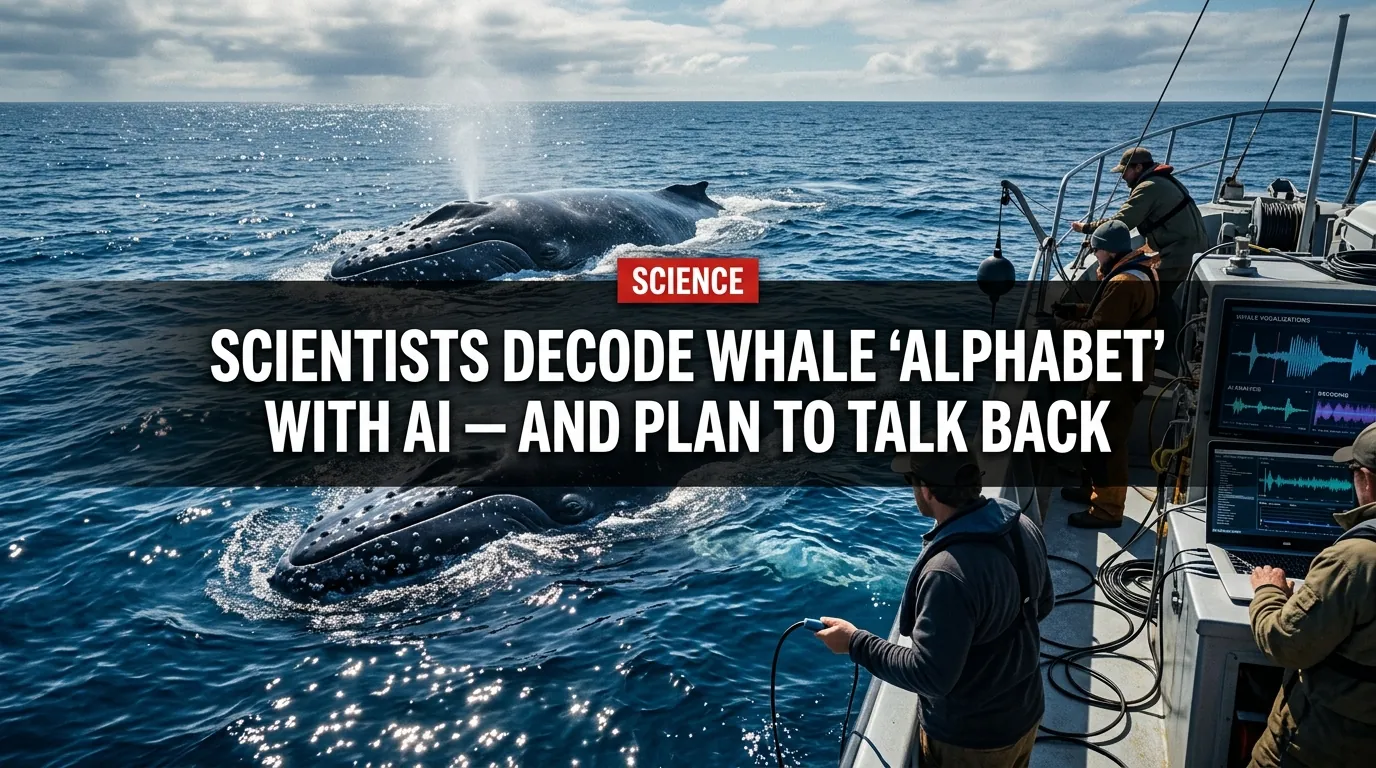
A team of scientists from MIT, Harvard, and UC Berkeley says they have cracked the basic structure of sperm whale communication — and they plan to start talking back this year.
Project CETI (Cetacean Translation Initiative), a nonprofit research consortium, has used machine learning to identify what it calls a "phonetic alphabet" of 156 distinct clicking patterns, along with vowel-like spectral shifts that suggest whales encode far more meaning in their clicks than scientists ever suspected.
- 156 codas identified as sperm whale "phonemes" — rhythmic click patterns that form the building blocks of communication
- Vowel-like sounds discovered in November 2025, published in Open Mind
- Two-way communication attempt planned for 2026 using AI-generated synthetic codas
- $33 million in funding from the TED Audacious Project
- 8,725 audio snippets analyzed in the landmark 2024 study
From Morse Code to Grammar
For decades, marine biologists treated sperm whale clicks like Morse code — simple, binary signals for echolocation and basic identification. Project CETI has upended that assumption entirely.
Working off the coast of Dominica in the Eastern Caribbean since 2020, the team deployed underwater listening stations, non-invasive drone tags developed at Harvard, and Google's DolphinGemma — a 400-million parameter AI model that runs on smartphones in the field for real-time acoustic analysis.
The result: clicks aren't just rhythmic patterns. They carry rhythm, tempo, rubato, and ornamentation — musical qualities that combine into what the team calls codas. And within those codas, whales modulate the frequency of individual clicks to produce something eerily close to vowels.
The Vowel Discovery That Changed Everything
In November 2025, a UC Berkeley-led team published findings that rocked the field. By applying unsupervised machine learning — the same approach used to translate between human languages without a shared dictionary — Dr. Beguš identified two distinct vowel patterns in sperm whale clicks:
- "ɑ-vowels" — open, resonant frequency shifts similar to the 'a' in "father"
- "i-vowels" — higher-frequency shifts resembling the 'ee' in "meet"
- Diphthong-like patterns — frequency trajectories that glide between two positions, much like human diphthongs
This means a single coda isn't just a rhythmic "word." The whale can modify how it clicks within that pattern to layer additional meaning — analogous to how humans can change the vowel in a consonant frame ("bat" vs. "bit" vs. "but") to create entirely different words.
The Skeptics Push Back
Not everyone is convinced. The discovery has split the marine biology community.
Dr. Luke Rendell of the University of St. Andrews called the vowel comparison "completely nonsense," arguing the spectral shifts could be recording artifacts from varying distances between the whale and the hydrophone.
Dr. Stephanie King of the University of Bristol offered a more measured critique: the patterns might reflect the whale's arousal or alertness state rather than intentional linguistic encoding. A whale that's excited might simply click differently than one that's calm — not because it's choosing different "vowels," but because its physiology changes.
The CETI team acknowledges these concerns but points to their dataset's scale and controls. Their click detection system runs at 99.5% accuracy, and dialect recognition hits 95.3% — high enough, they argue, to distinguish genuine patterns from noise.
The Team Behind the Breakthrough
Project CETI isn't a single lab — it's a consortium that reads like a who's who of AI and marine science:
| Role | Researcher | Affiliation |
|---|---|---|
| Founder & Lead | Dr. David Gruber | City University of New York |
| Biology Lead | Dr. Shane Gero | Carleton University |
| Linguistics Lead | Dr. Gašper Beguš | UC Berkeley |
| Robotics Lead | Dr. Robert Wood | Harvard SEAS |
| Cryptography Lead | Shafi Goldwasser | UC Berkeley (Turing Award winner) |
| WhAM Creator | Orr Paradise | UC Berkeley |
Google contributed DolphinGemma for field analysis. MIT's CSAIL built the machine learning pipeline. And a Turing Award-winning cryptographer is treating whale codas like an encrypted language waiting to be broken.
What Talking to Whales Actually Looks Like
The 2026 goal isn't a conversation about philosophy. It's far more modest — and scientifically rigorous.
The team plans to use the WhAM model to generate synthetic codas that mimic known patterns — location markers, identity calls, group coordination signals. These would be played through underwater speakers near a studied whale clan off Dominica, and researchers would observe whether the whales respond appropriately.
Success wouldn't mean "translating" whale language in any human sense. It would mean proving that the communication system is interactive — that whales don't just broadcast, but respond to specific inputs with predictable outputs. That alone would be unprecedented for any non-primate species.
The 4-Billion-Click Problem
The team estimates it needs 4 billion vocalizations to achieve anything approaching full translation — orders of magnitude beyond the current dataset. New permanent listening stations are being deployed around Dominica to capture this volume autonomously.
Meanwhile, the legal and ethical questions are already outpacing the science. The MOTH project has drafted 12 ethical principles for interspecies communication, specifically designed to prevent military or commercial exploitation of any future translation capability.
Whether Project CETI's critics are right about artifacts, or the team is right about underwater vowels, one thing is clear: AI has forced the question of animal language out of philosophy and into the lab. The whales have been clicking for 15 million years. We're just now learning to listen.
Project CETI's research is ongoing in Dominica. The team's full dataset and DolphinGemma model are expected to be open-sourced later in 2026.