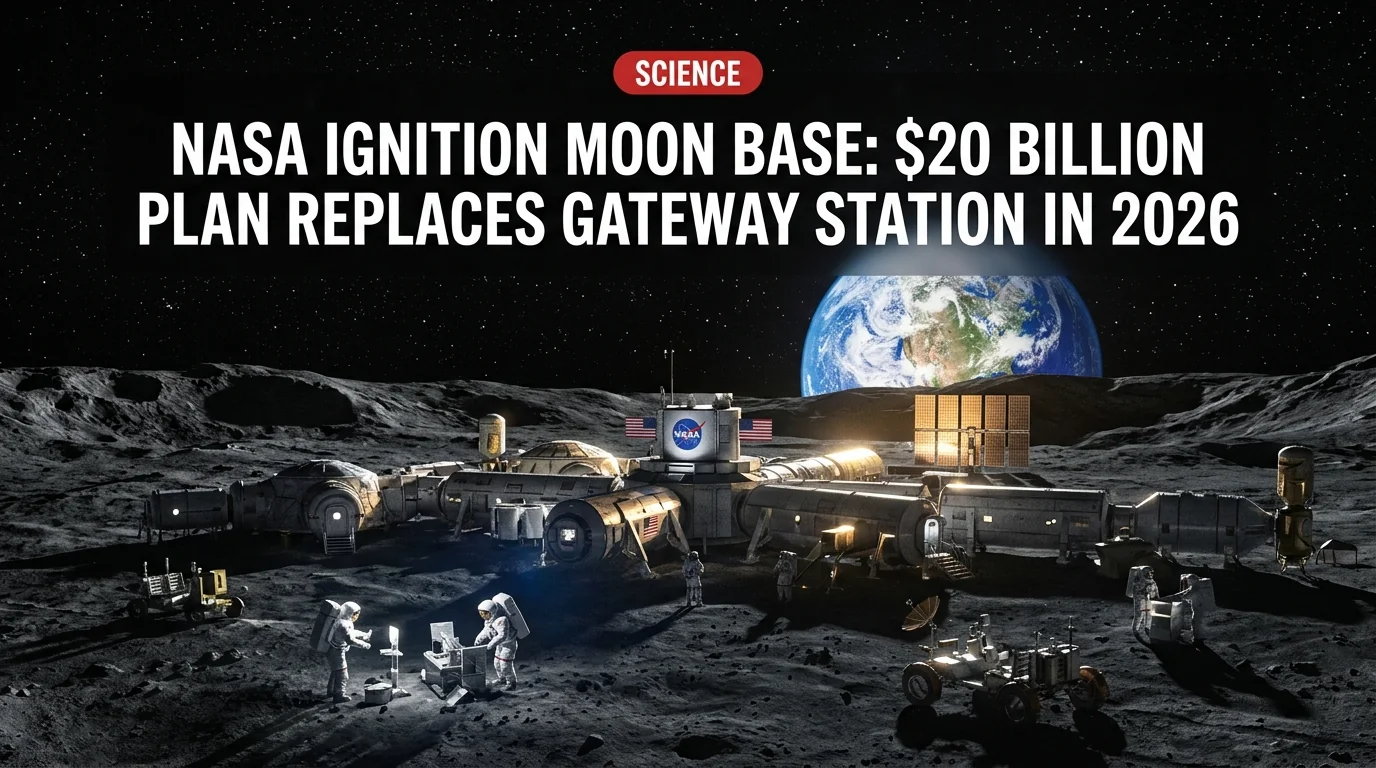
NASA has abandoned its orbiting Gateway lunar station in favor of something far more ambitious: a permanent base on the Moon's surface. The agency's new Ignition initiative, announced March 24, 2026, redirects $20 billion over seven years toward building humanity's first sustained outpost at the lunar South Pole.
The pivot marks the biggest strategic shift in NASA's Artemis program since its inception. Instead of assembling a space station in lunar orbit, the agency will land astronauts directly on the Moon beginning with Artemis IV in early 2028 and start constructing permanent infrastructure from the ground up.
Why NASA Killed the Gateway
The Gateway — a small space station planned for lunar orbit — was originally designed as a staging post for Moon landings. But under Administrator Jared Isaacman, appointed in February 2026, NASA concluded that surface-first operations deliver more science per dollar.
::keyfacts
- Old plan: Build Gateway in lunar orbit, then land from it
- New plan: Land directly, build a base on the surface
- Budget: $20 billion over 7 years for Ignition
- First landing: Artemis IV, early 2028
- Location: Lunar South Pole (one of 9 candidate regions)
- Goal: Permanent human presence, not just visits ::
"This revised, step-by-step approach is exactly how NASA achieved the near impossible in the 1960s," Isaacman said during the March 24 briefing. "Today, we are providing a demand for frequent crewed missions."
Some Gateway components will be repurposed for the surface base rather than scrapped entirely, though NASA has not specified which elements survive the transition.
The Three-Phase Ignition Roadmap
NASA's Ignition plan unfolds in three distinct phases, each building toward a self-sustaining lunar outpost.
::timeline
- Phase 1 — Learn (2028–2029): Artemis IV and V land crews for week-long stays. Focus on experiments, terrain surveys, and testing equipment in the harsh South Pole environment.
- Phase 2 — Build (2029–2031): Semi-habitable infrastructure goes up. Pressurized rovers, power systems, and resource extraction prototypes. Crewed missions every six months.
- Phase 3 — Stay (2031+): Permanent infrastructure supporting continuous human presence. Commercial resupply. In-situ resource utilization (water ice to oxygen and fuel). ::
After Artemis V, NASA plans to shift heavily toward commercially sourced and reusable hardware. The agency wants crewed landings every six months — a cadence that would have been financially impossible with the expendable SLS rocket alone.
The Artemis Shakeup: What Changed
The Ignition announcement follows a February 2026 overhaul that already reshaped the near-term Artemis timeline.
::stats
- Artemis II: Crewed lunar flyby, April 2026 (no landing)
- Artemis III: Demoted to LEO test mission, 2027 (tests docking with SpaceX/Blue Origin landers)
- Artemis IV: First crewed Moon landing, early 2028
- Artemis V: Second landing, late 2028
- Total program cost: $107 billion through 2026
- Single SLS launch cost: ~$4.1 billion ::
The original plan had Artemis III landing astronauts on the Moon in 2025, then 2026. The Aerospace Safety Advisory Panel (ASAP) issued a report in February calling those timelines "too risky" due to Orion heat shield issues and lander development delays. Isaacman's team responded by converting Artemis III into a low-Earth-orbit shakedown flight.
Why the South Pole?
All nine candidate landing regions cluster around the lunar South Pole — a location fundamentally different from the equatorial sites where Apollo astronauts walked between 1969 and 1972.
::proscons pros:
- Water ice in permanently shadowed craters can be converted to drinking water, oxygen, and rocket fuel
- Peaks of eternal light on crater rims provide near-constant solar power
- South Pole-Aitken Basin contains the Moon's oldest geological records
- 600 miles from Apollo sites means entirely new science territory cons:
- Extreme cold in shadows (as low as -230°C / -382°F)
- Rugged terrain with steep slopes and boulder fields
- Limited communication windows with Earth
- No prior human experience operating in polar lunar conditions ::
The nine candidate regions — including Haworth, Malapert Massif, Nobile Rim 1 and 2, de Gerlache Rim 2, and Slater Plain — were refined from an original 13 in October 2024 using data from the Lunar Reconnaissance Orbiter. NASA will select the final landing spot once a specific launch window is locked.
The $107 Billion Question
Artemis is already the most expensive space program in history when adjusted for inflation. Adding $20 billion for Ignition brings scrutiny, but NASA argues the surface-first approach is actually cheaper long-term than maintaining both a Gateway station and landing infrastructure.
::chart bar Artemis Cost Breakdown SLS/Orion development: 50 Starship HLS (SpaceX): 15 Blue Moon HLS (Blue Origin): 10 AxEMU spacesuits (Axiom): 5 Ignition base (new): 20 Other contractors: 7 ::
The agency lost 20% of its civil service workforce in 2025, adding pressure to simplify operations. Standardizing SLS manufacturing and leaning on commercial partners like SpaceX and Blue Origin are central to keeping costs manageable.
What Comes Next
The immediate focus is Artemis II, the crewed lunar flyby scheduled for early April 2026. Astronauts Reid Wiseman, Victor Glover, Christina Koch, and Jeremy Hansen will spend 10 days looping around the Moon — the first humans to travel beyond low Earth orbit since Apollo 17 in 1972.
::alert info Next milestone: Artemis II launch in April 2026 — the first crewed flight beyond Earth orbit in over 53 years. Success here is the critical "go/no-go" gate for everything that follows. ::
If Artemis II succeeds, NASA will proceed with the Artemis III docking test in 2027 and the historic Artemis IV landing in 2028. If it doesn't, the entire Ignition timeline could slip again.
NASA is also expanding its Commercial Lunar Payload Services (CLPS) program to deliver rovers, instruments, and technology demonstrators to the South Pole ahead of crewed missions. These robotic scouts will map terrain, test resource extraction, and identify the optimal base location within the nine candidate zones.
For the first time since the Apollo era, humans are heading back to the Moon — not to visit, but to stay. Whether the $20 billion Ignition bet pays off depends on hardware that hasn't flown yet and a timeline that has already slipped multiple times. But the ambition is unmistakable: NASA isn't planning a moonwalk. It's planning a moon town.