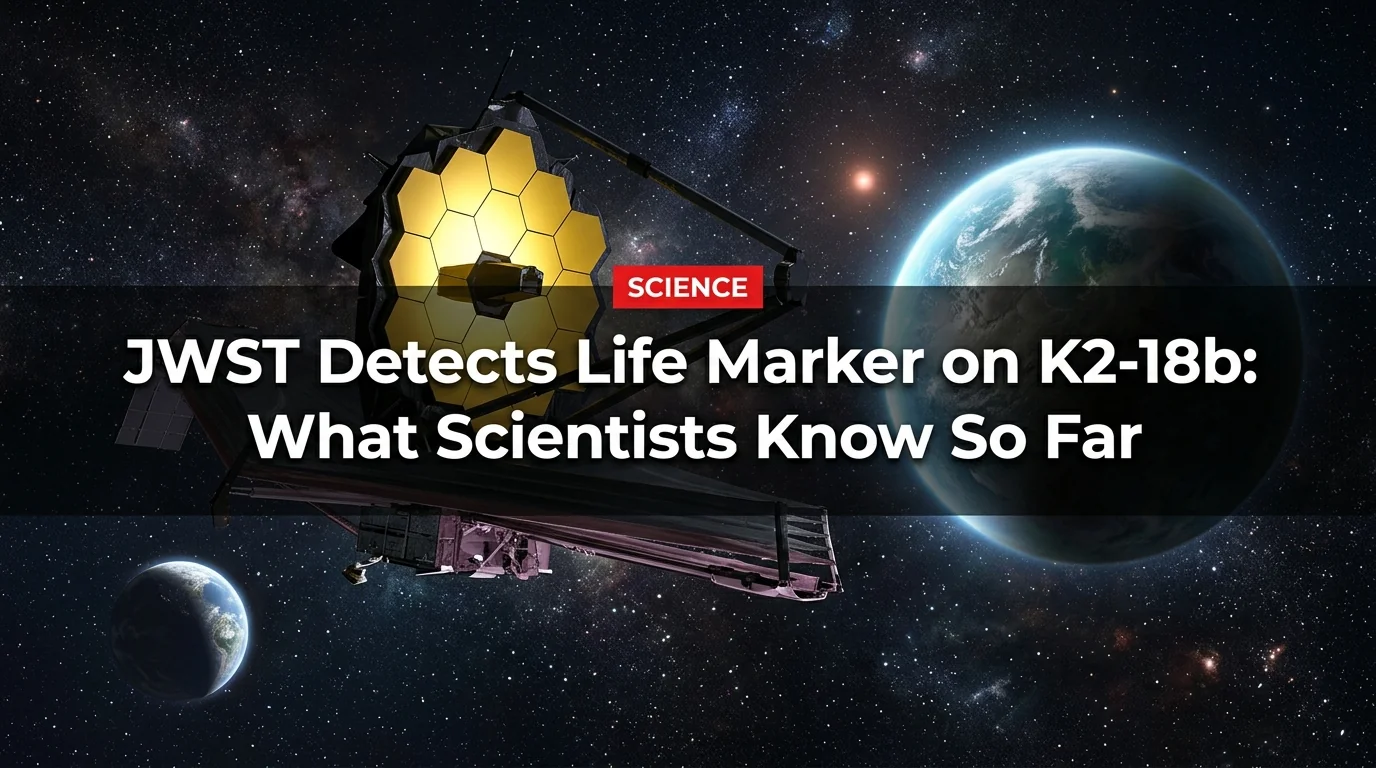
The James Webb Space Telescope has detected dimethyl sulfide (DMS) in the atmosphere of exoplanet K2-18b — a chemical that, on Earth, is produced almost exclusively by living organisms. While scientists stop short of declaring proof of alien life, the finding represents the strongest potential biosignature ever observed beyond our solar system.
The discovery has ignited a fierce debate between optimists who see biology and skeptics who urge caution. Here is everything we know.
What Was Found — and Why It Matters
Using JWST's powerful MIRI instrument, a team led by Cambridge astrophysicist Dr. Nikku Madhusudhan detected two sulfur-based molecules — dimethyl sulfide (DMS) and dimethyl disulfide (DMDS) — in K2-18b's atmosphere.
On Earth, DMS is produced almost exclusively by marine phytoplankton. You know that distinctive smell of the ocean? That is DMS. Finding it 124 light-years away, on a world orbiting in its star's habitable zone, is unprecedented.
- **First-ever** sulfur-based biosignature detected on a habitable-zone exoplanet
- DMS concentration on K2-18b exceeds **10 parts per million** — thousands of times higher than Earth's atmosphere
- The planet sits **124 light-years** away in the constellation Leo
- Statistical confidence stands at **3-sigma** (99.7%) — strong, but below the 5-sigma gold standard
Inside K2-18b: A World Unlike Any in Our Solar System
K2-18b is not Earth 2.0. It belongs to a class of planets called Hycean worlds — hydrogen-rich atmospheres sitting atop vast liquid water oceans. These planets have no analogue in our solar system, but they may be among the most common habitable environments in the galaxy.
Previous JWST observations had already confirmed water vapor, methane, and carbon dioxide in K2-18b's atmosphere — a chemical cocktail consistent with a world that could support life. The DMS detection adds the most provocative piece yet.
The Timeline: From Discovery to Debate
The Case For Life
Madhusudhan, who has led the K2-18b research for years, frames the discovery in historic terms:
His argument rests on three pillars:
- Bio-exclusivity on Earth. DMS is produced by marine microorganisms. No known geological or atmospheric process on Earth generates it in significant quantities.
- Extreme concentration. The 10+ ppm detected on K2-18b dwarfs Earth's atmospheric DMS levels (less than 1 part per billion). If abiotic chemistry produced it, entirely new reactions would need to exist.
- Habitable conditions. K2-18b sits in the habitable zone with confirmed water, methane, and CO₂ — the right environment for biology.
The Case For Caution
Not everyone is convinced. A July 2025 NASA-led study, spearheaded by JPL researcher Renyu Hu, re-examined the combined JWST data and found the statistical confidence dropped to 2.7-sigma when all observations were pooled — strong evidence, but not conclusive.
- DMS is bio-exclusive on Earth — no known geological source
- Concentration far exceeds what abiotic models predict
- Habitable-zone planet with water, methane, and CO₂ already confirmed
- 3-sigma detection from Cambridge team
- Falls below the 5-sigma gold standard for discovery
- NASA reanalysis reduced confidence to 2.7-sigma
- DMS found on Comet 67P in 2024 — possible abiotic pathway exists
- K2-18b's hydrogen-rich atmosphere has no Earth analogue for comparison
- Photochemical reactions could theoretically produce organosulfur compounds
Astrobiologist Michaela Musilova added: "All data we have been able to review related to K2-18b do not meet the 5-sigma requirements. We need to be careful about overstating what we have."
The Numbers at a Glance
| Metric | Value |
|---|---|
| Distance from Earth | 124 light-years |
| Statistical confidence (Cambridge) | 3-sigma (99.7%) |
| Statistical confidence (NASA reanalysis) | 2.7-sigma (99.3%) |
| DMS concentration | >10 ppm |
| Earth DMS concentration | <1 ppb |
| Threshold for confirmed discovery | 5-sigma (99.99994%) |
| Additional JWST time needed | 16–24 hours |
What Happens Next
The scientific community has a clear roadmap to resolve this question:
Short-term: Researchers need an additional 16 to 24 hours of dedicated JWST observation time on K2-18b to push the DMS signal past the 5-sigma threshold. Proposals for this telescope time are already under review.
Medium-term: Independent teams using alternative spectroscopic methods will attempt to confirm or refute the DMS signal. The key question: can K2-18b's hydrogen-rich atmosphere generate DMS through purely chemical processes?
Long-term: The Habitable Worlds Observatory (HWO), currently planned for the 2040s, will carry instruments specifically designed to detect biosignatures on Earth-sized planets with far greater precision than JWST can achieve.
Why This Changes Astrobiology Either Way
Regardless of whether the DMS on K2-18b turns out to be biological, this discovery has already shifted the field. For decades, the search for extraterrestrial life focused on finding "Earth twins" — rocky planets with oxygen and nitrogen atmospheres.
K2-18b proved that Hycean worlds — larger, wetter, hydrogen-wrapped — deserve equal attention. They are more abundant, easier to observe, and may host entirely different forms of life than anything we have imagined.
The answer to whether we are alone in the universe may not come from a planet that looks like ours. It may come from one that looks like K2-18b — strange, massive, and wrapped in an ocean of possibility.
The research was published in The Astrophysical Journal Letters, Volume 983. Additional analysis by NASA's Jet Propulsion Laboratory appeared in July 2025.