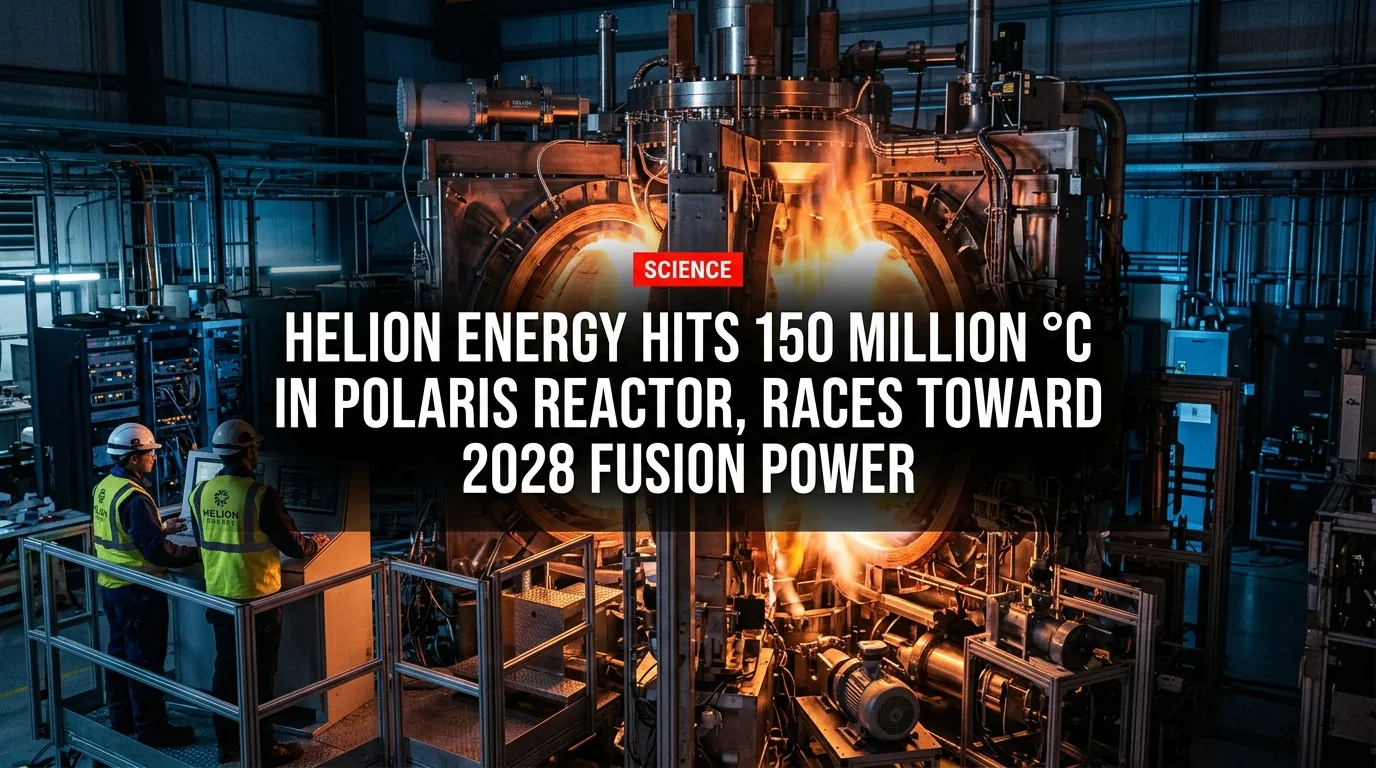
Helion Energy has crossed a threshold that the fusion industry has chased for decades. Its seventh-generation Polaris reactor reached 150 million degrees Celsius — 50% hotter than the previous private-sector record — and became the first privately built machine to achieve measurable deuterium-tritium fusion. The company is now on a direct path to delivering commercial fusion electricity to Microsoft by 2028.
The milestone, announced in February 2026 and confirmed through independent review, marks a decisive moment in the race to prove that fusion power can move from laboratory curiosity to grid-scale reality.
What Polaris Actually Did
Polaris is a 19-meter machine housed inside Helion's "Ursa" facility in Everett, Washington. It uses 2,500 capacitor banks delivering 100 GW of peak power per pulse to compress plasma at extreme temperatures. Over 3,800 diagnostic sensors monitor every pulse in real time.
::keyfacts
- Temperature: 150 million °C (13 keV) — 10x hotter than the Sun's core
- Fuel: First private machine to use deuterium-tritium (D-T) fuel
- Pulse target: 1 pulse per second (up from 1 per 10 minutes in predecessor Trenta)
- Location: Everett, Washington — the Ursa facility
- Independent review: Data verified by Dr. Ryan McBride, University of Michigan ::/keyfacts
The temperature figure matters because 100 million degrees Celsius is widely considered the floor for commercially viable fusion. Polaris blew past that mark by 50%, giving engineers significant headroom to optimize plasma confinement and energy capture.
How Helion's Approach Is Different
Most people picture fusion reactors as giant donut-shaped tokamaks — the design behind ITER, the $22 billion international project in France that has been under construction since 2010 and still hasn't produced first plasma. Helion took a radically different path.
::versus
| Feature | Helion (Polaris) | ITER (Tokamak) |
|---|---|---|
| Design | Field-Reversed Configuration (FRC) | Tokamak |
| Size | 19 meters | 73 meters tall |
| Energy capture | Direct energy recovery (like regenerative braking) | Steam turbine cycle |
| Cost to date | ~$1.1 billion raised | $22+ billion spent |
| Timeline to power | 2028 (contracted) | 2035+ (estimated) |
| Commercial model | Private, PPA-backed | Government consortium |
| ::/versus |
Helion's Field-Reversed Configuration creates a "smoke ring" of plasma that gets compressed by magnetic fields. When the plasma expands after fusion, it pushes back against those fields and generates electricity directly — no steam, no turbines, no boiling water. It is the electrical equivalent of regenerative braking in an electric vehicle.
This direct conversion approach is why Helion believes it can build reactors roughly the size of a shipping container that produce 50 megawatts — enough to power approximately 40,000 homes.
The Money and the Pressure
Helion has raised over $1.1 billion across multiple funding rounds, with its January 2025 Series F of $425 million valuing the company at $5.4 billion. The investor list reads like a who's who of tech capital.
::stats
- $1.1B+ Total funding raised
- $5.4B Company valuation (Jan 2025)
- $1.7B Additional milestone-based funding available
- 50 MW Target output per commercial unit
- 40,000 Homes powered per unit ::/stats
Key backers include Sam Altman (OpenAI CEO and Helion board chairman), Lightspeed Venture Partners, SoftBank Vision Fund 2, Peter Thiel's Mithril Capital, and Dustin Moskovitz's Good Ventures. Altman has called fusion energy "the most important technology humanity could develop."
But funding comes with expectations. Microsoft signed the world's first fusion power purchase agreement in May 2023, contracting to receive 50 megawatts of fusion-generated electricity starting in 2028. Steel giant Nucor has a deal for a 500 MW plant by 2030. These are not vague memoranda of understanding — they are commercial contracts with financial penalties.
The Skeptics Have a Point
Fusion has broken more promises than any other energy technology. The joke — "fusion is always 30 years away" — exists because it has been true for 70 years.
::timeline
- 2013 — Helion founded by Kirtley, Pihl, Slough, and Votroubek
- 2020-2022 — Trenta prototype achieves 100M°C and 10,000+ pulses
- Nov 2021 — $500M Series E raised to build Polaris
- May 2023 — Microsoft signs first-ever fusion PPA (50 MW by 2028)
- July 2024 — Tritium handling license granted by Washington State
- Late 2024 — Polaris construction completed, initial operations begin
- Jan 2025 — $425M Series F at $5.4B valuation
- Feb 2026 — 150M°C milestone and D-T fusion announced
- 2026-2027 — Net electricity demonstration expected
- 2028 — Microsoft PPA delivery deadline ::/timeline
Critics on forums like Hacker News and Reddit's r/fusion point to Helion's history of missed deadlines — the company previously targeted net energy demonstrations in 2017, 2019, and 2024. Academic skeptics question whether direct energy recovery can achieve the efficiency Helion claims, and whether the eventual transition to deuterium-helium-3 fuel (which produces fewer neutrons but requires far higher temperatures) is realistic.
Dr. Ryan McBride, the University of Michigan professor who independently reviewed Polaris data, offered cautious optimism: "It is exciting to see evidence of D-T fusion and temperatures exceeding 13 keV. I look forward to seeing more progress."
What Comes Next
Helion's immediate roadmap has three critical milestones:
::proscons
Remaining challenges
- Demonstrate net electricity from Polaris (more energy out than in) — expected 2026-2027
- Transition from D-T fuel to deuterium-helium-3, which is cleaner but harder
- Complete construction of Orion, the first commercial-scale generator in Malaga, WA
- Meet the 2028 Microsoft deadline — the credibility test for the entire company
What's working
- 150M°C achieved — well above the 100M°C commercial threshold
- D-T fusion demonstrated in a private machine for the first time
- Independent data verification builds scientific credibility
- Commercial contracts (Microsoft, Nucor) create accountability
- Over $1.1B in funding with $1.7B in milestone bonuses available ::/proscons
The Department of Energy is watching closely. Jean Paul Allain, Associate Director for Fusion Energy at the DOE, said private-sector milestones like Polaris are "de-risking" the path to commercial fusion — language that suggests government support could follow if Helion continues delivering.
Why This Time Might Be Different
The fusion industry has cried wolf before. But several things distinguish this moment from previous false dawns.
First, there is commercial accountability. Microsoft's PPA means Helion faces real financial consequences if it fails to deliver — not just reputational damage, but contractual liability. Second, the speed of iteration is unprecedented. Helion has built seven prototypes in 13 years, each dramatically more capable than the last. Third, the capital is private. Unlike government megaprojects that can absorb decade-long delays without consequence, Helion's investors expect returns.
::alert info Helion's Polaris is not claiming ignition or breakeven. The 150M°C milestone and D-T fusion demonstration are necessary steps toward net electricity, which Helion expects to prove within the next 12-18 months. ::/alert
None of this guarantees success. The gap between "record plasma temperature" and "electricity flowing to Microsoft's data centers" remains enormous. But for the first time, a private company has the hardware, the fuel, the contracts, and the capital to attempt the crossing.
The 30-year joke may finally have an expiration date.