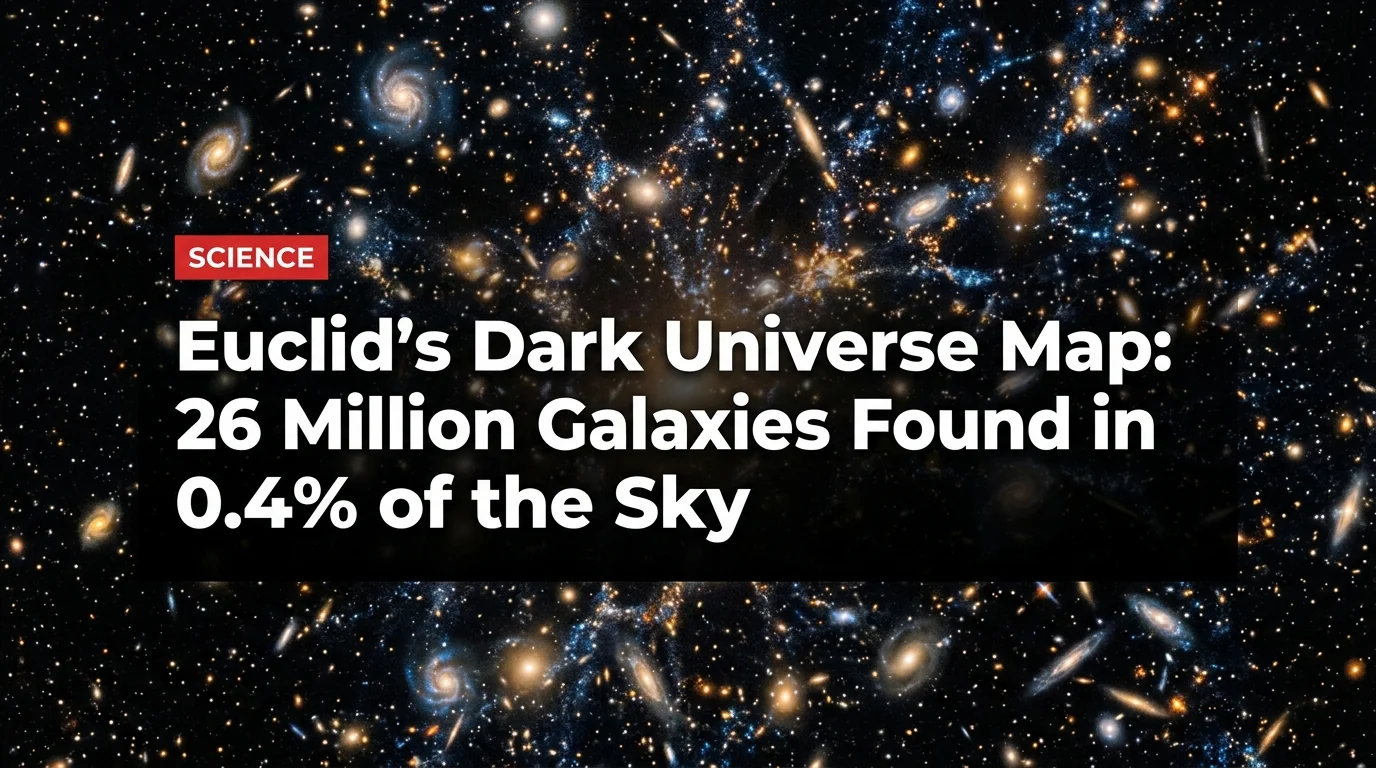
The European Space Agency's Euclid telescope has delivered its most ambitious dataset yet — 35 terabytes of observations covering just 0.4% of the planned survey area, but already revealing 26 million galaxies and rewriting what scientists thought they knew about the invisible forces shaping our universe.
Stationed 1.5 million kilometers from Earth at Lagrange Point 2, Euclid is the first space mission dedicated entirely to mapping dark energy and dark matter — the two mysterious components that make up 95% of the universe but remain completely invisible to conventional telescopes.
What Euclid Found — and Why It Matters
The March 2025 Quick Data Release sent shockwaves through the astrophysics community. In a single week of deep-field observations, Euclid catalogued more galaxies than ground-based surveys found in decades.
Dr. James Nightingale of Newcastle University called the influx of gravitational lens data a "seismic shift" for the field. Gravitational lensing — where massive foreground objects bend light from distant galaxies — is Euclid's primary tool for revealing where dark matter hides.
KEY STAT: Euclid found 500 gravitational lenses in one week. The entire field of astronomy had found roughly 1,000 in the previous four decades.
How Euclid Maps the Invisible
Dark matter doesn't emit, absorb, or reflect light. It's detectable only through its gravitational influence on visible matter. Euclid exploits this by measuring the precise shapes of billions of galaxies — when those shapes appear subtly distorted, dark matter is bending the light path between the galaxy and the telescope.
This technique, called weak gravitational lensing, allows Euclid to construct a 3D map showing how dark matter is distributed across 10 billion years of cosmic history. Combined with measurements of how galaxies cluster together, this reveals how dark energy has accelerated the universe's expansion over time.
- Euclid orbits at Lagrange Point 2, 1.5 million km from Earth
- Its VIS camera captures images at 0.1 arcsecond resolution — 4× sharper than ground telescopes
- The telescope sends ~100 GB of compressed data to Earth daily
- Over 2,000 scientists from 300+ institutes across 17 countries analyze the data
- By mission's end in 2030, Euclid will have catalogued 1.5 billion galaxies
The Dark Galaxy That Shouldn't Exist
In February 2026, a collaboration between Euclid, the Hubble Space Telescope, and Japan's Subaru telescope uncovered something extraordinary: Candidate Dark Galaxy-2 (CDG-2), a galaxy that appears to be almost entirely dominated by dark matter with barely any visible stars.
Dark galaxies have been theorized for decades but rarely observed. CDG-2 suggests they may be far more common than current models predict, potentially reshaping our understanding of galaxy formation.
Euclid vs. Previous Sky Surveys
To appreciate Euclid's leap forward, compare it to the surveys that came before.
| Survey | Type | Galaxies Catalogued | Time Period | Coverage |
|---|---|---|---|---|
| Sloan Digital Sky Survey | Ground-based | 15 million | 2000–2020 | 35% of sky |
| Gaia | Space (Milky Way) | 1.8 billion stars | 2013–present | Full sky |
| Euclid (Week 1) | Space (deep) | 26 million | 1 week | 0.4% of sky |
| Euclid (projected) | Space (deep) | 1.5 billion | 2024–2030 | 33% of sky |
The Sloan survey took two decades to catalogue 15 million galaxies from the ground. Euclid surpassed that count in seven days from space — and it has only scanned a sliver of its target area.
The €1.4 Billion Mission Timeline
Euclid's journey from concept to cosmic cartographer spans over a decade of engineering and science.
What October 2026 Will Reveal
The real prize arrives with Data Release 1 (DR1) in October 2026. This will be the first dataset large enough for meaningful cosmological conclusions — answering questions that have haunted physicists for decades:
- First direct 3D measurement of dark matter evolution across cosmic time
- Enough data to test whether dark energy is truly constant or changing
- Expected 10,000+ gravitational lens discoveries in this release alone
- Cross-validation with ground-based surveys for unprecedented accuracy
- Still represents only ~15% of the total planned survey
- Systematic uncertainties from stray light issues may limit some measurements
- Full cosmological constraints require combining with DR2 (expected 2028)
- Some galaxy redshift measurements need spectroscopic follow-up from ground telescopes
The Bigger Picture: Why 95% of the Universe Is Missing
Everything humans have ever seen — every star, planet, nebula, and galaxy — accounts for just 5% of the universe's total mass-energy content. The rest breaks down like this:
Dark energy drives the universe's accelerating expansion. Dark matter provides the gravitational scaffolding that holds galaxies together. Without them, the cosmos as we observe it simply couldn't exist — yet we have no idea what either one actually is.
Euclid won't tell us what dark matter and dark energy are made of. But by mapping their distribution and behavior across 10 billion years, it will narrow the field of theoretical explanations from dozens to a handful — or, if scientists are lucky, reveal something entirely unexpected.
The Team Behind the Map
Euclid is a collaboration on a scale matching its ambitions. ESA leads the mission, with NASA contributing critical near-infrared detectors. The Euclid Consortium — over 2,000 scientists from 300+ institutes — handles instrument development and data analysis. Thales Alenia Space built the spacecraft; Airbus Defence and Space developed the payload module.
ESA Director of Science Prof. Carole Mundell called Euclid the "ultimate discovery machine," enabling humanity to explore "the invisible forces shaping our universe."
With 99.6% of the survey still ahead, the most transformative discoveries are yet to come.