
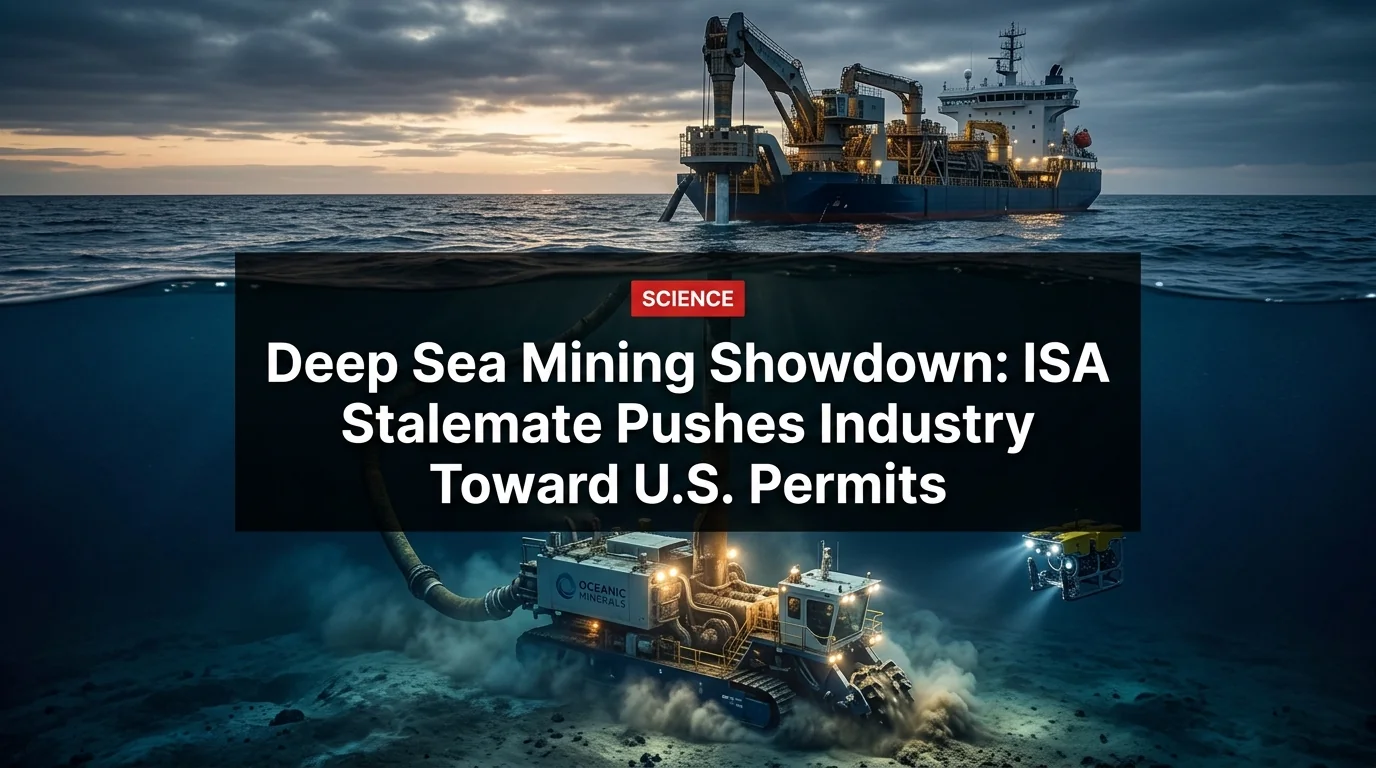
The international framework governing deep-sea mining is fracturing. After the International Seabed Authority failed — for the third time — to finalize regulations at its 31st session in Kingston, Jamaica on March 20, 2026, the industry's most aggressive player has stopped waiting.
The Metals Company, a Canadian mining firm traded on Nasdaq, is now pursuing permits directly through the U.S. government. On March 9, NOAA determined that TMC's application to mine 65,000 square kilometers of the Pacific seafloor is in "substantial compliance" with American law. The move has been called everything from a strategic masterstroke to environmental piracy.
The Regulatory Collapse
The story begins in 2021, when the tiny Pacific island nation of Nauru triggered a legal mechanism known as the "two-year rule" — Section 1, Paragraph 15 of the 1994 UNCLOS Implementing Agreement. It required the ISA to finalize mining regulations by July 9, 2023.
That deadline passed. An informal 2025 target passed. Now 2026's first session has ended without a Mining Code. The ISA sits in what legal scholars call a "regulatory grey zone" — technically obligated to consider mining applications, but lacking the rules to evaluate them.
What's at Stake: The Clarion-Clipperton Zone
The prize is a 4.5-million-square-kilometer abyssal plain between Hawaii and Mexico called the Clarion-Clipperton Zone. Scattered across its floor are trillions of polymetallic nodules — potato-sized rocks containing manganese, nickel, copper, and cobalt. These are the raw materials powering the energy transition: EV batteries, wind turbines, grid storage.
The ISA has already granted 31 exploration contracts covering more than 1.5 million square kilometers of seafloor. TMC holds three of the most advanced.
- The Clarion-Clipperton Zone spans 4.5 million km² of Pacific seafloor
- TMC's application covers 65,000 km² with an estimated 619 million tonnes of wet nodules
- The ISA has granted 31 exploration contracts across 1.5 million km² of ocean floor
- 40 countries now support a moratorium or precautionary pause on deep-sea mining
The U.S. Gambit
President Trump's April 2025 executive order, titled "Unleashing America's Offshore Critical Minerals," reframed deep-sea mining as a national security imperative. The argument: the U.S. cannot depend on China for the critical minerals needed for defense systems, AI infrastructure, and clean energy.
NOAA moved quickly. New regulations finalized in January 2026 allow companies to file consolidated applications for both exploration and commercial recovery permits simultaneously — cutting what was previously a multi-year, multi-step process.
TMC wasted no time. Its U.S. subsidiary filed for a 65,000-square-kilometer mining zone in the CCZ, and NOAA confirmed the application's compliance within weeks.
- 168 member states plus EU
- Mining Code still unfinished after 5+ years
- Requires environmental impact assessments, benefit-sharing with developing nations
- Resources treated as "Common Heritage of Humankind" under UNCLOS
- Governed by 1980 Deep Seabed Hard Mineral Resources Act
- NOAA streamlined permitting in January 2026
- No benefit-sharing obligations to other nations
- Framed as national security necessity
The Battle Lines
The deep-sea mining debate has crystallized into three camps, each speaking past the other.
Gerard Barron, TMC's CEO, frames the choice as inevitable: "It is now a question of when — rather than if — commercial-scale nodule collection will begin. Polymetallic nodules can provide a new and lower-impact source of critical metals for the U.S."
ISA Secretary-General Leticia Reis de Carvalho, who defeated the industry-aligned Michael Lodge in a 79–34 vote in 2024, has pushed back sharply: "Any unilateral action would constitute a violation of international law and fundamentally violate the principles of multilateralism."
Environmental groups are the most alarmed. Sofia Tsenikli of the Deep Sea Conservation Coalition calls the U.S. pivot "reckless," warning it "risks sacrificing the ocean for short-term commercial interests."
The Environmental Unknown
Scientists remain deeply uncertain about the ecological consequences. The CCZ's abyssal plain hosts species found nowhere else on Earth — many not yet cataloged. Nodule harvesting would involve dragging collector vehicles across the seafloor, creating sediment plumes that could smother filter-feeding organisms across vast areas.
Planet Tracker, a financial think tank, estimates deep-sea mining could cause $500 billion in natural capital destruction. Industry proponents counter that mining the seafloor is less destructive than terrestrial mining and could boost U.S. GDP by $300 billion over a decade.
*Values in billions USD. ISA royalties shown at high-end estimate ($321M/year).*What Comes Next
The ISA Council reconvenes in July 2026 for Part 2 of its 31st session. Its Legal and Technical Commission will rule on whether TMC's pivot to U.S. law constitutes a breach of its existing exploration contracts — a finding that could lead to contract termination.
Meanwhile, NOAA continues reviewing TMC's application. A final decision on an exploration license and commercial recovery permit is expected later this year.
The deeper question is whether the international order governing the ocean floor — painstakingly built over four decades — can survive a major power deciding to go it alone. Forty nations say the answer should be a moratorium. One nation, backed by the world's most aggressive mining company, is betting the answer doesn't matter.
The seabed was designated the "Common Heritage of Humankind" under international law — a principle asserting that its resources belong to everyone, especially developing nations. Whether that principle survives 2026 may depend on what happens in a conference room in Kingston and a regulatory office in Washington.